
Home Blog Page 5198

LivePerson Debuts Enhanced Maven AI Capabilities to Help Brands Deliver Personalized, High-Impact Conversational Experiences

Upgraded Conversational AI Features Increase Agent Efficiency and Solve Routing Problems to Make It Easy for Brands to Orchestrate Customer Journeys at Scale

LivePerson, Inc., a global leader in conversational commerce, announced new Maven artificial intelligence capabilities that increase Maven’s power to help brands drive efficiencies and improve customer experiences in messaging channels.
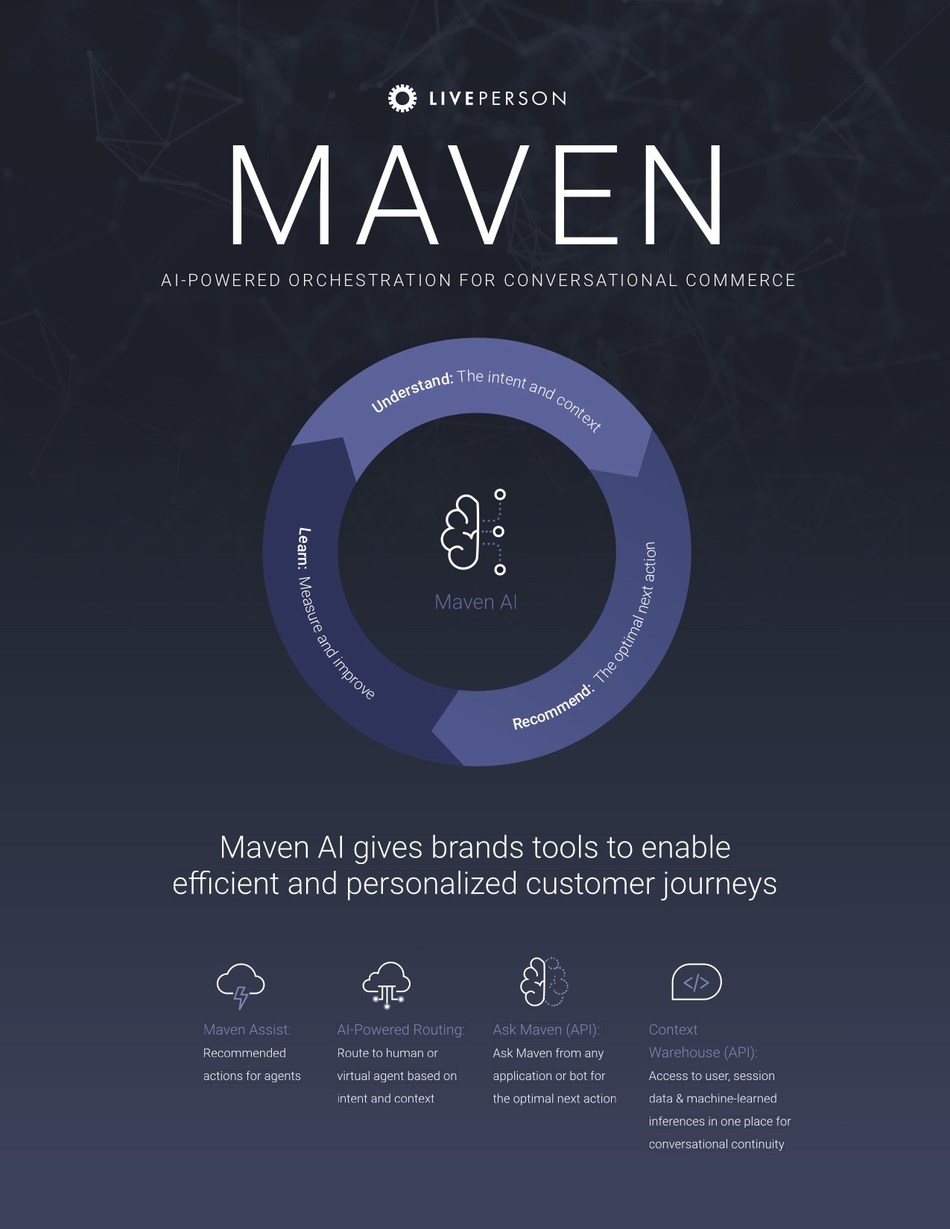


Powered by LivePerson’s proprietary machine learning technology, Maven AI orchestrates conversations between brands and customers over SMS, Facebook Messenger, WhatsApp, RCS, Apple Business Chat, Amazon Alexa, and other popular messaging platforms and voice assistants. Maven’s decision-making leads the “tango” of human agents and automated bots that makes it possible for brands to have personalized conversations with their customers on a massive scale while outperforming traditional websites and 800-numbers.

Read More: Parks Associates: Free Trials Influence Over Half of OTT Video Service Subscriptions

Maven’s new capabilities represent the latest evolution of LivePerson’s suite of conversational AI services for brands. As part of this integrated set of solutions, the debut of Maven’s enhancements means brands can use AI to deliver highly-personalized conversational experiences without needing to design, maintain, and scale a conversational AI infrastructure on their own:

Maven Assist: recommends the optimal next actions for human agents to take — surfacing content or suggesting bots capable of responding to the customer’s intent.

Maven AI-Powered Routing: dynamically routes conversations to the right agents, bots, or content to solve customer requests quickly based on the AI’s understanding of “contextual information,” including the customer’s profile information, interaction history, and contact center operations.

Maven Developer APIs: a set of developer tools (Ask Maven and Context Warehouse) to make existing bots or other systems smarter by consulting Maven on optimal next actions, plus the ability to integrate multiple sources of data (for example, CRM or conversation history) into Maven’s decision-making.

“What brands looking to leverage AI to power conversational commerce should know is that they don’t need to build in-house expertise in machine learning, routing, and other complicated systems behind conversational AI,” said Alex Spinelli, chief technology officer at LivePerson. “Maven solves these orchestration challenges so brands can focus on the core competitive advantages that make them the best at getting their customers what they want.”

Maven Assist increases agent efficiency and customer satisfaction with its real-time recommended actions. Agents, who with Maven can quickly share personalized content with customers instead of searching through their email or sticky notes for information, can also vote on Maven recommendations to improve them over time.

Read More: Ceros and Getty Images Announce Expanded Integration To Deliver Stunning Video Content

Maven AI-Powered Routing gives brands a way to build and manage AI policies without the expensive, complex process of developing in-house routing capabilities. In addition, existing bots can be integrated into Maven AI-Powered Routing through the Ask Maven and Context Warehouse APIs. These advanced routing capabilities unlock new conversational commerce use cases for companies of all kinds, including:

  • Airlines can route a customer back to the same agent they messaged with previously to follow up on a lost baggage claim.
  • Banks can quickly identify VIP customers and route them to dedicated advisors for high-touch, personalized experiences.
  • Telco companies can route inquiries about a service outage to a bot to provide status updates until the issue is resolved, freeing up agents for other urgent tasks.
  • Cable providers can route pay-per-view customers to specific bots and agents to handle high-volume inquiries before “the big game” or other high-profile events begin.

LivePerson developed Maven based on its experience orchestrating billions of brand-to-consumer interactions, and the AI continues to improve with every conversation, strengthening its ability to help businesses with customer care, marketing, sales, and brick-and-mortar experience use cases. Maven was recently selected as the winner of the “Best AI-Based Solution for Customer Service” from AI Breakthrough, a leading market intelligence organization that recognizes top technologies in the global artificial intelligence market.

LivePerson offers a complete suite of conversational commerce services for enterprises, deployed at some of the world’s largest brands. Compared with traditional phone calls, messaging conversations increase customer satisfaction by 20%, double agent efficiency, and cut labor cost per interaction in half.

Read More: Acoustic Expands Leadership Team Following Brand Launch as Largest Independent Marketing Cloud


For Loyal Customers, Relevance Tops Incentives

0

Loyalty isn’t dead — but traditional loyalty programs are dying. And businesses are earning loyalty through relevance.

Sinch Engage logoFor retail marketers, the loyalty program is a straightforward exchange: for some sort of perk from the retailer (discounts, points toward a purchase, etc.), the customer will offer up access to personal data valuable to marketers. It’s a tactic that has been a reliable element of the marketer’s playbook — and one that has largely evolved to embrace digital and mobile engagements. And the longstanding belief has been that customers will keep buying the same things from their favorite retailers as long as they receive the right perks.


But these beliefs are being challenged because consumers just aren’t that interested in loyalty programs — certainly not as interested as marketers think they are. A 2018 survey from Oracle found that while 58 percent of retailers believe that consumers are eager to sign up to every loyalty program, only half are even signing up for select, highly-relevant programs — and nearly 20 percent rarely join any. And for those who are engaging in these programs, loyalty is no longer a given — recent research shows that anywhere from 59 to 71 percent of consumers aren’t made more loyal by loyalty programs.

The problem? Loyalty programs are designed to drive transactions, but consumers aren’t primarily driven by discounts. Instead, they are looking for relevance, to engage with brands that truly “get” them. Loyalty programs don’t deliver relevance — while 58 percent of retailers believe their offers are mostly relevant compared to 32 percent of consumers believing those brand offers are relevant.

Consumers want highly-personalized communications and timely notifications — particularly on their mobile devices, and increasingly, in video, rather than text. And they’re willing to make some concessions to make it happen: nearly 90 percent of shoppers from a recent survey stated they’d be alright with being tracked or watched if it means a more personal loyalty experience.

Loyalty, Meet Relevance – with Personalized Video

Marketers can’t buy customer loyalty any longer. They have to earn it with excellent customer experiences built on relevance. Loyalty, as we have thought about it, is dead. Today, true loyalty is driven by the overall customer experience, strengthened through relevance.

In the Digital Marketing era, relevance has been driven by Personalization — the ability to merge data and creative to reach each customer as if they were your only one. And customers are demanding this: 61 percent will switch companies that no longer meet their needs, and 44 percent get frustrated when companies fail to use their personal information to make interactions and offers more relevant. The cost of irrelevance? More than $1 Trillion to U.S. companies, according to Accenture.

Evolving from direct mail to Email Marketing, Social Media, Content Marketing and Web Content, Personalization is today driving the next channel for marketers: highly-relevant personalized video delivered to customers on their mobile devices.

And customers love it — we’ve regularly seen clients reduce their customer churn by upwards of 20 percent while doubling their Sales over control.

Today, by coupling explicit customer data with implicit analysis, retailers can present personalized video offers to customers who have opted-in at the exact right time. Triggered by location data and previous purchase history, a customer receives a personalized video suggesting they visit the store right down the street for a special offer that expires in an hour.

Driven by churn analysis indicating exhibiting signals that they might shop elsewhere, a retailer sends a personalized video with highly-compelling offers to come back and buy again. Shopping-cart abandonment can produce a custom video showing the clothes a customer could reconsider buying.

While loyalty programs are dying, loyalty is very much alive — through brand relevance driven by highly-personalized video.

Read more: What’s Happening to Brand Loyalty?

New WBR Insights Report Finds Retailers Not Ready for Advanced Mobile Experiences

Retailers are not prepared to support the next wave of technologies like AI, Chatbots and AR as part of their mobile engagement strategy according to the latest report from WBR Insights (the custom research division of Worldwide Business Research). In a survey of 100 senior retail executives, only 9% said they were able to support these features, while more than half (52%) are not. The greatest barriers to their implementation: budget (64%), the lack of internal resources (55%) and the lack of executive buy-in (42%).

Created in cooperation with retail-solution providers Arm Treasure Data and mobile marketing platform Vibes, “How New Tech is Creating Seamless Mobile Shopping Experiences” seeks to understand the issues and opportunities that are top of mind for retailers in regards to their overall mobile customer retention and engagement strategies.

Read More: RevJet Announces Updated Ad Creative Builder for Social and Native Advertising Platforms

Additional key findings include:

  • The retailers surveyed felt that mobile payments (60%), artificial intelligence (AI) and chatbots (48%) and on-demand same day services (47%) have the most potential for improving the mobile e-commerce experience for consumers.
  • Augmented reality (27%). voice recognition technology (25%), and progressive web apps (PWA; 22%) are the technologies that most retailers are actively evaluating for implementation in the next 12-24 months.

Read More: XcooBee’s Email Guard Protects Your Personal Email Address

“Consumers want the ability to seamlessly browse for and buy products at their convenience, so it’s no surprise that mobile payments and on-demand services are at the top of retailers’ technology wish list,“ said Andrew Greissman, Research Director for WBR Insights. “As consumers continue to demand more information and flexibility from their mobile shopping experience, technologies like voice recognition and augmented reality will become must-haves for engagement.”

Read More: Bango Adds Spotify as Business Partner to Delight Millions of New Customers

Dovetale Launches New Influencer Relationship Management Platform and Crosses 650 Customers Worldwide

Dovetale is Transforming How Marketing Teams Manage Their Influencer Programs

Dovetale, a web-based influencer CRM, launches a first-of-its-kind custom database management platform for marketing teams with influencer/creative programs.

Since Dovetale launched two years ago, it has become the best search engine in the world for finding influencers and content creators. Today, over 650 marketing teams use the platform, including some of the world’s biggest brands and agencies.

“The starting point for every influencer program is search. Search engines like Google don’t optimize for pages on social media and platforms like Instagram don’t provide search experiences optimized for finding influencers,” said Mike Schmidt, Founder of Dovetale. “What naturally comes after this however is being able to reach out, manage and build workflows with potential influencer partners – the new Dovetale CRM capability solves this.”

Read More: TMC Names Pareteum a 2019 Communications Solutions Products of the Year Award Winner

Dovetale is challenging traditional influencer marketing and helping marketing teams move past transactional marketing. While there are other influencer CRMs available in the market, none of them are affordable and customizable the way Dovetale is. Marketing teams can customize their influencer outreach, process and manage their workflow from multiple sources like Shopify, FedEx, PayPal and more.

Read More: The Globe and Mail Selects AWS as Its Preferred Cloud Provider

Influencer marketing platforms have never been more important due to rising customer acquisition costs on social networks. The Dovetale platform is the most customizable and economical solution for marketing teams of any size. The key advantage of Dovetale when marketing teams are switching or evaluating using a platform is in the pricing economics. Dovetale is by far the most affordable and powerful toolset on the market today.

“When we were thinking about our pricing strategy, we want to let any company try influencer marketing without spending their entire budget on a platform and not being tied to a year-long contract like our competitors,” said Schmidt.

Read More: SugarCRM Hires Veteran Software Executive John Donaldson as Chief Financial Officer

Microland Names Ashish Mahadwar as President for Global Sales & Marketing

Microland, India’s leading digital IT transformation company announced that Ashish Mahadwar will be joining the Bangalore-headquartered company as President, Global Sales and Marketing based out Microland’s San Jose office in the US. Mahadwar brings to the position the ability to accelerate innovation and global scale, in honor of evolving client needs.

A diversified global career of over 30 years has prepared Mahadwar to scale application, infrastructure and consulting capabilities globally. He was most recently Chief Operating & Revenue Officer at a leading IT services company in the San Francisco Bay Area and before that he was a Senior Advisor at Bain Capital. Prior, he was a member of the Executive Committee and EVP/General Manager of the Emerging Business Group at CSC reporting to the CEO, where he was responsible for all next-Gen businesses. From 2003 – 2014, Mahadwar served Cognizant Technology Solutions in a variety of roles. The last position he held there was SVP/General Manager, Enterprise Application Services.

Read More: Richardson Launches Enhanced Service Through Consultative Sales Training Program to Equip Service Professionals with Skills

Mahadwar sees Microland as uniquely positioned in the IT services market. Mahadwar observed, “With thirty years of focus on infrastructure management, Microland can support enterprises in their digital journey in a truly meaningful way. Today, as infrastructure blends with automation and IIoT, this deep specialization means Microland has the agility and innovation chops to create strong competitive advantage for our clients. I’m so excited by this opportunity.”

A proud member of Microland’s large club of employees who have left and then returned, Mahadwar spent nine years in significant roles with Microland early in his career, including launching India’s first Internet Professional Services Company, as VP of planetasia.com. Upon his return he will lead new customer acquisitions, strengthen relationships with existing clients, forge technology partnerships, and enable Microland’s strategic transformation as a partner helping enterprises move to a digital world.

Read More: AODocs Recognized as a Strong Performer in Cloud Content Platforms by Independent Research Firm

“Ultimately, Ashish’s charter will be to build on our progress around the world ensuring our clients’ embrace of AI, automation and IIoT is predictable, reliable, stable and industry-leading.” Kar noted. “Microland will look to Ashish to contribute mightily to Microland’s thought leadership reimagining how innovative application of next-gen infrastructure will turbocharge nearly every aspect of an enterprise.”

Read More: Zee Jay Digital and Allocadia Form Strategic Partnership

Amplitude Launches Engage, a Behavioral Targeting Solution for Automated Campaign Personalization

Amplitude, the product intelligence platform, launches Amplitude Engage to help teams power targeted campaigns with the insights and segments they derive from first-party behavioral data. Amplitude Engage dynamically syncs custom segments in Amplitude to in-app messaging and marketing platforms like Airship, Braze, Intercom, Marketo, and Facebook.

To break through in today’s noisy channels, companies need to deliver the right message to the right person at the right time. Investments in marketing platforms automate orchestration and delivery, but most campaigns still lack the context of users’ behavior. Companies are forced to make broad assumptions from demographic profiles because they cannot operationalize all the behaviors they want to — especially those that occur on owned platforms (websites, apps, help centers, and more).

With Amplitude Engage, companies can act on their first-party behavioral data by leveraging the power of Amplitude’s advanced analytics and segmentation tools to drive targeted campaigns in their marketing platforms.

“We have already seen Amplitude Engage revolutionize the way marketing and growth teams target campaigns across engagement channels,” said Spenser Skates, Co-founder and CEO of Amplitude. “Amplitude is excited to continue to develop the world’s leading product intelligence platform to help teams take intelligent actions using their data.”

Read More: Infor Continues to Enrich Customer Experience with Infor Concierge Portal

Instead of big email blasts or catch-all push campaigns, companies use the context of users’ behavior to create timely, personalized communications to specific user segments. That means less spam for consumers and more efficient programs for marketers.

Amplitude with Amplitude Engage includes:

  • Behavioral segmentation for self-service access to the complete user journey to segment and validate audiences based on lifecycle, content preferences, usage or purchase history, and intent.
  • Dynamic targeting to instantly push audiences to in-app messaging and marketing platforms and/or set up scheduled syncs that automatically update to support programmatic campaigns.
  • Impact measurement to optimize for recurring business value by easily seeing campaign impact on usage frequency, repeat purchases, retention, and in-product conversion.

Amplitude Engage has built-in connectors to Airship, Braze, Facebook, Intercom, Iterable, Leanplum, Marketo, and Segment, with more on the way.

“The combination of Braze’s leading messaging experiences and Amplitude’s advanced behavioral segmentation will help companies drive better engagement and ROI,” said Braze President and CCO Myles Kleeger. “Amplitude Engage will provide our customers with meaningful and actionable insights inside of the Braze platform. The campaign interaction data will then flow back into Amplitude, informing future insights, and demonstrating the power of the Braze Alloy ecosystem.”

Already over 100 companies are powering targeted campaigns by leveraging the advanced segments they create in Amplitude.

Read More: maihiro products GmbH Founded by Spin-off

“Better segmentation leads to better engagement,” said Emmanuel Frenehard, CTO at iflix. “With Amplitude Engage, iflix has improved campaign conversion-to-view rates and increased ad revenue four-fold by leveraging behavioural segmentation to target users. Engage has empowered us to execute highly targeted experiences and tune campaigns to drive impact.”

With Amplitude Engage companies are able to:

Programmatically target hundreds of customer segments – Canada’s leading online coupon platform, Flipp, now seamlessly automates hundreds of personalized campaigns which has helped increase click-thru-rates by over 20%.

Reduce acquisition costs with tailored experiences – Rappi, South America’s largest on-demand delivery platform, has reduced acquisition costs 30% by tailoring push campaigns in Braze to customers in-product behavior.

Rapidly test new segments – Dave, a financial management platform, drove over 500,000 conversions to a new product by easily testing variations of customer segments — a process that now takes 5 seconds, instead of 5 days.

Measure campaign impact on revenue-producing outcomes – Rappi saw a 10% increase in orders from new users by optimizing campaign timing and messaging for first-time purchases.

Since the beginning of 2019, companies have already used Amplitude Engage to sync segments more than 550,000 times to their in-app messaging and marketing tools.

Read More: Bigtincan Recognized by Key Industry Organizations as Leader in Sales Enablement

Brands Experiencing Unintended Consequences of GDPR, According to New MarkMonitor Research

Domain strategy and brand protection affected by political and regulatory issues

Almost six in 10 (58%) marketers say GDPR has impacted the way they approach domain management and security, with almost one-third (31%) saying the same about Brexit. This is according to the latest global research report released by MarkMonitor, a Clarivate Analytics company and world leader in enterprise brand protection.

In addition, 38% say the increased cyber threat has changed or is changing their domain strategy. This figure highlights the growing importance of security, as 18% of marketers say their domains have been targeted by a cyber attack. Yet, despite this, maximising web traffic was identified as the most important aspect of domain management, with security falling behind in second place.

In the same vein, 62% of marketers say their main motivation of a domain registration strategy is to launch new products and services, but only 23% say it’s the mitigation of brand abuse.

Read More: New Tiled Plugin for Adobe XD Turns Designs into Interactive Experiences Without Coding; Adobe Fund for Design Makes Investment in Tiled

“The domain space is evolving at pace, influenced by the changing cyber threat landscape, political and regulatory changes, and the introduction of new domains, such as generic top-level domains (gTLDs) or .brand extensions. As a result, it is important that brands focus on securing and managing their domain portfolio,” says Chrissie Jamieson, VP of marketing, MarkMonitor.

“What the research shows is that brands, and marketers in particular, are aware of the importance of their factors and how they influence the domain management, but there is some disconnect in how this is carried out.”

When asked about their approach to domain management, many marketers say their organisation takes a siloed approach, admitting only one department is responsible. In some instances, the responsibility sits solely with one employee. Twenty-seven per cent of marketers say it is their department that is responsible for domain management, followed by IT (27%) and operations (12%). Only 22% of brands say their organisation uses a combined approach.

Read More: Episerver Accelerates Mazda’s Launch of All-New Mazda3 Site

Jamieson concludes: “With domains forming the core of brand identity, the implications of a domain attack can be catastrophic. As a result, the management and security of them is critical and should be a collaborative focus across the business. In addition, domain management should form the foundation of online brand protection.”

Research was commissioned by MarkMonitor and conducted by independent survey company Vitreous World. A sample of 700 marketing, legal and IT decision makers from five countries were surveyed, including the U.K., U.S., France, Germany and Italy. Interviews were conducted online in April 2019.

Read More: Teikametrics Introduces Masterclass on How to Start an Amazon Business

TrustArc Expands Privacy Platform with Enhanced Data Inventory and Mapping to Operationalize Global Compliance and Risk Management

Data Inventory Hub Streamlines the Privacy Compliance Process – from Data Discovery to Data Inventory / Mapping to Compliance Reporting and Ongoing Management

TrustArc, the leader in privacy compliance and data protection solutions, announced Data Inventory Hub, which revolutionizes the process for creating and managing a centralized data inventory and data flow maps. Data Inventory Hub helps companies understand how customer and employee data is used and where it resides within the business ecosystem so they can manage privacy and compliance risks for the EU General Data Protection Regulation (GDPR), California Consumer Privacy Act (CCPA), Brazil LGPD, and other global requirements.

Both GDPR and CCPA requirements compel businesses to rely on a comprehensive data inventory to support risk management, compliance reporting, and data subject access requests (DSAR). A recent IAPP / TrustArc Survey found that the top two planned privacy technology purchases are for data inventory & mapping and data discovery tools – highlighting the growing need for these capabilities.

Data Inventory Hub is part of the TrustArc Platform and combines privacy expertise developed over thousands of customer engagements with proven technology and integrations with market-leading data discovery tools to provide a streamlined, easy-to-use solution. The solution enables companies to easily identify and inventory data usage, create visual data flow maps, support DSAR / consumer rights requests, generate compliance reports, maintain audit trails, and much more.

Read More: Bigtincan Recognized by Key Industry Organizations as Leader in Sales Enablement

“In order to fully assess privacy and compliance risks, companies need to understand how customer and employee data is used and where it resides,” said Chris Babel, CEO of TrustArc. “This includes what data is collected, where it is stored, who it is shared with and how long it is retained. For a large enterprise, a data inventory can entail hundreds to thousands of websites, systems and vendors, which creates a complex and overwhelming task to manage. Data Inventory Hub simplifies the process of creating and managing a data inventory and data flow maps and using that information to manage the privacy program and supporting processes across the organization.”

Data Inventory Hub Streamlines Core Privacy Management Functions

  • Comprehensive Data Inventory: Build and manage a centralized and detailed data inventory of IT systems, third parties (vendors), and company affiliates across the organization.

  • Automated Data Flow Mapping: Automatically generate data flow maps that visually identify where employee and customer data resides and how that data moves through the business ecosystem.

  • Actionable Program Management: Access to a customizable dashboard with privacy KPIs, regulatory news feed, and Privacy Profile regulatory analysis.

  • On-Demand Compliance Reporting: Create GDPR Article 30 reports and documentation to support CCPA look back and other internal compliance requirements.

Read More: Comscore Announces Multi-Year Agreement with Xandr as Measurement Partner for Leading Addressable Advertising Consortium

Data Inventory Hub Integrates with Leading Data Discovery Solutions

Data Inventory Hub can integrate with other IT systems, including data discovery solutions, to streamline metadata input and use of existing data inventory information to power privacy program processes and controls.

“When enterprises automate discovery of sensitive information through AI and machine learning and map data to subjects for risk visibility and planning they can operationalize the technical capabilities required for comprehensive data privacy governance,” said Jitesh Ghai, Senior Vice President and General Manager, Data Quality, Security and Governance at Informatica. “At Informatica, we enable organizations to respond to data subject requirements, at scale. Our partnership with TrustArc means that our shared customers are able to use Informatica’s Secure@Source to accelerate populating their TrustArc Data Inventory Hub content to meet today’s complex privacy challenges.”

“There’s often a disconnect between the privacy policies and contracts that have been agreed to on paper and what’s happening with the actual data,” said Kristina Bergman, CEO of Integris Software. “Operationalizing GDPR and CCPA, such that compliance is automated, requires applying privacy processes and controls to a diverse set of data repositories. By taking advantage of the TrustArc Data Inventory Hub, Integris Software enables data inventory in an accurate, continuous and scalable way, ensuring that TrustArc knows exactly what’s in your dataset, not just what the metadata implies.”

“The first step in building a compliant privacy program is to develop a comprehensive inventory of data use. We’re excited to be working with TrustArc to help customers tackle this complex challenge — wedding Sherpa’s powerful data discovery to TrustArc’s data inventory and mapping capabilities,” said Kevin Ogrodnik, CEO of Sherpa Software.

Read More: Infor Continues to Enrich Customer Experience with Infor Concierge Portal

ReadyCloud CRM Rebrands to the ReadyCloud Suite, a CRM, Point-Of-Sale, Email Marketing, Shipping & Returns Solution Built for E-Commerce

1

ReadyCloud CRM —an ecommerce suite built for consumer retention and growth—has officially rebranded to the ReadyCloud Suite in a move to showcase enterprise-level features for CRM, email marketing, point of sale, shipping, and returns.

“We’re excited to announce that ReadyCloud CRM has officially rebranded to the ReadyCloud Suite,” commented Michael Lazar, an Executive at ReadyCloud Suite. “As a leader in cross-channel ecommerce CRM software, we’re on a mission to bring a suite of powerful tools to retailers nationwide that helps them improve operations and marketing while building better relationships with their customers from day one.”

The ReadyCloud Suite is loaded with easy-to-use features, tools and plugins. It integrates with the most popular online stores and marketplaces, including Amazon, eBay, Magento, WooCommerce, Shopify, BigCommerce, Square and others, to create rich cross-channel reports based on consumer order and product return activity.

Read More: New Breed Ranked as One of America’s Fastest-Growing Private Companies by Inc. Magazine

Using order data, the ReadyCloud Suite creates instant customer profiles to help the e-retailer improve the customer experience. This includes fulfilling orders faster, offering “Amazon-like” returns, automatically sending customer follow-ups by email or text message (SMS), and communicating internally with team tasks, so a customer inquiry or support request is always in lockstep with their order history.

Read More: RENTCafé CRM Adoption Grows 34%, Reaches 3.1 Million Units

“Today’s e-retailers have a lot of browser windows open at all times,” Lazar comments. “They patchwork together different services to their daily business needs. As a result, customer data can get isolated, and sales, support and administrators don’t have the visibility into their daily operations that they should. The ReadyCloud Suite is a marriage of business-essential tools to help internal visibility, collaboration and, ultimately, the customer. It builds a team experience around the customer journey.”

The key to adding these tools is the ReadyCloud App Store. It features a growing library of robust components that include enterprise-level shipping software, ecommerce returns software and point of sale to address the e-retailer’s business needs today and in the future.

Read More: LiveRamp Appoints Clark Kokich as Chairman of the Board

Parks Associates: Free Trials Influence Over Half of OTT Video Service Subscriptions

Future of Video features AT&T VP as Keynote

New Parks Associates research finds that over 50% of US broadband households that subscribed to an OTT video service within the past year indicate that the service trial played a key role in their subscription decision. Parks Associates will host its second annual Future of Video: OTT, Pay TV, and Digital Media, taking place December 9-11 at the Marina del Rey Marriott in Marina del Rey, California, to examine the factors influencing consumer decisions in their video subscriptions and consumption. The firm announced Tim Gibson, VP Video & Application Marketing, AT&T, as the first confirmed keynote for the event.

“US viewers have an abundance of options for video entertainment. In addition to traditional pay-TV services, more than 270 OTT services are vying for consumers’ attention. Competitors include virtual MVPDs such as Sling TV and Hulu+Live TV, ad-based services such as Pluto TV and Crackle, SVODs including Netflix, and TVODs such as Amazon Prime,” said Brett Sappington, Senior Research Director and Principal Analyst, Parks Associates. “The consumer’s selection and purchasing journey, including trialing and selecting their video service, is multifaceted and varies among consumer groups. At Future of Video, we will explore the service, content, and bundling innovations that enhance the viewer’s video entertainment experience and the challenges that the industry will face as it moves to the future.”

Read More: 360insights Wins Sales and Service World Award for Best Cloud Computing and SaaS Product for Sales

Parks Associates will host Future of Video with leaders in the entertainment industry, including content creators, distributors, and technology providers for television, film, and streaming media. Early event sponsors include Massive, Caavo, Penthera, and Premion.

Topics:

  • Future role of broadcast TV
  • Path ahead for pay TV
  • Changing environment for content licensing
  • Growing success: TV networks and direct-to-consumer services
  • Impact of OTT’s original content wars
  • How the pay TV experience is evolving in an online world
  • Winning back subscribers: Coping with churn in OTT
  • Opportunities and challenges for small OTT video services
  • Data and decision making in video services
  • Making money in ad-supported video services
  • Reaching consumers: Sales and marketing for video services
  • Offering kid-oriented video services and content
  • The impact of connected devices on the video experience
  • Connected devices as aggregation platforms
  • Evolutions in ad technology
  • New approaches to piracy and password sharing

Read More: Personalized Mobile Messaging Platform Raises $40 Million Series B

Advisory Board:

  • Rob Caruso, VP, Device Partnerships, Netflix
  • Matt Clark, Director, Business Development, Amazon Fire TV, Amazon
  • Jim Denney, VP, Product Management, Hulu
  • Mary Kay Evans, CMO, Verizon Digital Media Services
  • Tim Gibson, VP Video & Application Marketing, AT&T
  • Rob Gelick, EVP & GM, CBS Digital Entertainment, CBS Interactive
  • Thomas Hughes, EVP, Lionsgate
  • Larry Johnson, Global Director, Media & Entertainment, Oracle
  • Colleen Moraghan, SVP, Data Solutions, 605
  • Erick Opeka, President, Cinedigm Digital Networks
  • Dan Reich, SVP, Multiplatform Product Strategy & Development, Viacom International
  • Gary Schanman, SVP, Video Products, Charter
  • Matt Smith, Executive Director, Business Development & Strategy, Comcast Technology Solutions
  • Elana Sofko, COO, Chicken Soup for the Soul Entertainment
  • Paul Stathacopoulos, VP, Corporate Strategy, TiVo
  • Blake Stuchin, VP, Digital Media Business Development, NFL

Future of Video will explore the evolution of business models, shifting consumer attitudes regarding video services, and new strategies to impact retention and consumer perceptions.

Read More: GlobalWebIndex Launches B2B Workforce Dataset, Partners with Slack on First Report Examining Global State of Work