Industry-first guide helps enterprises adopt, scale and extend automation with IDP solutions
Organisations have data-intensive processes and stakeholders looking to optimise resources and maximise financial returns. To address these challenges, many businesses are embracing Robotic Process Automation (RPA) but lack guidance on what solutions and strategies lead to true automation success. The new Intelligent Document Processing (IDP) Playbook provides that expert advice.
AntWorks, the global provider of artificial intelligence and intelligent automation solutions powered by fractal science, sponsored the IDP Playbook by research firm Everest Group, who created this first-of-its-kind guide independently with a technology-agnostic methodology. The IDP Playbook notes that commonly adopted RPA solutions cannot process semi-structured and unstructured data, and does not learn; whereas intelligent automation builds on RPA, extracts data from complex unstructured documents with Machine Learning and enables end-to-end automation of entire business processes.
“The new Everest Group IDP Playbook offers enterprises a methodology to plan and sustain multi-year automation programs for content-centric processes,” said Sarah Burnett, Executive Vice President and Distinguished Analyst at Everest Group. “IDP is still new to many organisations and a comprehensive primer such as the Playbook enables them to visualise and plan a roadmap that answers the questions of what to do next and how to achieve those never-ending efficiency needs and targets.”
Asheesh Mehra, AntWorks Co-Founder and Group CEO, added, “The bad news is that the technology tool ecosystem is broken, limiting enterprises to task automation. The good news is that the industry is coming to the realisation that straight-through processing requires a clean data set. The IDP Playbook provides a powerful way for enterprises to advance to true process automation.”
The IDP Playbook provides industry trends and best practices, analyses IDP market characteristics and includes enterprise case studies by Mercer and CRISIL.
VERB Technology Company, Inc., a leader in business-focused interactive video sales and marketing applications and the pioneer of Augmented Sales Intelligence software, announced gross proceeds of $5,030,000 in equity financing following the sale of Company Preferred Stock and warrants.
Pursuant to a Securities Purchase Agreement dated August 14, 2019, the Company issued 5,030 shares of its Series A Convertible Preferred Stock and granted warrants to purchase up to approximately 3.2 million shares of common stock. The sole placement agent on the financing was A.G.P./Alliance Global Partners, who also acted as the sole book-running manager for the Company’s $20.5M Public Offering that closed on April 9 of this year, and included several investors that also participated in that offering. Details of the offering can be found in the Company’s Form 10-Q filed August 14, 2019.
Net proceeds of the sale of securities, following transaction related expenses, are expected to be used for working capital purposes to fund the Company’s current growth as reflected in the August 14, 2019 Form 10-Q, which includes consolidated, pro forma unaudited financial statements showing a 37% increase in SaaS revenue for Q2 over Q1, a 32% increase in revenue and 19% increase in gross profit in the first 6 months of 2019 over the first 6 months of 2018, as well as the retirement of approximately $2.8 million in debt.
Jeff Clayborne, CFO of VERB, stated: “We are pleased to announce the closing of this offering involving many of the same participants as in our April public offering, who continue to support the execution of our business plans and objectives and believe in our ability to create long-term stockholder value. Proceeds will augment our impressive digital revenue growth as we continue to build momentum as a leader in SaaS sales and marketing applications.”
Fast-Follow Investment to Drive Data Science and Continued Growth; Major Customers Include Albertsons, ASOS, Equinox, Venmo, WeWork
Simon Data, the market-leading enterprise Customer Data Platform (CDP), announced the close of a $30 million Series C funding round to expand its mission of unlocking the power of data to deliver the next generation of customer experiences. The funding follows a $20 million Series B round in late 2018, and was again led by Polaris Partners with continued participation from .406 Ventures and F-Prime Capital. The company has raised $59 million to date.
“This is a business whose explosive growth is driven by putting their clients at the center of everything they do,” said Dave Barrett, Managing Partner at Polaris Partners. “Simon Data pairs a disruptive new data science-fueled technology with a partnership approach that’s designed to help enterprises deliver a new generation of customer experiences. They’ve emerged as a clear category leader, and this investment is all about extending that position.”
The modern customer’s expectations have increased pressure on enterprise brands to deliver a differentiated customer experience beyond email. This pressure has compelled brands to confront the reality of their outdated or unworkable martech stacks for the first time. The growing consensus is that data is often the limiting factor, and Simon’s approach represents the first coherent solution.
“There’s a massive opportunity for businesses of all sizes to drive better customer experiences through data,” said Jason Davis, Co-Founder and CEO of Simon Data. “Yet so many businesses today – in particular those at scale – are unable to leverage the heavy investments they’ve made in data science and infrastructure. We built Simon in partnership with high-growth, data savvy businesses that are defined by their ability to create amazing customer experiences. Our enterprise partners are now realizing the benefits of that approach.”
Most CDPs either integrate crudely into enterprise data environments or poorly into existing marketing technologies. Simon differentiates by doing both well – offering seamless, comprehensive data integration paired with AI-driven orchestration and optimization. This enables customers to meet ever-increasing consumer demands, regardless of their current martech stack.
The problem is compounded in the enterprise, as most larger companies leverage a combination of legacy providers to deliver customer messaging. These “all-in-one” solutions cannot adapt to the sophisticated demands of modern marketing; ultimately, they require a CDP to make them work together. Simon directly integrates into all such providers, harmonizing disparate messaging channels to deliver a superior customer experience.
Simon’s unique platform and agnostic approach have been a primary driver of its ongoing success; current clients include Albertsons, ASOS, Equinox, Venmo, and WeWork.
“The confusion around what a CDP is and does makes it nearly impossible for brands to choose the right partner,” said Joshua Neckes, Co-Founder and President of Simon Data. “The space is fraught with pretenders, retreads, and also-rans but the value is very real when properly delivered. Our focus has been pairing a clear set of capabilities with a partnership approach that helps companies deliver the outcomes they’re after. With over 250% growth and doubling our client count in each of the last two years, we think it’s working.”
CallSource, the Provider of Insightful Data and Actionable Analytics, Now Provides In-Dealership & Phone Coaching so You Can Set More Appointments and Sell More Cars
CallSource, the inventor of call tracking and a leader in providing actionable solutions to the automotive industry, is pleased to announce the launch of Own-Set-Close Automotive Phrases & SkillsCoaching. Own-Set-Close offers the best phone skills and word tracks designed for today’s highly-informed and digital-savvy consumer.
When recent automotive data shows that 80% of inbound auto sales calls do not result in an appointment, dealerships know that they can no longer ignore the importance of the phone.
“Own-Set-Close is unlike any other program offered to dealers,” says Pogo Parr, President of Automotive at CallSource. “By providing in-dealership and over the phone call coaching to dealers, CallSource now provides all the tools a dealer needs to operate and perform better on the phone to increase their bottom line. With CallSource’s call coaching and EveryLead platform, you can’t get more accurate data and reporting that boosts your dealership. That’s what it is all about, right? – having really great data that dealers can use so they can easily track what’s working and increase sales.”
Unlike other one-and-done automotive training programs, Own-Set-Close is phrases & skills coaching over time. It begins with word tracks that instantly make your team more effective on the phone. While our coaches are onsite, they will dive into your CRM and update templates and workflows as needed to measure your coaching success using key performance indicators.
One of the fastest ways to sell more cars in the dealership is to help your people improve their phones skills. With Own-Set-Close, you can use your CRM data to ensure that your employees are increasing phone skills by booking more appointments and making more sales. With coaches that have years of dealership and car-selling experience, they not only talk the talk but can walk the walk.
Rauxa Acquisition Complements Publicis Groupe’s Expertise in Delivering Data-Driven Creativity Offerings in the US, Specifically across CRM and Personalized Creative
Publicis Groupe announced its acquisition of Rauxa, an independent, full-service marketing agency. Rauxa will become part of Publicis Media, the media solution hub of Publicis Groupe.
Founded in 1999, the agency has averaged double-digit growth every year, with a net revenue of around 70M$ in 2018, and more than 300 employees spanning New York, Los Angeles, San Francisco, Seattle, Orange County and Dallas. Rauxa’s clients include Verizon, Samsung, Alaska Airlines, Vans, Celgene and 20 other leading client brands.
Arthur Sadoun, Chairman and CEO of Publicis Groupe, said: “With the acquisition of Rauxa, Publicis Groupe is reinforcing its expertise in driving one-to-one consumer engagement for clients, through data-driven creativity offerings and scaled capabilities. The addition of Rauxa’s data, tech, media, creative and production expertise will accelerate Publicis Media’s and the Groupe’s ability to deliver across all parts of the consumer journey.”
Jill Gwaltney, Founder of Rauxa, said: “Twenty years ago, we started Rauxa because we believed that brands’ would need an agency focused on doing the very best job of one-to-one marketing. Today, our largest priority remains helping clients achieve their goals through this focus. Joining the Publicis Media family gives us that much more firepower and scale to do so.”
Rauxa will operate as a Publicis Media agency brand in the United States, and will continue to be led by its founder Jill Gwaltney, and its President and Chief Executive Officer Gina Smith, reporting to David Penski, Global CEO of Publicis Media Exchange (PMX) and Tim Jones, Regional CEO Americas for Publicis Media. Rauxa will work closely alongside Publicis Media’s digital agencies (Moxie, MRY and Digitas) driving deeper communications touchpoints across strategy, CRM and personalized creative.
One of the leading AI-powered Marketing Operations platforms, Metadata.io announced new features for B2B marketers. Marketers can now automatically execute Digital Advertising campaigns to get predictable lead flow. Better retargeting, integration, UX, data capture, and analytics now form the backbone of the system building on new targeting, optimization, and multivariate experimentation support.
A “Super-Brain” to Optimize Digital Marketing Campaigns
The patented AI engine from Metadata acts as a “super-brain.” It smartly boosts Digital Marketing campaigns by running operations at a scale that would not be humanly possible. The entire process is automated. The platform identifies target prospects automatically. Then, it performs multivariate tests and operational responsibilities. Thus, it helps optimize Digital Marketing campaigns in real-time to positively impact the ROI.
The company has provided exceptional services by delivering actual demand backed by MQLs and predictable pipeline. Renowned organizations like Nexmo, Nutanix, and Splunk have employed Metadata’s AI-powered Marketing Operations platform.
Gil Allouche, CEO of Metadata said, “Metadata.io aims to deliver AI-powered Marketing Execution technology that will forever change Marketing Operations. Today’s CMOs are under pressure to drive pipeline at scale and prove it. And, B2B marketers need modern digital technology to deliver results, while eliminating tedious technical, mundane tasks that clog campaign cycles and produce unsatisfactory outputs. We are constantly expanding and improving our AI-powered solution to meet these demands.”
Latest Updates and Features in Metadata’s Platform:
Upload Contact List – Allows teams to upload a contact list for retargeting previously converted leads with bottom-of-funnel offers or inactive leads.
Generate Public API Key – To expand integration options.
Pause or Restart Multiple Experiments and Campaigns – Pause and restart multiple experiments in batches in the Campaign or Experiment tables.
Improved Campaign and Experiment Status Indicators – Users will see only Drafts and Active campaigns. But the platform will remember their choices if they choose different statuses.
Date Filters on the Experiment Page – “From/To” Date Filters on the Experiment page will allow users to view experiments and their stats during the chosen time period.
Stats Summary on the Experiment Page – Summary of stats for a selected range of experiments.
Date Filter Dropdown on the Dashboard – This dropdown shows stats from the most frequently used period of times (last 7, 14, 30, 90 days, and one year).
Opportunity Amounts in the Experiment and Leads Tables – Sortable columns with the number of Influenced and Triggered Opportunities. It also shows their respective dollar amounts.
Industry executive with more than 20 years of customer experience joins growing PSA software company
VOGSY, the only professional services automation (PSA) solution built on the Google Platform, announced that Leslie Camacho is its new vice president of customer success. Leslie is responsible for managing and scaling VOGSY’s high-performance customer teams, as well as client onboarding and management.
Known for his customer-first approach, Leslie brings more than 20 years of leadership experience building and managing customer success teams for companies. He is passionate about helping service-based businesses achieve their bottom-line revenue goals, improve margins and increase profits.
“Leslie’s client service background is the perfect addition to our executive team, as we both share the same customer-centric approach. His expertise will help us continue to provide the best value to our customers and partners,” said Mark van Leeuwen, CEO of VOGSY.
Prior to joining VOGSY, Leslie was chief customer officer at Pixel and Tonic, the craft CMS company. He has also served in senior consulting roles and leadership positions at several software companies and services firms, helping them improve operations, better utilize teams and increase financial oversight. He is a certified scrum product owner and scrum master.
“My whole goal is to help owners and leadership teams succeed and improve operations into a streamlined and organized approach so they can grow business and increase profits, as well as do what they love most – making their clients happier,” said Leslie Camacho, vice president of customer success at VOGSY.
Parent company of WordPress.com will be joined by ZBS CRM’s two co-founders, Michael Stott and Woody Hayday
Automattic Inc., the company behind website-building platform WordPress.com, has acquired ZBS CRM, the WordPress–based CRM plugin founded by developers Mike Stott and Woody Hayday.
ZBS CRM will get a new name — Jetpack CRM — in the near future, but will continue to provide entrepreneurs and small businesses with a no-nonsense contact-management system delivered through the WordPress platform.
The CRM plugin’s next major release – version 3.0 – is scheduled for late September. It will feature better performance and extensibility, and introduce Mail Campaigns (among other new features).
As ZBS CRM becomes part of Automattic, a planned price increase for version 3.0 has been scrapped, and the CRM will remain at its low-entry-point pricing model for the foreseeable future. Service for existing users will continue as–is.
Automattic is a fully distributed company with more than 930 people working from 70 countries. The ZBS team is also fully distributed.
“We’re excited to join Automattic, where we’re confident that our no-nonsense CRM will mature into the refined contact-management platform we’ve been building toward. With access to new people and resources, we look forward to developing a CRM solution for the wider market,” said Woody Hayday, ZBS CRM co-founder.
Upgraded Conversational AI Features Increase Agent Efficiency and Solve Routing Problems to Make It Easy for Brands to Orchestrate Customer Journeys at Scale
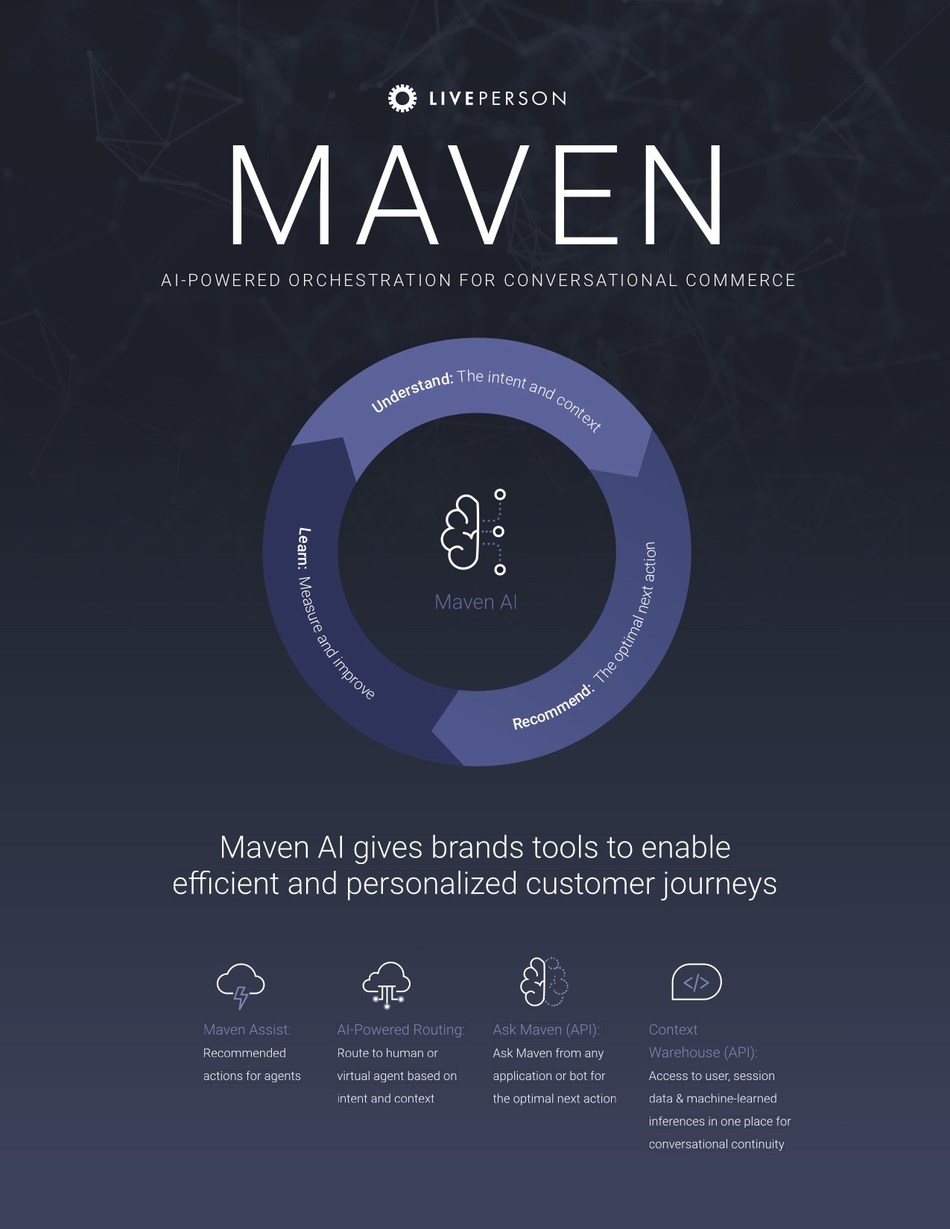
LivePerson, Inc., a global leader in conversational commerce, announced new Maven artificial intelligence capabilities that increase Maven’s power to help brands drive efficiencies and improve customer experiences in messaging channels.
Powered by LivePerson’s proprietary machine learning technology, Maven AI orchestrates conversations between brands and customers. The debut of Maven’s enhancements means brands can use AI to deliver highly-personalized conversational experiences without needing to design, maintain, and scale a conversational AI infrastructure on their own.
Powered by LivePerson’s proprietary machine learning technology, Maven AI orchestrates conversations between brands and customers over SMS, Facebook Messenger, WhatsApp, RCS, Apple Business Chat, Amazon Alexa, and other popular messaging platforms and voice assistants. Maven’s decision-making leads the “tango” of human agents and automated bots that makes it possible for brands to have personalized conversations with their customers on a massive scale while outperforming traditional websites and 800-numbers.
Maven’s new capabilities represent the latest evolution of LivePerson’s suite of conversational AI services for brands. As part of this integrated set of solutions, the debut of Maven’s enhancements means brands can use AI to deliver highly-personalized conversational experiences without needing to design, maintain, and scale a conversational AI infrastructure on their own:
Maven Assist: recommends the optimal next actions for human agents to take — surfacing content or suggesting bots capable of responding to the customer’s intent.
Maven AI-Powered Routing: dynamically routes conversations to the right agents, bots, or content to solve customer requests quickly based on the AI’s understanding of “contextual information,” including the customer’s profile information, interaction history, and contact center operations.
Maven Developer APIs: a set of developer tools (Ask Maven and Context Warehouse) to make existing bots or other systems smarter by consulting Maven on optimal next actions, plus the ability to integrate multiple sources of data (for example, CRM or conversation history) into Maven’s decision-making.
“What brands looking to leverage AI to power conversational commerce should know is that they don’t need to build in-house expertise in machine learning, routing, and other complicated systems behind conversational AI,” said Alex Spinelli, chief technology officer at LivePerson. “Maven solves these orchestration challenges so brands can focus on the core competitive advantages that make them the best at getting their customers what they want.”
Maven Assist increases agent efficiency and customer satisfaction with its real-time recommended actions. Agents, who with Maven can quickly share personalized content with customers instead of searching through their email or sticky notes for information, can also vote on Maven recommendations to improve them over time.
Maven AI-Powered Routing gives brands a way to build and manage AI policies without the expensive, complex process of developing in-house routing capabilities. In addition, existing bots can be integrated into Maven AI-Powered Routing through the Ask Maven and Context Warehouse APIs. These advanced routing capabilities unlock new conversational commerce use cases for companies of all kinds, including:
Airlines can route a customer back to the same agent they messaged with previously to follow up on a lost baggage claim.
Banks can quickly identify VIP customers and route them to dedicated advisors for high-touch, personalized experiences.
Telco companies can route inquiries about a service outage to a bot to provide status updates until the issue is resolved, freeing up agents for other urgent tasks.
Cable providers can route pay-per-view customers to specific bots and agents to handle high-volume inquiries before “the big game” or other high-profile events begin.
LivePerson developed Maven based on its experience orchestrating billions of brand-to-consumer interactions, and the AI continues to improve with every conversation, strengthening its ability to help businesses with customer care, marketing, sales, and brick-and-mortar experience use cases. Maven was recently selected as the winner of the “Best AI-Based Solution for Customer Service” from AI Breakthrough, a leading market intelligence organization that recognizes top technologies in the global artificial intelligence market.
LivePerson offers a complete suite of conversational commerce services for enterprises, deployed at some of the world’s largest brands. Compared with traditional phone calls, messaging conversations increase customer satisfaction by 20%, double agent efficiency, and cut labor cost per interaction in half.
Loyalty isn’t dead — but traditional loyalty programs are dying. And businesses are earning loyalty through relevance.
For retail marketers, the loyalty program is a straightforward exchange: for some sort of perk from the retailer (discounts, points toward a purchase, etc.), the customer will offer up access to personal data valuable to marketers. It’s a tactic that has been a reliable element of the marketer’s playbook — and one that has largely evolved to embrace digital and mobile engagements. And the longstanding belief has been that customers will keep buying the same things from their favorite retailers as long as they receive the right perks.
But these beliefs are being challenged because consumers just aren’t that interested in loyalty programs — certainly not as interested as marketers think they are. A 2018 survey from Oracle found that while 58 percent of retailers believe that consumers are eager to sign up to every loyalty program, only half are even signing up for select, highly-relevant programs — and nearly 20 percent rarely join any. And for those who are engaging in these programs, loyalty is no longer a given — recent research shows that anywhere from 59 to 71 percent of consumers aren’t made more loyal by loyalty programs.
The problem? Loyalty programs are designed to drive transactions, but consumers aren’t primarily driven by discounts. Instead, they are looking for relevance, to engage with brands that truly “get” them. Loyalty programs don’t deliver relevance — while 58 percent of retailers believe their offers are mostly relevant compared to 32 percent of consumers believing those brand offers are relevant.
Consumers want highly-personalized communications and timely notifications — particularly on their mobile devices, and increasingly, in video, rather than text. And they’re willing to make some concessions to make it happen: nearly 90 percent of shoppers from a recent survey stated they’d be alright with being tracked or watched if it means a more personal loyalty experience.
Loyalty, Meet Relevance – with Personalized Video
Marketers can’t buy customer loyalty any longer. They have to earn it with excellent customer experiences built on relevance. Loyalty, as we have thought about it, is dead. Today, true loyalty is driven by the overall customer experience, strengthened through relevance.
In the Digital Marketing era, relevance has been driven by Personalization — the ability to merge data and creative to reach each customer as if they were your only one. And customers are demanding this: 61 percent will switch companies that no longer meet their needs, and 44 percent get frustrated when companies fail to use their personal information to make interactions and offers more relevant. The cost of irrelevance? More than $1 Trillion to U.S. companies, according to Accenture.
Evolving from direct mail to Email Marketing, Social Media, Content Marketing and Web Content, Personalization is today driving the next channel for marketers: highly-relevant personalized video delivered to customers on their mobile devices.
And customers love it — we’ve regularly seen clients reduce their customer churn by upwards of 20 percent while doubling their Sales over control.
Today, by coupling explicit customer data with implicit analysis, retailers can present personalized video offers to customers who have opted-in at the exact right time. Triggered by location data and previous purchase history, a customer receives a personalized video suggesting they visit the store right down the street for a special offer that expires in an hour.
Driven by churn analysis indicating exhibiting signals that they might shop elsewhere, a retailer sends a personalized video with highly-compelling offers to come back and buy again. Shopping-cart abandonment can produce a custom video showing the clothes a customer could reconsider buying.
While loyalty programs are dying, loyalty is very much alive — through brand relevance driven by highly-personalized video.
We store cookies on your computer to improve your experience and provide more personalized services, both on this website and on other sites. For more information about the cookies we use, see our Privacy Policy. We won't track your information when you visit our site. We will have to use at least one cookie to ensure that you won't have to make this choice again.AcceptDeclinePrivacy Policy










 For retail marketers, the loyalty program is a straightforward exchange: for some sort of perk from the retailer (discounts, points toward a purchase, etc.), the customer will offer up access to personal data valuable to marketers. It’s a tactic that has been a reliable element of the marketer’s playbook — and one that has largely evolved to embrace digital and mobile engagements. And the longstanding belief has been that customers will keep buying the same things from their favorite retailers as long as they receive the right perks.