Home Blog Page 5146

7 Tips for Creating a Customer-Centric Organization

simpli.fi logo Client Satisfaction is more important than ever. No matter what industry you are in, customers will make comments—online and off—that affect the future of your business. Therefore, entrepreneurs need to prioritize Customer Success (CS) and teach their teams to deliver exceptional service that builds meaningful relationships with clients.

“In the age of transparency, [client] trust in traditional Advertising messages has waned while their trust in the opinions of friends, bloggers and online comments and postings of those they consider reliable sources of influence has increased,” writes Jeb Blount in his book, “People Love You.”

Blount goes on to explain that this change puts “advocacy, referrals, and personal recommendations on a new pedestal of importance.” Potential customers are going to believe the things they hear and read about your business. These comments will affect their decision to buy your products or services. You must take steps to ensure that when clients are talking about your company, they are saying GOOD things. Here is how to deliberately create a customer-centric organization that builds long-lasting client relationships, and in turn, a solid reputation.

1. Make It Easy to Work with You

To create a successful CS organization, you need to be nimble and flexible on processes and services. Of course, there will always be elements that an organization must keep intact to function, such as using a CRM system, maintaining your service-level agreements and setting critical operational processes.

However, there are definitely variables that you can augment to make working with your partners easier. Although we have Insertion Orders and campaign order templates available, we allow clients to use their own order templates or work from email if they prefer. We also offer self-service and managed service models and make it easy for businesses to modify approaches.

We adapt to our clients’ workflows, rather than expecting them to change for us. For example, some of our customers have one point of contact, who we speak to weekly. Others prefer us to set up multiple calls with various stakeholders. We are fine with that!

That said, we don’t sacrifice our core values or overpromise—a common mistake entrepreneurs make, especially in the technology industry. It is not feasible to say “yes” to every one-off request. You can be easy to work with without changing your value proposition.

2. Be Flexible Internally, Too

Don’t be afraid to try new things as you consider how to best support your customers. We restructured our CS team multiple times to find what works best. At first, we divided our team by type of client. Then, we moved to a regional structure, in which team members support all clients within a particular region. This makes it easier to build strong relationships because our team understands the nuances of each region.

3. Build to Scale

As you adopt processes, think of how they will translate as you grow your team from 5 to 50, to 100 and beyond. When I started my most recent job eight years ago, it was hard to imagine the 275-person operation we run today. I have had to rethink big things like my communication strategy, and smaller things, like our seating chart.

Getting the whole team together for weekly check-ins is easy when you are small, but with 120 people across the country, even a virtual meeting is a scheduling nightmare. Now we use Slack for team announcements.

In the past, departmental meetings were simple, but as our team grew we had to scale and install a new process. We also use Slack for these meetings and follow up through team level meetings with innovative ways to re-instill the importance of the information at hand.

Be deliberate with all your decisions, even the team’s seating arrangement. Last year, I told our regional directors I didn’t care how they arranged the floor. Turns out I did. We ended up rearranging desks three times in one day—quite the disruption. We laugh about it now, but it reminded me that seemingly small decisions matter when you are growing a team. (It also taught me that even though I don’t want to be involved in every decision, I do expect to be kept in the loop.)

4. Be a Servant Leader

Your team can’t support your customers unless they are supported themselves. Robert Greenleaf coined the concept of “servant leadership” in the 1970s. He believed managers get the best work from their team by empowering and serving them. I do this by making sure Managers have everything they need to do their job and the ability to make decisions without dealing with red tape. This has a trickle-down effect: I empower my team and they empower theirs. Our CS professionals are encouraged to seek out solutions, pool ideas with the entire department, and be creative in how to best serve the client.

5. Remove the Element of Fear

If your employees are disgruntled, customers feel it. You need all your employees, especially the CS team, to feel invested and secure. To do so, make it OK to fail. Tell your team (and show your team) that if they make a mistake, you will be there to correct it and to put processes in place to prevent it from happening again. As a Business owner, accept mistakes are going to occur, especially if you are encouraging people to make bold, swift decisions.

6. Create a Bond Strong Enough to Withstand Problems

Author Stephen Covey coined the concept of the Emotional Bank Account to describe “the amount of trust that’s been built up in a relationship.” You need to invest in your relationships with employees and clients so they trust you—even when there are problems.

Customer Success means owning the “Sale after the Sale,” and sometimes, that means conflict resolution. At my company, that could mean a client is unhappy because a campaign didn’t perform as expected or an ad didn’t render properly. But because we have strong emotional connections with our customers, they trust us to reconcile the issue. A small setback doesn’t terminate our relationship.

To build this level of trust, you need to understand your clients’ goals. Ask them about their objectives and challenges. Understand the environment they operate in and how their success is evaluated. This sort of fact-finding takes soft skills so coach your team to communicate effectively and read body language and tone.

7. Hire with Care

You can’t perfect CS unless you have the right people. Be painstaking about your hiring. At my company, we don’t extend an offer unless we have unanimous consent from our interview panel. When hiring with CS in mind, look for people with exceptional communication skills and the ability to learn quickly and navigate conflict. I think these attributes, along with culture fit, matter more than industry experience.

Want to grow your company? Make it a CS-centric one. This is how you will turn new clients into loyal customers, or better yet, advocates who will help turn prospects into business.

Read more: Identifying the Key Ingredients for Optimizing Customer Experience

Shutterstock Custom Launches Smart Brief to Simplify and Expedite the Creative Brief Process

New Product Dramatically Cuts Brief Drafting Time and Enables Collaboration to Meet Client Needs Faster and with Less Upfront Effort

Shutterstock, Inc., a leading global technology company offering a creative platform for high-quality content, tools and services, announced the launch of Smart Brief, a new streamlined and guided experience to improve the quality and speed of the briefing process. With this update, clients spend less time inputting briefs and more time leveraging collaboration tools to quickly obtain high-quality branded content and reduce the approval process time.

_pT4Vi9QSince its launch, Shutterstock Custom has helped hundreds of enterprise clients scale branded content creation with an innovative technology platform and editing tools. In a world where social media platforms have significantly increased the volume of content, transcending country borders and languages, brands are struggling to keep up and deliver localized content at scale and Shutterstock Custom fulfills enterprise marketers’ need to scale high-quality branded content. After analyzing hundreds of briefs and client interviews, the new Smart Brief technology was designed to simplify brief input time for quicker, more accurate results.

Read More: Brainshark To Deliver Featured Presentation At Sales Enablement Society 2019 Annual Conference

Key features of the Smart Brief process include:

  • Intelligence – new guided experience only asks relevant questions as the user moves through the process to capture accurate inputs and eliminate conflicting and unnecessary information
  • Collaboration – clients have the ability to accept changes and recommended improvements from other team members, view and revert to previous versions and quickly clone existing briefs
  • Flexibility – as needs change throughout the year, clients can adjust control, production value, and service level per project

dwRG-eSQ“The traditional creative brief process is laborious, time-consuming, and leaves a lot open to interpretation. But a good brief that captures the brand voice serves as the foundation of any campaign and is absolutely essential to its success. Using innovative technology, we set out to automate and simplify the experience,” said Sylvain Grande, SVP of Product & UX at Shutterstock. “The result, Smart Brief, streamlines our clients’ workflow and in turn, allows them to receive content faster without compromising results or having to be on set.”

Read More: New Research Shows Businesses Aren’t Proactive Enough When It Comes To Managing Online Reputation

ET Beyond original content creation, Shutterstock Custom also now offers pre- and post-production services. The enhanced service and support include:

  • Rapid Ideation in the form of individualized brief concepts that are tailored to the brand while inclusive of fresh and unique ideas.
  • eCommerce Optimization to easily generate assets that are designed to drive engagement and purchases on major e-commerce marketplaces.
  • Convert to Pins and Mobile Video function that will turn existing images or videos into ready-to-share formats on different platforms.

Read More: At 50%, Connected TV Hits New High Of Video AD Impressions Served By Extreme Reach

Greater Raleigh Region’s Largest Esports Event to Date Generates $1.45 Million in Economic Impact and Drives Employment

The Six Major Raleigh Draws A Sold-Out Crowd With 2.6K Daily Attendees

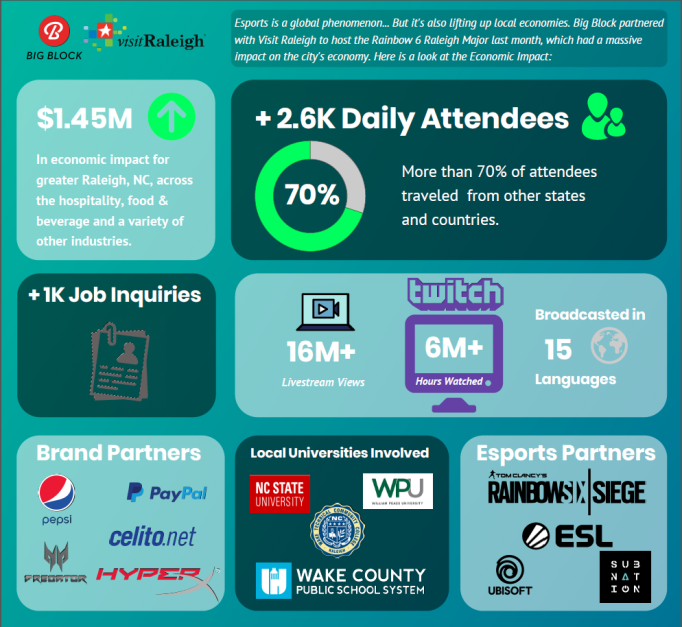
The Greater Raleigh Esports Local Organizing Committee – made up of the Greater Raleigh Convention and Visitors Bureau (Visit Raleigh), the Greater Raleigh Sports Alliance (GRSA) and media and esports agency Big Block – released a report detailing the success and impact of hosting the Six Major Raleigh last month. The inaugural event unlocked $1.45 million in direct economic impact for Greater Raleigh, generating over 1,000 job inquiries, attracting more than 2,600 daily attendees, with over 70% of them traveling from other states and countries. Additionally, the event was broadcast to a global audience on Twitch in 15+ languages, garnering more than 16 million livestream views and over 6 million total hours watched.

Image

“As esports grows, we believe that Greater Raleigh can serve as a global hub for the whole industry. Our motto is Play. Watch. Make., which means that the Greater Raleigh community not only plays and watches esports, but we also make and design the software and technologies that help power the global esports industry,” said Loren Gold, Executive Vice President of the Greater Raleigh Convention and Visitors Bureau (Visit Raleigh). “With five major game publishers and companies like Lenovo, Red Hat and SAS in our community, we have both the high demand and modern capacity that global esports organizations are looking for in a host city. Combine this with our active local and regional gaming communities, plus game development curriculum at several of our educational institutions like NC State University, William Peace University, Wake Tech Community College and Wake County Public Schools, Greater Raleigh clearly becomes a genuine home for global esports.”

Read More: Brainshark To Deliver Featured Presentation At Sales Enablement Society 2019 Annual Conference

The Six Major Raleigh was produced by ESL for Ubisoft at the Raleigh Convention Center and featured a handful of Ubisoft global sponsors. Local brand supporters included Visit Raleigh, Pepsi and Celito.net. Big Block served as the city’s consultant throughout all stages of the engagement process, from regional awareness and facility readiness, to pre/post event and client management.

In addition, Big Block conducted a local Esports Summit to educate and engage local corporations and groups interested in supporting esports on a long-term basis. A diverse group of civic, sports, educational and business leaders attended and expressed strong interest in supporting the industry and growing a sustainable esports ecosystem for the Greater Raleigh area.

“Esports is not something that can be homegrown overnight,” said Ed Tomasi, Managing Director of esports at Big Block. “By leveraging our team’s 20 plus years of collective relationships, trust and experience in global esports production and brand management, Greater Raleigh has quickly been elevated on the global stage for having the facilities and ecosystem for hosting world-class esports events.

Read More: New Research Shows Businesses Aren’t Proactive Enough When It Comes To Managing Online Reputation

As a result of the partnership, a new Greater Raleigh Esports Local Organizing Committee (GRELOC) has recently been formed, and is currently chaired by the Visit Raleigh, GRSA and Big Block. The committee’s 3-5-year plan is to build the amount of hosted esports events to over five per year and garner local corporate brands and educational institutional partners to support a financially healthy and sustainable esports ecosystem for Greater Raleigh.

Big Block’s extensive work in traditional sports and media, paired with its content and experiential platform Subnation, has allowed the integration of brands like Marvel and Volkswagen into the esports world, and has perfectly positioned Big Block to lead forward-thinking brands into the world of competitive video gaming.

Read More: At 50%, Connected TV Hits New High Of Video AD Impressions Served By Extreme Reach

Bidstack Reaches New Checkpoint with Latest Senior Hires

Bidstack, the in-game advertising platform is excited to announce two new appointments – Nina Mackie, Senior Director of Global Agency Partnerships and Charlotte Cook, Account Director of Games.

Nina has enjoyed a 22-year career in advertising; initially starting in print advertising in Scotland, before progressing into digital. Her breadth of knowledge spans from editorials in the Trinity Mirror to digital ad platforms across mobile, WIFI, DOOH and programmatic.

Commenting on her appointment, Mackie said, “46% of all video gamers are now women and as demographics near gender parity huge opportunities to monetise this channel for game publishers and developers are emerging. Brands should be evolving their marketing strategies to incorporate gaming and capitalising on the increased attention span of consumers viewing within-game ads.

Read More: AXA Insurance Revolutionises Digital Customer Service With RingCentral Engage Digital

“Bidstack is one of the most exciting start-ups in London at the moment and is already disrupting the industry with a revolutionary new channel that straddles digital advertising as a whole. Solving an age old problem by helping advertisers reach the unreachables using a non-disruptive ad experience; Bidstack is an essential channel for a multitude of brands.”

Making her mark on both the publishing and distribution sides of gaming, Charlotte Cook has worked at some of the most influential gaming companies of our time. She had a hand in launching multiple chart-topping AAA titles such as Grand Theft Auto, BioShock and Borderlands, as well as PC favourites Total War and Football Manager. Cook was also a part of the team that created the campaign for Mario and Sonic at the London 2012 Olympics.

Cook said, “We’re now entering an era of the gaming industry where there is increased scrutiny on in-game purchasing and the monetisation of games. The opportunity here at Bidstack appealed to me because ‘within game’ or ‘native in-game’ advertising is a really simple concept that has the potential to provide a sizeable incremental revenue stream to games publishers and developers; while ensuring the gameplay and experience is not impacted.

Read More: SocketLabs Names Keith Hontz As CEO

“I’m really looking forward to bringing my experience and knowledge of gaming to the Bidstack team, to help evolve the business and learn more about the media and advertising world.”

Cook and Mackie will be joining the growing Bidstack team at the company’s HQ in London.

James Draper, Bidstack CEO said, “Charlotte and Nina have proven track records in their previous roles and are recognised experts in their fields of work. The invaluable knowledge and understanding they share in both the gaming and advertising industries respectively shows the level of talent we attract.” 

Read More: Brainshark Named Best Training Solution In 2019 Golden Bridge Awards

Marketers Need to Focus More on Psychology Than Technology Says Quantcast CTO Peter Day

AI and Machine Learning Used like ‘Punctuation Points’ in Marketing Presentations

At a series of marketing and agency industry events in Sydney and Melbourne last week, Quantcast Global CTO Dr Peter Day shared his insights into how companies can survive and prosper in difficult climates whilst creating great products that disrupt with lasting impact.

Based upon a career working at the cutting edge of AI and machine learning, Day said agencies and marketers need to do three things to confront the incoming headwinds of digital disruption – organise for autonomy, optimise for the velocity of learning, and be fearlessly optimistic.

Day added that AI and machine learning are two terms that are currently going through ‘hype cycles’ and used like ‘punctuation points in marketing presentations’, making it very difficult for people outside of the industry to separate fact from fiction.Peter Day event

The real value Day believes, belongs in machine learning and its ability to give humans ‘superpowers’, arguing that these systems free up time from the mundane, repetitive tasks which computers are great at.

Read More: Kochava And Cuebiq Partner To Measure The Impact Of OOH Advertising In Driving App Downloads

Technology is only doing what computers have done for years – ‘one thing but one thing very, very well, with human intelligence and creativity still holding the key to successfully changing behaviours.’ Therefore marketers need to continue to focus ‘more on psychology than technology‘ to remain successful and relevant.

Marketers Need to Focus More on Psychology Than Technology Says Quantcast CTO Peter DayOn the challenges faced by the agency world, Day praised agencies as the ‘masters of public influence’, offering the controversial view that agencies should eventually be in a position to save publishers by directly funding content.



Group Business Director at Carat Matt Evans, who attended the event said it was refreshing to hear a current and qualified perspective on marketing technology and AI in particular.

Read More: Petra Industries Unveils Next-Generation B2B Ecommerce Platform, Powered By OroCommerce

“It’s no surprise that the advances in technology have changed the face of marketing and advertising forever. So, keeping abreast of the latest perspectives is absolutely business critical at all levels of our industry.

“Peter’s refreshing take on the subject was a great balance between avoiding well-worn paths and exhausted clichés, and offering genuine insights into succeeding in the new world,” he added.

Read More: Verishop Selects Akeneo To Deliver Product Experience Excellence Amid Rapid Growth

Reach3 Insights expands Los Angeles office; Hires Diego Rodriguez as Senior VP, Media & Entertainment

Reach3 Insights announced the appointment of Diego Rodriguez as Senior Vice President, Media & Entertainment. As the company’s Southern California office continues to grow, Rodriguez will support the growing demand for fast and engaging audience insights as global entertainment giants race to define their service offerings in streaming, online and traditional environments.

Rodriguez brings with him over 15 years of both qualitative and quantitative research experience across a wide range of industries in the U.S. and internationally. Within media and entertainment, Rodriguez has worked with some of the largest television, movie studios and streaming companies.

Read More: Content Recommendation Platforms Taboola And Outbrain Merge To Disrupt “Global AdTech” Ecosystem

­­­­“We’re thrilled to have Diego join Melva Benoit in further building out our growing Los Angeles team,” said Matt Kleinschmit, CEO and Founder of Reach3. “A key pillar of the Reach3 client promise is our ability to connect and engage with ALL consumers through modern communications channels in a more natural, organic fashion. The work that Diego has pioneered in Hispanic and Latino engagement across all industries will further our capacity to give our clients the deep human insights they’re after.”

“When I heard Reach3 was expanding to Los Angeles, I knew I had to get involved and help engage the Latino community,” said Rodriguez upon his new appointment. “I’m eager to introduce a new wave of market research solutions to the media and entertainment industry, ultimately helping these companies to better engage their audiences through messaging-based research solutions and unlocking new pathways to business success.

Read More: Marquee TV Selects ViewLift To Power New OTT Content Platform

Reach3 Insights is a full-service research consultancy that develops scalable, conversational insight solutions for today’s modern, agile enterprise. Led by CEO Matt Kleinschmit, the company uses immersive, in-the-moment research designs and dynamic digital storytelling to deliver deep experiential insights that inspire action. Reach3 is part of Reid Campbell Group and a sister company to Rival Technologies, a tech company developing chat, voice and video solutions that integrate into messaging platforms and technologies that people actively use on a daily basis.

Read More: Agora.Io Fuels Faster Time-To-Market For Mobile App Developers With Agora Partner Gallery

Infogroup Names Seasoned Harte Hanks and Epsilon Executives as EVP, Enterprise Sales, and SVP of Technology, Yes Marketing

Key Hires Bring Deep Expertise in Enterprise Sales and Integrating Best-Of-Breed Software Solutions Within a Partner Model

Infogroup, a leading provider of data and data-driven marketing solutions, announced two important executive appointments: Brad Wamsley as Executive Vice President, Enterprise Sales; and Dan DeZutter as Senior Vice President of Technology, Yes Marketing. These strategic appointments emphasize Infogroup’s ongoing commitment to expanding its enterprise sales efforts and continually improving its offerings through industry-leading technology integrations.

“Both Brad and Dan are proven leaders when it comes to creating and leading highly effective teams, and we’re thrilled to be bringing their skills, reputation, and expertise into the Infogroup fold,” said Mike Iaccarino, chairman and CEO of Infogroup.

In his new role, Wamsley, who previously spent more than 25 years leading vital growth initiatives at global marketing services firm Harte Hanks, will play a key role in strengthening Infogroup’s presence in existing verticals, expanding the company’s client base, and strengthening the company’s channel relationships.

Read More: Agora.Io Fuels Faster Time-To-Market For Mobile App Developers With Agora Partner Gallery

Most recently, Wamsley served as Vice President of New Business and Vice President of Growth Markets at Harte Hanks. As their VP of Growth Markets, Wamsley built and led a 75+ person team responsible for approximately 160 Enterprise accounts and $175 million in annual revenues, across all of the firm’s products and services.

“Infogroup is a leading, well-established brand with an incredible reputation and an already-enviable client list,” Wamsley said. “At the same time, there’s still some amazing greenfield space out there that represents a huge growth opportunity for Infogroup, among large Enterprises in particular. I’m excited to roll up my sleeves and go after those opportunities, with a respected and seasoned team by my side.”

Read More: OOH Advertising Trade Association, Geopath, Launches New Methodology

DeZutter previously served as Senior Vice President of Enterprise Architecture and Innovation at Epsilon, where he led the Solution Architecture and Innovation team for Epsilon’s Technology Practice. In his new role, DeZutter will lead ongoing technology integration efforts and explore new opportunities to further enhance the company’s technology stack for even greater efficiency and client results.

During his 15 years at Epsilon, DeZutter helped establish the future technology vision for their world-class CRM and direct marketing network. After departing Epsilon in 2018, DeZutter served as Director of Enterprise Data Management of Discover Financial Services.

“My new role with Yes Marketing aligns perfectly with my passion for using data and technology to deliver business results,” DeZutter said. “By combining the vast data resources of Infogroup with Yes Marketing’s technology and agency capabilities, we’re able to drive amazing results for our clients, and I’m excited to be a part of that.”

Read More: MindTickle Debuts Adaptive Spaced Reinforcements For Effective Knowledge Retention

605 Names Brian Katz Vice President of Sales

TV Measurement and Data Analytics Company Adds to Growing Sales Team

605, a next-generation television measurement firm, recently announced the hire of Brian Katz as Vice President of Sales, the latest addition to 605’s growing sales team. Katz brings more than two decades of experience in TV and digital research, audience insights, sales and data strategy to the company.

In this role, Katz will bring 605’s next-generation TV analytics to MVPDs and TV networks, as well as other publishers and media companies. He will work closely with the sales team and integrate with other areas of the business to help the company’s growing client roster leverage 605’s multi-source viewership data and analytics, which offer whole-home TV viewing visibility by combining the best attributes of both set-top-box and ACR data.

Read More: MindTickle Debuts Adaptive Spaced Reinforcements For Effective Knowledge Retention

“As a growing data analytics firm driving the next generation of TV measurement, you want someone like Brian on your team,” said Noah Levine, Chief Revenue Officer at 605. “Brian has lived and breathed research and insights initiatives in the TV advertising industry over the course of his career, with a proven track record for driving sales, generating new client partnerships and improving ROI. He has witnessed the evolution of TV viewing and advertising over the past two decades, and we love what he adds to the 605 team.”

“No other company has brought to market a multi-source viewership dataset (ACR & STB) on a national deterministic scale and offer its clients full-funnel attribution measurement solutions,” said Katz. “I’m super excited to join 605 and continue to evolve and advance the TV industry’s standard of measurement.”

Read More: Content Recommendation Platforms Taboola And Outbrain Merge To Disrupt “Global AdTech” Ecosystem

Reporting to Levine as Vice President of Sales, Katz will work closely with 605’s client base to help them increase the effectiveness and efficiency of their media campaigns, enabled by 605’s vast deterministic TV viewership data. 605’s data footprint currently includes more than 21 million U.S. households, across all 210 DMAs.

Prior to joining 605, Katz cultivated a deep background in audience insights and research, advanced TV and data driven sales innovation and product strategies. Katz previously has held leadership roles at video marketing technology company Eyeview, TiVo Research, Magid and NBC Universal.

Read More: Marquee TV Selects ViewLift To Power New OTT Content Platform

Gong Charts New Future for Sales Leaders, Launches Revenue Intelligence

AI-based approach increases revenue team effectiveness by transforming interactions into insights

Gong, the leading sales-enablement platform leveraging artificial intelligence to go beyond traditional CRM and transform revenue teams, called on sales and revenue leaders to chart a new path towards a better customer reality at #celebrate, the inaugural Revenue Success Summit. Revenue Intelligence is that transformation, leveraging AI to record details of every single customer interaction a salesperson has, both verbal and written, across every relevant channel and converting them into actionable insights for revenue leaders.

Today, salespeople spend over 50% of their time manually updating their CRM system, leading to data that is limited and stale, ultimately creating a distorted view of customer reality. The goal of Revenue Intelligence is simple, and moves away from the surface-level view of traditional customer interactions: it’s a shift from making business decisions based on opinions and gut feelings to data and facts delivered through the platform’s insights engine, which reveal true customer reality.

Read More: Confirmit Announces 2019 Air Award Winners

“Revenue Intelligence is a powerful resource because it gives us visibility into the strategies, people, and results that will ultimately impact our business,” said David Ellis, director of sales, LinkedIn. “Revenue Intelligence enables us to go from hypothesis to data to insight, which will ultimately help us improve the skills of our reps, enhance the conversations we’re having, drive greater customer success, and advance LinkedIn’s vision of economic opportunity.”

Success within Revenue Intelligence is found in three key areas: People Success, Deal Success, and Strategy Success. People Success enables you to understand and replicate the behaviors of your best team members to raise the effectiveness of your entire sales team. Deal Success gives you unfiltered visibility into every customer interaction that’s taken place for a given sales opportunity and surfaces warning signals so you can take action before a deal goes south. Strategy Success provides real-time insights into the voice of your market to inform and adapt your go-to-market plans in real-time. With Revenue Intelligence, Gong’s customers have found onboarding time decrease between 20-50%, win rates increase by at least 10%, and overall deal sizes increase by 35%.

“We are seeing a significant trend of B2B companies investing more in technology to enable customer-facing functions from sales to customer success. Our research shows that organizations across all verticals are reporting that technology is having a substantial effect on sales effectiveness and sales productivity,” said Craig Rosenberg, Co-Founder and Chief Analyst at TOPO. “One of the key drivers of this trend has been the ability to analyze customer engagement from live conversations to digital activities. Companies are starting to realize that this is much bigger than just call recording. It’s about capturing the right engagement data to create an accurate view of the customer reality.”

Read More: FrontRunner Technologies Partners With Derooted To Add Interactive Sound Element To DOOH Experience

Revenue Intelligence augments the traditional CRM model with AI-driven automation that captures a comprehensive view of customer reality in real-time, leading to a collaborative and transparent working environment. Instead of leaving everyone to focus on their own quotas and deploying their own strategies, Revenue Intelligence brings revenue teams together with a unified view of the customer reality.

“It may seem like an impossible task, but with Revenue Intelligence, anyone who is focused on growing revenue will have insights and data behind all of the nuances and subtleties of a customer conversation,” said Amit Bendov, Gong’s CEO and Co-Founder. “Revenue Intelligence enables collaboration across the organization, welcomes a new era of transparency, and makes sales an agile sport. It will ultimately make every revenue professional as effective as possible. In five years we will look back on the time when we operated solely based on our opinions, as manually entered into the CRM, and be dumbfounded as to how we even did business. It’s high time we all said, ‘Goodbye opinions. Hello, reality.’”

Read More: OOH Advertising Trade Association, Geopath, Launches New Methodology