Home Blog Page 5510

How to Be Less Boring at Your Next Webinar

Although webinars have been around for a while, their popularity has only continued to grow – the market is poised to approGoToWebinar Logoach $1 billion in the next decade. This is mainly due to the fact that they’re such an effective marketing tool. A webinar gives you a conversation at scale, which no other platform can deliver. And yet, webinars aren’t always treated with the attention they deserve and sometimes come across as overly scripted or just plain boring. The challenge for webinar hosts is making their presentations more engaging, personalized and interactive.

First, let’s take a look at some data. Our Big Book of Webinar Stats analyzed over 350,000 webinars hosted by GoToWebinar, and the results suggest there are some data-supported, practical strategies for making webinars more engaging.

The study gave every webinar an attendee engagement score, based on criteria including whether attendees asked questions, how much time they remained in attendance and whether they responded to polls. Average scores above 60 represent highly engaged attendees who are more likely to turn into high-quality leads. However, the average score for demand generation webinars was only 42.4 in 2017. So, how can you earn a higher score for your webinar? Here are some ways to model your webinars after those that scored the highest —

Read More: CRM Data Is Still Numero Uno Block in Building “the Path to Sales Mastery”

Show personality

First off, turn on your webcam! Turning yourself from a faceless voice into a real person is a great first step toward getting people to pay attention to you and care about what you have to say.

The next step is to have fun. You may take your presentation very seriously, but that doesn’t mean you have to take yourself too seriously. If you get nervous, don’t forget that the more preparation you do beforehand, the more comfortable and present you’ll be when the day comes, allowing your personality to shine through. Having a co-presenter can be great for playing off of another person in a fun way, not to mention having someone to help handle Q&A.

Engage with polls, prizes, handouts, and surveys

Q&A sessions are just one of several tactics for engaging an audience. Another one is prizes – early on in the session, offer a prize for the most engaged participant. Awakening your attendees’ competitive spirit makes the webinar more memorable while incentivizing people to ask more questions turns the session into more of a conversation.

According to our research, handouts were only used in 10 percent of demand gen webinars last year, while polls were used in 14 percent and surveys in 16 percent. These are each tried-and-true methods for boosting engagement, and this data suggests that they are being underutilized.

Read More: Interview with Sandie Overtveld, Vice President Sales, APAC at Zendesk

Use a proven title format

The webinars that drew the biggest crowds last year were presented in a list format, i.e. “10 Underused Methods for [blank].” The list is a longtime marketing favorite and the numbers continue to back it up. Lists convey clear value to the audience and have obvious takeaways.

The next best format was “how-to,” which, again, communicates from the start that there will be actionable takeaways. “101” titles also did well. These work best when you’re covering a trending topic that people want to learn about. All this may sound obvious or, well, boring but if you want results, it’s best to go with what the data tells us is most effective.

Read More:  Sales Call Analytics Is the Difference Between Winning and Losing Customers

Use Strong Images

Powerful images are the backbone of a good presentation. Filling an entire slide with a single high-res, attention-grabbing picture, with just one or two words in front of it will pique the attention of your audience. It also provides the hidden benefit of giving a visual queue for the presenter, if you happen to lose your train of thought.

As for the pictures themselves, pop culture always works, since it’s an easy, common reference point. If you’re looking for something more striking, find a source for images like Deviant Art, which is a site where artists share their work and, if you ask nicely, you may get to use something you like. Another option is mining the internet for memes and .gifs, which are always entertaining.

Finally, in terms of visuals, don’t forget to follow the basics – keep the slides clean, use a large font and include as few words as possible. People can read faster than you can present and you want them engaging with you, rather than reading.

Seventy-three percent of B2B marketers and sales leaders say a webinar is the best way to generate quality leads. It’s time to start making the most out of this powerful tool!

Read More: Interview with Sandie Overtveld, Vice President Sales, APAC at Zendesk

Josh Allen Joins Drift as Company’s First Chief Revenue Officer

0

Conversational marketing leader adds former CarGurus and LogMeIn sales leader to executive team.

Drift, the world’s leading conversational marketing and sales platform, today announced that Josh Allen has been appointed the company’s first Chief Revenue Officer.

Josh Allen Joins Drift as Company’s First Chief Revenue Officer

Read More: Interview with Anil Kaul, CEO at Absolutdata

As CRO, Allen will be responsible for building and executing Drift’s long term go-to-market sales strategy as the company strives to transform businesses’ sales and marketing into the now. He joins Drift after serving as SVP, North America Sales & Service at CarGurus (NASDAQ: CARG) where he led a team of more than 300 sales, service, and operations professionals during the company’s most expansive growth period.

Allen also spent a decade at LogMeIn (NASDAQ: LOGM), where he held a number of leadership positions, including VP of Sales for two of the company’s three business units, and helped open and expand their international headquarters in Dublin, Ireland.

Read More: Interview with Sandie Overtveld, Vice President Sales, APAC at Zendesk

“Josh has been at the helm of sales teams at some of the world’s fastest-growing companies,” said David Cancel, founder and CEO, Drift. “He’s seen what it takes for organizations to continually accelerate revenue growth as they scale their sales strategy on the path to IPO and beyond. We’re thrilled to have that experience on our team at such a critical and exciting time for Drift and the category of Conversational Marketing.”

“From the people, to the brand, to the mission, it’s hard to find a company with the ingredients that they have at Drift,” said Allen. “I’ve been admiring what David, Elias and the team have been building, but when I experienced the operation in person, it was magnetic. I had to become a part of it. I’m excited to be joining during this stage of hypergrowth, and I’m looking forward to helping businesses from all around the world engage with customers in the now with conversational marketing.”

Read More: Interview with Sandie Overtveld, Vice President Sales, APAC at Zendesk
Pipeliner CRM Cloud Released

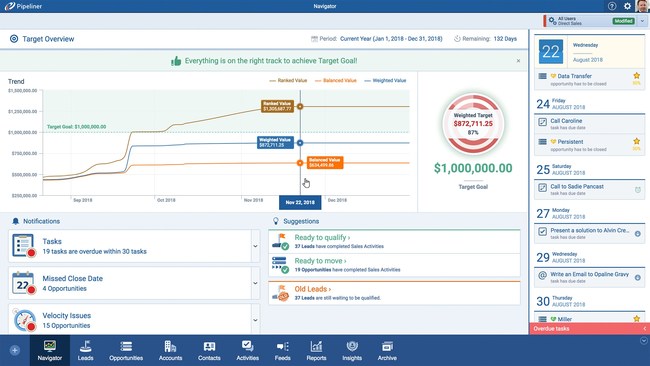
Pipeliner today announced the release of a cloud version of its popular and unique visual CRM that has gained significant traction globally over the past number of years. Pipeliner CRM Cloud is the latest addition to a product line that already includes Pipeliner CRM Hybrid, an online/offline system as well as the market leading iOS and Android Mobile CRM Apps.

Pipeliner CRM Cloud's Voyager AI engine continually navigates and explores the data contained in the universe of customer and prospects captured within Pipeliner CRM. Using intelligent algorithms, Pipeliner Voyager guides and informs salespeople and sales managers by selecting and presenting key indicators that identify actions needed to be taken, areas that need attention as well as providing an early warning system on the health of opportunities in the pipeline.
Pipeliner CRM Cloud’s Voyager AI engine continually navigates and explores the data contained in the universe of customer and prospects captured within Pipeliner CRM. Using intelligent algorithms, Pipeliner Voyager guides and informs salespeople and sales managers by selecting and presenting key indicators that identify actions needed to be taken, areas that need attention as well as providing an early warning system on the health of opportunities in the pipeline.

Read More: Interview with Anil Kaul, CEO at Absolutdata

With the release of the cloud version, Pipeliner CRM can now service the largest addressable market of any CRM given that it now has superior products for those who want a cloud-only CRM as well as those who require robust offline capabilities and those who need the most effective mobile CRM app available.


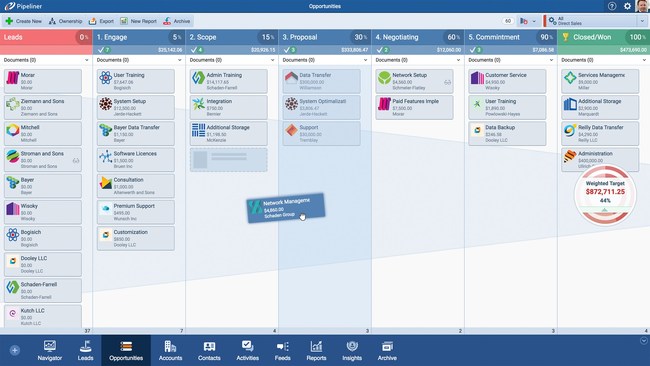
Pipeliner CRM Cloud: Dynamic, Instant Intelligence, Visualized! This ensures a supreme user experience, short learning curve plus high and rapid adoption rates. Its unique administration backend means that non-technical users can easily configure the system, so no programmers, consultants or systems integrators and there is no need for an expensive, full-time administrator which saves companies money and minimizes risk.

Read More: Why Delivering ABM-Focused Conversations at Scale to Your Customers Matters in the Buying Process

“Many people have been asking us to release a cloud-only version of our hugely successful CRM and today we are delighted to release Pipeliner CRM Cloud to the market,” said Nikolaus Kimla, Founder & CEO of Pipelinersales. “Web technology has now evolved to where we can deliver the same supreme user experience in the cloud as we have in our hybrid version. In fact it provides us with the opportunity to enhance and innovate at an even more rapid rate.”


Pipeliner CRM Cloud is available in three versions: Starter, Business & Enterprise and delivers a level of visualization and instant, dynamic insights unrivalled in the CRM space. This ensures a supreme user experience, short learning curve plus high and rapid adoption rates. Its unique administration backend means that non-technical users can easily configure the system, so no programmers, consultants or systems integrators and there is no need for an expensive, full-time administrator which saves companies money and minimizes risk.

Read More: Interview with Anil Kaul, CEO at Absolutdata

Nielsen Acquires Digital Games Market Intelligence Provider, SuperData Research

0

SuperData Research will complement and strengthen Nielsen’s industry-leading video games and esports solutions

Nielsen Holdings plc announced it has completed its acquisition of SuperData Research, a leading provider of market intelligence on digital games, gaming video content, and virtual/augmented reality across mobile, PC online, console and other digital platforms. The company analyzes the spending of over 160 million paying digital gamers, worldwide.

Intelligence provided by SuperData will enhance the industry-leading capabilities of Nielsen Games and Nielsen Esports, tapping into the $109B video gaming industry. SuperData provides custom and syndicated data solutions to clients and tracks the consumption of games-as-media, including esports and gaming streaming content on digital media platforms.

Nielsen Games and Nielsen Esports offer unrivaled expertise in a rapidly changing marketplace, innovative technology, and groundbreaking research, analytics and insights for video game publishers, console manufacturers, and media platforms, as well as esports rights holders, brands, and other industry stakeholders around the world.

Read More: Decoding The Current State of SDR Automation Platform Powered by AI

With this acquisition, clients will now have greater access to global market intelligence around digital video gaming use, sales, and audiences, in addition to our existing areas of expertise such as consumer research, video game tracking, esports sponsorship valuation and consulting services.

“We recognize the growing importance of the digital gaming ecosystem, and the combined strength and expertise of our businesses will deliver best-in-class solutions and services to games and esports clients around the world,” said Chris Morley, Global President, Nielsen Sports, Games and Esports.

Read More: Why Delivering ABM-Focused Conversations at Scale to Your Customers Matters in the Buying Process

“Gamers are the trailblazers for media consumption and have become more important than ever to the global entertainment landscape. SuperData and Nielsen’s combined capabilities will allow us to provide gold standard insights that are essential to the growth of the industry,” said Janelle Benjamin, COO and co-founder, SuperData.

“Video games have become a mainstream form of entertainment that engages and excites billions of people globally. In Nielsen we found a shared vision of helping clients understand the changes taking place in consumer entertainment preferences,” said Joost van Dreunen, CEO and co-founder, SuperData.

SuperData is headquartered in New York, with clients in North AmericaEuropeAsia and Latin America. Going forward, the company will be referred to as “SuperData, a Nielsen company.”

Read More: Interview with Anil Kaul, CEO at Absolutdata

Mixpanel Brings on Seasoned Executives to Tackle the Global $26 Billion Analytics & Business Intelligence Market

0

With leaders from LinkedIn, Google, and other top tech companies, Mixpanel capitalizes on the global demand for user behavioral analytics at large and small organizations alike.

Mixpanel, the world’s leading user behavior analytics platform, today announced strategic additions to its executive team. Joining the company are Pierre Berlin, Vice President of Global Sales; Alison Holmlund, Vice President of Customer Success; and Adam Kinney, Head of Machine Learning and Automated Analysis. With these leaders, Mixpanel will accelerate its momentum in the industry and enable large and small organizations to invest in innovation, product growth, and improved customer experiences with user behavior insights.

“Today, Mixpanel serves 30% of the Fortune 100, and demand is stronger than ever across all business segments for user analytics,” said Amir Movafaghi, CEO of Mixpanel. “Over the last year, we’ve seen three major trends driving this demand and our growth.”

Read More: Decoding The Current State of SDR Automation Platform Powered by AI

“First, with customer data volumes growing every year, we’re continuing to invest in machine learning to easily surface automated insights, so people never miss out on ways to improve their products and customer experiences. Second, as organizations try to leverage user behavior insights and tools across multiple departments, professional services will play an increasingly large role in helping teams transform their workflows and make smart decisions. Finally, worldwide demand for user behavior analytics is growing every year, and we see an opportunity to bring on an experienced global sales leader to expand into new regions.”

According to Gartner, global revenue in the business intelligence (BI) and analytics software market reached $18.3 billionin 2017, an increase of 7.3 percent from 2016. By 2020, it’s estimated that this market will be $26 billion in revenue, spanning across the Americas, EMEA, and APAC markets. Leading global enterprises, including BMW, DocuSign, Expedia, Overstock, and Ventee-Privee, continue to partner with Mixpanel to leverage user behavioral insights everyday when making decisions, across product, marketing, analytics, and customer experiences teams.

Read More: Why Delivering ABM-Focused Conversations at Scale to Your Customers Matters in the Buying Process

New Executive Leadership

Adam Kinney, Head of Machine Learning and Automated Analysis

Adam Kinney is an experienced data science leader, having worked at some of the most data-driven tech companies in the world, including Twitter, Google, and Schibsted. He joins Mixpanel to lead the company’s investment in helping its customers get the most value from their data with automatic user insights.

“With terabytes of information pouring into companies every day, we know that most businesses aren’t finding or taking action on valuable user insights hidden in their data,” said Adam Kinney. “Mixpanel is at the forefront of helping companies better understand their users, including the great work already done by its world-class team of ML experts.

“My role is to build on that foundation, using machine learning and statistical techniques to generalize and automate user analysis and prediction. We’re excited to push the field of analytics and provide automated insights for data-driven professionals, so they can save time and make discoveries they might’ve missed without Mixpanel.”

Read More: Interview with Anil Kaul, CEO at Absolutdata

Pierre Berlin, Vice President of Global Sales

With 20 years of experience building and developing teams, Pierre Berlin will be scaling Mixpanel’s sales force and its fast-growing international presence. Throughout his career, Pierre has successfully led SaaS go-to-market teams during periods of high-growth and global expansion.

Earlier in his career, Pierre spent 10 years in roles across marketing, sales, and management at Business Objects (acquired by SAP). Next, he was at LinkedIn for more than five years, where he opened offices in FranceItalySpain, and the Middle East and North Africa region, before leading the entire LinkedIn Talents Solution team in EMEA, consisting of 800 people across nine offices. Most recently, Pierre helped London-based start-up DueDil establish its B2B go-to-market strategy in Europe.

“The choice to join Mixpanel was a simple one,” said Pierre Berlin. “We have a product that’s changing the way people innovate with user insights, a market of passionate data-driven professionals at global companies like BMW, Vente-Privee, OLX, and Skyscanner, and one of the most talented teams I’ve ever worked with in my career.”

Read More: Interview with Sandie Overtveld, Vice President Sales, APAC at Zendesk
Alison Holmlund, Vice President of Customer Success and Support

With over 20 years of experience in fast-growing technology companies, Alison Holmlund specializes in architecting exceptional customer experiences, from supporting tiny startups to providing enterprise companies with strategic advice and services.

Before joining Mixpanel, Alison was the Chief Customer Officer of Host Analytics, where she focused on the continuous success of Host Analytics customers from on-boarding through contract renewal. Prior to that, she led customer-facing teams at Proofpoint and Netscape. In 2016, she was named a Silicon Valley Woman of Influence for her exceptional leadership, technical acumen, and philanthropic contributions.

“It wasn’t just the technology that inspired me to join this leadership team. It was also our company’s ethos of listening to our customers,” said Alison Holmlund. “Our award-winning Support team and professional services help organizations around the globe reach their business goals through an end-to-end analytics strategy. The Success and Support teams at Mixpanel are defined by our passion for providing value at every touchpoint of the customer experience—from implementation to ongoing customer support and technical consultation.”

Read More:  Sales Call Analytics Is the Difference Between Winning and Losing Customers

Lyft Business Reimagines Transportation with Salesforce

With Salesforce Pardot and Sales Cloud, Lyft Business will be able to drive customer engagement and loyalty

Salesforce (NYSE : CRM ), the global leader in CRM, today announced that Lyft, the fastest growing rideshare company in the U.S., is using Salesforce Pardot and Sales Cloud to identify the best prospects, convert more leads and drive customer loyalty.

Lyft Business designs transportation experiences and programs that make the ride matter—by driving business forward, rewarding people, and ultimately, upgrading the transportation management experience. From providing rides that don’t require an app or smartphone to enabling a seamless expensing process, Lyft Business allows companies to quickly and easily design a transportation solution for the people they care about.

Read More: Decoding The Current State of SDR Automation Platform Powered by AI

Today, Lyft Business serves thousands of organizations and their people, including healthcare organizations, automobile dealerships, universities and Fortune 1000 businesses—each striving to provide the best transportation experience for their employees and customers, patients, travelers and more. By working closely with each of their customers, Lyft Business has discovered how complex the customer lifecycle is and the varying challenges that each industry has when it comes to transportation. For example, healthcare companies are focused on providing predictable patient wait times and getting patients to appointments on time, while universities and college campuses need a safe and efficient way to get students home at all hours. That’s why Lyft Business turned to Salesforce, to gain a deeper understanding of their customers, in order to engage the right buyer, with the right content, at the right time.

With Salesforce Pardot and Sales Cloud, Lyft Business now has a single platform to drive alignment between marketing and sales—delivering better leads, increased engagement and deeper customer relationships. Now, the Lyft Business marketing team and sales team are able to work together closer than ever before, with access to the same data, along with real-time information on prospects, leads and customers—to build customer loyalty.

Read More: Why Delivering ABM-Focused Conversations at Scale to Your Customers Matters in the Buying Process

“Lyft Business works with organizations of all types—from healthcare organizations to consulting firms and universities,” said, Samantha Goldman, Head of Marketing, Lyft Business. “With Salesforce, we’re able to deliver a personalized experience for each of our prospects and customers. No matter the company size or industry, we’re now able to more seamlessly create a better customer experience.”

“Lyft is a beloved consumer brand for making ridesharing so simple,” said Michael Kostow, SVP & GM, Salesforce Pardot. “Salesforce is enabling Lyft Business to rapidly scale, by providing that same level of consumer experience to businesses—allowing them to engage with the best prospects, at the right time and with tailored content.”

Read More: Interview with Anil Kaul, CEO at Absolutdata

Salesforce Expands the Sales Cloud Platform with Faster Prospecting, Flexible Billing and Intelligent Marketing Automation

  • High Velocity Sales now delivers tailored sales cadences and work queues to each inside sales rep – increasing their productivity and focus on the most valuable prospects
  • New Salesforce Billing streamlines the revenue lifecycle with usage-based pricing, evergreen subscriptions and flexible invoicing
  • Salesforce Pardot is now powered by Einstein and Lightning, aligning marketing and sales teams with AI-powered campaign insights and behavior scoring to deliver smarter, more personalized customer experiences

Salesforce, the global leader in CRM, today announced advancements to the Sales Cloud platform, delivering a faster, smarter and more integrated sales process from lead-to-cash. Now, companies can complete the entire sales process, from marketing to sales to billing, right within Salesforce.

“Automation, integration and speed are essential to business success in the Fourth Industrial Revolution,” said Adam Blitzer, EVP & GM, Salesforce Sales Cloud. “By extending our Sales Cloud platform with faster prospecting, flexible billing and intelligent marketing automation, we’re providing our customers with a comprehensive and unparalleled lead-to-cash platform.”

Read More: Decoding The Current State of SDR Automation Platform Powered by AI

Arming Inside Sales Teams with High Velocity Sales

Time lost on manual tasks like researching prospects leaves the average inside sales rep spending a mere 32 percent of their day selling1. High Velocity Sales arms insides sales reps with the insights and tools needed to identify the best leads, eliminate busy work and boost pipeline. Updates to High Velocity Sales now deliver new levels of automation and intelligence, making it easier than ever to prospect faster and manage leads more effectively. New innovations include:

  • Sales Cadences enable managers to create customized, pre-built activity sequences for their sales teams. With Sales Cadences, best practices can be built right into the CRM, guiding new and veteran inside sales reps through the prospecting process—including when to email a prospect, when to call and even what to say, with call scripts and email templates.
  • Work Queues create a prioritized email and call list right inside Sales Cloud. Based on insights from Sales Cadences and Einstein Lead Scoring—which uses machine learning to automatically analyze which leads are most likely to convert into opportunities—Work Queues ensure that inside sales reps know exactly what next steps to take, in order to build the strongest pipeline.

Read More: Why Delivering ABM-Focused Conversations at Scale to Your Customers Matters in the Buying Process

Connecting Finance and Sales with Salesforce Billing 

Billing processes are often the last and most difficult mile in completing the sales cycle, particularly as new recurring business models emerge. Powered by Lightning, new Salesforce Billing is the latest addition to Salesforce CPQ, enabling businesses to build deeper, recurring relationships with their customers. Now, it is easier than ever to automate renewals and adjustments, and streamline the revenue lifecycle without ever leaving Salesforce. Salesforce Billing includes:

  • Usage-Based Pricing allows companies to deliver more purchase flexibility to their customers. Companies are now able to deliver quotes, contracts and orders based on the consumption of goods and services. Because it is built on the Sales Cloud Platform, all usage information, renewals, order changes and more are automatically updated and applied to the customer account—removing the need to toggle between systems.
  • Evergreen Subscriptions automatically renew customer contracts. Now, customer opportunities, quotes, payments and revenue reports seamlessly update at set intervals—enabling companies to complete orders faster and generate accurate and timely revenue reports.
  • Flexible Invoicing enables companies to automatically bill customers when predetermined intervals and milestones are achieved. With Flexible Invoicing, now any company has the agility required to invoice based upon the delivery of goods and services. For example if a roofing company is re-roofing a commercial building, they are able to send invoices to the building owner monthly or quarterly, or as each stage of the project is completed.

Read More: Interview with Anil Kaul, CEO at Absolutdata

Arming Marketers with Pardot, Now Powered by Einstein and Lightning 

Collaboration between sales and marketing teams is notoriously difficult to accomplish, because their systems and processes tend to be disconnected. Pardot makes collaboration between marketing and sales seamless—enabling marketers to create more leads, increase pipeline and arm sales with personalized content at the right time. With Pardot now on Lightning and Einstein, sales and marketing teams are even more closely aligned on a single platform and able to work from the same data sets, campaign insights and customer engagement history. New features for Pardot include:

  • Einstein Campaign Insights enables marketers to drill down into what drives campaign engagement. Powered by machine learning, Einstein Campaign Insights uncovers which marketing campaigns are most successful based on content and subject line engagement. Now, marketers can use those insights to create even more tailored campaigns that resonate with prospects.
  • Einstein Behavior Scoring identifies prospects most likely to convert, based on their engagement behavior. Einstein is able to leverage engagement history within Pardot to determine which prospects are most likely to turn into a customer, based on how they interact with website and email campaigns.

Read More: Interview with Sandie Overtveld, Vice President Sales, APAC at Zendesk

MediaMath Announces Enhancements to Native Advertising Offering

MediaMath announced enhancements to its native advertising offering with new creative management solutions and supply partnerships that fully integrate native advertising into its omnichannel DSP, empowering clients to leverage a single platform to manage a larger share of their media spend, and a creative format proven to be more engaging to consumers. The launch comes on the heels of MediaMath’s recent round of funding of $225 million and demonstrates its  commitment to improving the consumer experience while create business outcomes.

“Native is good for the entire ecosystem. It’s good for consumers because it provides a simple, clean, seamless transition between content they are already consuming and targeted marketing messages. It’s good for marketers because it drives strong performance. And it’s good for publishers because it increases their control over the appearance of their site,” said John DeFilippis Senior Director, Channel Lead Display and Native at MediaMath. “This offering helps marketers coordinate communications across every touchpoint at scale, advancing the promise of programmatic by connecting consumers with the content and brands they love.”

Read More: Decoding The Current State of SDR Automation Platform Powered by AI

The native advertising market is projected to reach $41.14 billion in the US alone in 2018. Consumers are using social channels more for both communication and news gathering, and it’s the job of the marketers to provide a positive experience. This launch is a natural progression for MediaMath, as the company continues to serve ads that have engagement rates and match the format of the page they appear on for a seamless online experience with high quality content.

MediaMath’s new native offering enables clients to upload creative assets in their component parts, such as images, headlines, copy and click-through-URLs, tracking tags, directly into T1, and then use the same assets flexibly across any compatible native inventory. MediaMath has partnered with Sharethrough, TripleLift and Powerlinks to launch these capabilities with a globally-scaled inventory of premium native ad opportunities. MediaMath has also been testing leveraging the same framework to target Facebook and Instagram inventory with the same creative units.

Read More: Why Delivering ABM-Focused Conversations at Scale to Your Customers Matters in the Buying Process

“MediaMath’s focus on improving the quality of experiences for consumers across every digital touchpoint fits perfectly with Sharethrough’s approach to developing high-quality native advertising that performs. Native is a modern ad format that naturally flows with the content on a page, leading to better engagement with consumers. Our direct integration with MediaMath’s built-in native workflow creates an efficient workflow for buyers without requiring external tools,” maintains Sharethrough CEO, Dan Greenberg.

 Product Features:

  • Single platform workflow:will allow MediaMath customers to activate native as a channel within existing campaigns, and leverage creatives across all compatible inventory.
  • Improved customer experience:Native ads are less intrusive and including native in omnichannel campaigns allows advertisers to employ frequency capping and creative sequencing.
  • Premium inventory:Premium publishers that care greatly about creating a good UX experience use native formats to seamlessly incorporate advertising into their site.
  • Bulk creative upload:MediaMath has industry-unique capability to upload creatives in-bulk for compatibility across the widest range of inventory.

Read More: Interview with Anil Kaul, CEO at Absolutdata

Seismic HomePage Unveiled to Deliver True Personalization to Sellers for Maximum Productivity

Seismic Announces Series of Product Updates Designed to Further Leverage the Platform’s Intelligence and Situational Awareness Capabilities

Today, Seismic has announced the launch of Seismic HomePage. Seismic HomePage is a situationally aware homepage that spotlights relevant information for each individual seller and recommends next steps based on what is likely to help them engage their unique set of buyers. The launch is one of multiple product announcements from the global leader in sales and marketing enablement — all focused on further leveraging the platform’s intelligence and data analysis capabilities to deliver a highly personalized seller experience for maximum productivity.

Now  Sellers Can Maximize the Amount of Time They Spend with Buyers

At the time of this announcement, Doug Winter, co-founder and CEO at Seismic, said, “Today’s launch reflects Seismic’s continued commitment to offering the smartest sales enablement solution, taking advantage of the platform’s wealth of data and intelligence to deliver only the information and content that the individual seller needs to do their job to their best of their ability.”

Read More: Why Delivering ABM-Focused Conversations at Scale to Your Customers Matters in the Buying Process

Doug added, “With all the information they need always on one page, sellers can maximize the amount of time they spend with buyers, developing the types of relationships that are truly beneficial for both parties.”

The new feature brings together key assets from across the Seismic platform and from other integrated technologies such as CRMs. The new Seismic HomePage analyzes each seller’s unique activities, opportunities, and preferences and then offers personalized recommended next steps and actions to take, maximizing productivity in both preparing for and engaging in buyer interactions. The product feature is also mobile responsive, particularly important for sellers preparing on the road or before on-site buyer interactions.

Personalized and Predictive Search

Seismic today also announced significant enhancements to the platform’s search capabilities. In addition to incorporating technologies such as image and video recognition algorithms courtesy of Microsoft and Google, Seismic has also infused situational awareness into its search functionality, offering personalized search results based on who the user is, what their role is, and where else they spend time within the Seismic platform.

Additional factors in search rankings include how the relevant content has performed in peer and prospect engagement.

Seismic also now offers recommended next steps for each piece of content shown in search results, allowing sellers to immediately take action on a piece of content, whether that means sending it to prospects, collaborating on it with colleagues, or learning more about it from content creators.

Read More: Interview with Anil Kaul, CEO at Absolutdata

Sellers Always Have the Best Piece of Content Immediately Available to Them

“The best search engines are designed to retrieve the information you need as quickly as possible, and sellers who spend less time searching for what they need can spend more time on their customers.

Doug concluded, “With Seismic, sellers always have the best piece of content immediately available to them for any situation, and they also immediately know what to do next with it.”

The Second Acquisition in Artificial Intelligence

Seismic has also acquired Zensight, an artificial intelligence platform designed to help sellers find qualified prospects, recommend the right messaging, and uncover insight into sales performance. Zensight is the second AI-focused marketing and sales technology acquisition Seismic has completed in the past two years, having acquired the team behind Email Co-pilot in November 2016. Zensight’s technology offerings are already being integrated into Seismic’s email and analytics capabilities.

Read More: Interview with Sandie Overtveld, Vice President Sales, APAC at Zendesk

“We’re incredibly excited to have the Zensight team aboard here at Seismic, and they are already making a tangible impact on boosting the intelligence of the Seismic platform,” said Winter. “With a product team that is roughly three times the size of our next largest competitor’s, we are always on the lookout for others that have incredible technologies that help sales and marketers be better at their jobs. The Zensight team shares that passion with us, and they will be an invaluable part of that team going forward.”

Currently, Seismic helps in improving close rates and delivering larger deals for sales while increasing marketing’s impact on the bottom line. Large enterprises use Seismic to increase sales productivity through the automatic distribution of relevant information and personalized content to reps for any buyer interaction. Powerful content controls and visibility into usage ensures brand integrity and reduces risk. Seismic’s machine learning and analytics capabilities continuously improve the entire enablement process for large enterprises, increasing the ROI of sales content and tying it directly to revenue.

Read More: Decoding The Current State of SDR Automation Platform Powered by AI

Selling AI Is a Blessing and a Curse

0

Selling has become a lot more mechanical, a lot more automatic and as a result, many sales reps lose OPPORTUNITIES!


Technology can help solve most problems that sales teams deal with. AI, in particular, can help sales teams in securely capturing, storing and analyzing your team’s calls and meetings with measurable insights. We spoke to Joe Caprio, VP Sales at Chorus.ai to learn about his personal journey into sales and the emerging sales technologies that he finds compelling to work with.

Tell us about your journey in sales. What attracted you to join Chorus?

I started as a manufacturing rep, traveling around New England doing face to face meetings, steak dinners, and box seats. My move to sales came after a long time in the field so there were a lot of things I had to re-learn, such as social selling or why everyone stops working at 3 pm to play ping pong.

Many skills that I used to rely on that I no longer had access to, like mirroring or eye contact and the personal relationships were harder to develop. As I looked around at my peers, I realized I was the only dinosaur that had grown up in the field. These kids didn’t even know what they were missing! Selling has become a lot more mechanical, a lot more automatic and as a result, many sales reps lose OPPORTUNITIES!

I was attracted to Chorus because it helps human beings be better at their jobs and instills in them the face-to-face skills that are missing from so many sales teams. Knowing that sales reps just starting out can quickly learn the ropes and find success using the same skills I did is fulfilling – customers and sellers are happy and that’s not a bad thing.

What is Chorus.ai for sales and how different is it from other AI-tech companies?

Chorus is the technology that bridges the gap between your telephone, screenshare software and your CRM. If CRM was invented today instead of 30 years ago, we would have designed it entirely differently. We no longer work with pen and pad and technology has advanced dramatically, yet many businesses, especially their sales reps, have failed to advance with it.

While HubSpot pumps data into Salesforce.com and Outreach helps you track your emails, there are very few companies that help people track and better understand their phone calls and screen sharing.

What information is actually being collected and analyzed when employees and their customers have conversations?

This is where Chorus.ai comes in for sales.

The biggest difference between us and other AI companies is that we are not just promising to deliver results. We are a tactical product that has very clear use cases that exist within the workflows your reps and managers already have. Using Chorus.ai results in clear sales benefits even after a short use time.

How different is selling AI products compared to other technologies, for instance, SaaS and Cloud?

Selling AI is a blessing and a curse. It’s great because companies want to write about us and people want to try our projects out and it’s a curse because people get distracted by AI. The conversations are not always about business outcomes or about driving an ROI. Sometimes people simply want to interact with a fancy AI-driven chatbot and do not understand what sophisticated algorithms can achieve.

How do you leverage AI and automation at Chorus?

We use AI extensively at Chorus and we built our entire onboarding program internally. We bring in new reps with a fully built out list of best practices with real examples and utilize automatic notifications, including competitor names on a first call, discount mentions in the last call, and customers expressing frustration during onboarding. It is all shipped automatically to the team for remediation. At the end of the day, we’re turning a live conversation into text and then organizing that text into specific categories using AI. Chorus.ai is rooted in AI and machine learning.

Which sales tech automation and tools do you use? How do they make your work easy?

People will occasionally poke fun at me because I stump for the same products every chance that I get.

I love Datafox, Drift, InsightSquared (is2) and I will never live a day without Outreach or Zoom. I don’t mean to dismiss anything else that is out there.  

I believe in products that I am familiar with or have been able to trust in the past; those are the ones that end up working for me best today.

What’s more helpful is that those products are the most common choices for our target customers too. It is the B2B SaaS/high-tech company-preferred tech stack. Our customer base is also our partner community, we work together and we serve the same customer list. We’re fully aligned and our products compliment each other.

Tell us about the core tenets of your sales management strategy. How does it empower your sales teams to deliver on the performance targets?

For strategy or methodology, I grew up on Sandler and then consumed Challenger when I switched to tech sales. I am a firm believer in a consultative, solutions-focused process where you’ve been there before and your customer maybe has less experience in the matter.  Your job is to help your customer solve their problem.

The newest movement around a customer’s journey is my favorite thing of all time. I believe Jerry O’Shea from is2 said it best: “if I remove myself from the equation and pretend that the only person left is the customer, then everything that I do will be to help him or her to get the job done. By using this philosophy, I am truly operating by using a buyer-centric approach.

What are the major pain points for sales-driven companies in leveraging programmatic technologies for their own benefits?

It’s a constant struggle between structure and agency. Lock down the talk tracks, lock down the email templates and you’ll prevent embarrassing misfires. You might also prevent ingenuity from your reps. So it’s important to find a balance that allows the tech to help your employees and maximize their talents, instead of trying to replace them.

What are your predictions and observations on the “Role of Chatbots and AI Conversations” influencing sales journeys?

It’s not a fad. It’s not going away. What Ben Sardella at Outboundworks or Dave Gerhardt at Drift is doing is truly amazing to watch. We’re going to continue to automate root tasks and enable humans to be better at their jobs until we’re all selling like Iron Man. The best teams are going to be the ones that are able to really empower their teams to be selling superheros.

How is the ad tech industry in the US different from its European counterpart?

I think everything is different in the US when compared to the EU. Fundamental principles of selling are the same, but the landscape is different. You have got to either have a real process or hire peple with real experience in that community or you’ll always lag behind the vendors that do.

How do you prepare for an AI-centric world as a sales leader?

I just try and stay up on it as much as I can so I do not fall behind. Beyond that, I hire really smart and driven people and I force myself to keep an open mind to new ideas, practices, and technologies. Luckily, I have worked hard enough in my life to be less tactical and more strategic. My job is to make sure whatever gadgets we are evaluating will lead to a business outcome. I don’t have to actually understand exactly how the new product will work.

Which events and webinars do you most occasionally attend and why?

I love Sales hacker and David Skok. I already mentioned Sandler and Challenger, but they are definitely worth mentioning again. I think MSP in San Francisco are doing amazing work. Pete Kazanjy deserves a lot of credit for what they’ve built and I think Chris Ortolano is a name that a lot of people don’t’ talk about as much as they should.

Your advice to salespeople in the ad tech industry

Well here comes the old man yelling at the clouds quote. Don’t be so quick to get noticed for the sake of getting noticed. I think LinkedIn can sometimes be a dangerous weapon for people that are learning the hack tricks to get shares and views but maybe we should spend a little more time on adding value to our messages instead of adding views to our posts.

Tag a person whose answers to these questions would like to read from the industry?

Rob Perez or David Gerhardt from Drift, Ben Brockland or Bastian Janmaat from Datafox, Will Larkin or Ray Carroll from Engagio, Neil Scott and Matt Roy from Insightsquared, Greg Holmes at Zoom, Charlie Besecker at Qualtrics, Jon Hill at Energage, Steve Mckenzie and John Davagian at Salsify,  Ben Solari or Evan Robinson at Datarobot, Matt Belitsky here at Chorus.ai, Ithink Heather Mason at Salesforce.com always has interesting things to say. Bryan Stevenson and the whole team at Catalant are doing real work. Mark Kosoglow/Manny Medina at Outreach, Niels Kvaavik at truly, Ryan Arnet at Docsend, Saket Kumar, Alex Jaffe at procore-he runs sales enablement, Chris Ortolano.

Would you like to be recommended or participate in an event as a Speaker that we partner with –

see above 🙂