Home Blog Page 1117

PAR Technology’s Data Central Selected by Earl Enterprises to Strengthen Backoffice Capabilities

Global restaurant technology company joins forces with the international leader in restaurants, hotels and entertainment

ParTech, Inc. (PAR) a global restaurant technology company and provider of unified commerce for enterprise businesses, announced that its leading backoffice solution, Data Central, has been selected by internationally renowned hospitality brand Earl Enterprises as PAR continues to expand its already impressive list of partners with yet another gigantic addition.

“We’re excited to be selected by a company as popular and forward-thinking as Earl Enterprises,” said PAR CEO Savneet Singh. “We’re always looking for ways to spread our technology to as many restaurants as possible, but it must be with brands that we believe in and that believe in us. Earl Enterprises and its impressive roster of great brands fit that bill to a tee.”

Read More: SalesTechStar Interview with Scott Little, Chief Revenue Officer at WalkMe

Earl Enterprises – which represents notable full-service dining brands such as Buca di Beppo, Brio Italian Grille and Guy Fieri’s Chicken Guy – selected PAR’s Data Central, allowing its existing restaurants to seamlessly integrate with existing point-of-sale programs, accounting, payroll systems and more. It will also implement the technology to all future locations of its brands moving forward.

“We believe Data Central to be the best-of-breed back of house solution for our brands,” Tom Seeker, Chief Information Officer for Earl Enterprises said. “Data Central is seamless and it will be a simple solution for not only our accounting purposes, but also for inventory management, scheduling and data management. PAR’s tech stack keeps everything in one place, so this partnership was a no-brainer on our end.”

With Data Central, companies can track inventory from delivery through preparation to help manage waste and food costs. It also easily communicates scheduling with employees through multiple devices. In addition, Data Central has easy access to daily sales and analyze server performance, allowing for management to always have a finger on the pulse of their brands.

Read More: How Price Optimization Can Simplify the Complex in Enterprise Sales

Write in to psen@itechseries.com to learn more about our exclusive editorial packages and programs.

CrossCom Appoints New President and Chief Operating Officer

CrossCom

CrossCom, an industry leader in supporting technology solutions for retailers, restaurant, grocery and hospitality customers, announced today that Timothy Gallegos has accepted the position of President and Chief Operating Officer. The move serves to ensure the execution of CrossCom’s growth strategy as the company manages the challenges of an evolving business environment.  Tim, who has served as CrossCom’s Chief Operating Officer since July of 2019, has over 25 years of experience in leading retail and grocery technology solutions.  He was previously employed to ensure service delivery for a 780-million-dollar business, guiding 3000 employees toward providing an exceptional customer experience.

Read More: How Price Optimization Can Simplify the Complex in Enterprise Sales

CrossCom appoints new President and COO

“Tim has proven himself to be an exceptional leader.  Tim is extraordinarily bright and hardworking, and he is of exceptional personal character”.  We have seen the impact of his leadership over the past 3 years and are looking forward to what Tim will achieve in his new role,” said Greg Miller, CEO of CrossCom.

The combination of Tim’s decades of industry experience, formal education, years of CrossCom experience and passion for supply chain effectiveness and automation, make him uniquely qualified to help drive CrossCom’s strategic success.

Read More: SalesTechStar Interview with Scott Little, Chief Revenue Officer at WalkMe

Write in to psen@itechseries.com to learn more about our exclusive editorial packages and programs.

o9 Solutions To Provide End-To-End Integrated Business Planning Capabilities To Johnsonville, LCC

o9 Solutions, a leading enterprise AI software platform provider for transforming planning and decision-making, announced it has been selected by Johnsonville, LLC, the most popular brand of sausage in the United States, to transform its supply chain planning capabilities and enable more data-driven planning and decision-making. The family-owned and operated Wisconsin-based company, based in the town that bears their name, sells and serves more than 70 varieties of sausages across 40+ countries and in more than 75 U.S. professional, semi-pro, and college sports stadiums.

Jason Beyersdorf, IT Director at Johnsonville, said: “We choose o9 because of the innovative culture and capabilities. The technology will move us to a single platform and data model, enabling business value in the areas of supply chain execution and financial and integrated business planning (IBP). These new capabilities will also allow us to shutter the fragmented and restrictive legacy technology that was no longer effective in achieving our business goals.”

Read More: SalesTechStar Interview with Scott Little, Chief Revenue Officer at WalkMe

Jon Dietz, Supply Chain Director, shared: “o9 capability will transform the way we develop our demand and supply plans. In addition, implementation will enable end-to-end network optimization, drive cash efficiency, and provide stability in a dynamic and volatile business environment. Ultimately, we’ll amplify the value proposition our internal and external customers expect from our supply chain team.”

“o9 will provide the necessary connectivity between IBP and the below-the-line planning elements that will enable us to holistically measure the impact of a scenario and decision throughout the entire Johnsonville value chain,” said Tucker Reimer, Director of Integrated Business Planning.

“More and more food producers are on their digital transformation journey to capture real-time insights, anticipate customer needs, and meet that demand across every channel,” said Chakri Gottemukkala, Co-founder and CEO of o9 Solutions. “We look forward to helping Johnsonville with its integrated business vision by providing it with an AI-powered and collaborative planning and decision-planning platform. This will enable more data-driven decisions across the company because of the increased collaboration it will deliver among the supply chain, commercial, and finance teams.”

Read More: How Price Optimization Can Simplify the Complex in Enterprise Sales

Write in to psen@itechseries.com to learn more about our exclusive editorial packages and programs.

HCLTech Marks Fifth Anniversary in Romania With Major Expansion Plans

To hire 1,000 people in next two years, partner with local universities

HCLTech, a leading global technology company, announced plans to expand its operations in Romania and hire 1,000 more people in the country in the next two years.

HCLTech, which completed five years of successful operations in Romania, will scale up its offices in Bucharest and lasi. A third of the new roles will be offered to graduates recruited through partnerships with leading Romanian universities.

“We are investing in creating opportunities for local talent in Romania to pursue careers in technology. As we celebrate our fifth anniversary and embark on the next phase of our growth journey in the country, we remain committed to supercharging progress for our people and local communities.”

The company currently employs approximately 1,000 people in Romania to serve global clients by leveraging its portfolio across digital, cloud, engineering and software. It was named as a Global Top Employer for 2023 and certified as number one in Romania by the Top Employers Institute for its HR and people practices.

Commenting on the occasion, Iulian Paduraru, HCLTech’s country lead for Romania, said: “We are investing in creating opportunities for local talent in Romania to pursue careers in technology. As we celebrate our fifth anniversary and embark on the next phase of our growth journey in the country, we remain committed to supercharging progress for our people and local communities.”

Read More: SalesTechStar Interview with Ryan Neu, co-founder and CEO at Vendr

H.E. Mr Rahul Shrivastava, Ambassador of India to Romania, Albania and Moldova, said: “It is a matter of pride for all of us that HCLTech, one of the leading India-headquartered IT services and solutions providers, has achieved significant success in Romania in just five years. HCLTech’s growth in Romania can be attributed to its customer-centric approach, strong execution capabilities and focus on innovation and digital transformation. HCLTech has become a key player in the country’s IT services market.”

“HCLTech is an important market player in Romania. We expect its growth trajectory to continue to improve as the business strengthens its local workforce and broadens its technology offerings in Romania.” Alexandra Simion, Associate Consultant, IDC

Read More: 5 Ways Data-Driven BDR Leaders Motivate Their Teams

HCLTech has signed Romania’s Diversity Charter, and 47% of its employees in the country are women, which is well above the national average and that of the global technology industry. HCLTech also has a comprehensive internship program in Romania to help train students and hire them for entry-level technology roles. It is also serving local communities through its corporate as well as employee-driven environmental, social and governance (ESG) efforts.

Write in to psen@itechseries.com to learn more about our exclusive editorial packages and programs.

Movista Unveils Next-Generation Mobile App for Frontline Retail Teams

Amp by Movista reimagines the way in-store work is executed.

Movista, the leading retail execution SaaS provider, today announced the release of Amp by Movista, its next-generation mobile execution app designed for frontline retail teams. Amp supports new features that enhance the productivity and experience of in-store work and boasts a modern and intuitive user interface that drives employee engagement.

Amp’s noteworthy feature enhancements include mobile tasking, which gives team leaders the ability to create tasks on the fly; work escalation, which automatically notifies managers or relevant employees of urgent or at-risk work for always-on-time completion; and mobile reassignments, which enables frontline employees to redirect tasks to other individuals or teams. Amp also includes a redesigned and fully integrated communications module that supports individual messages, group messages, and team announcements for quick and compliant work collaboration.

Read More: SalesTechStar Interview with Scott Little, Chief Revenue Officer at WalkMe

Amp acts as a mobile extension of Movista’s retail execution platform for retailers and field teams, giving all workforces the ability to execute tasks at scale and optimize merchandising and sales performance through one collaborative application. Amp is available for Movista customers to download on the iOS App Store and Android Play Store.

Read More: How Price Optimization Can Simplify the Complex in Enterprise Sales

“Amp is the next evolution of frontline mobile work,” said Scot Delancey, Chief Product Officer at Movista. “With productive new capabilities and a thoughtfully designed interface, it will serve as a much-needed work aid for today’s overstrained frontline teams. In-store work will become more streamlined and intuitive at a time when retailers and field teams of all types and sizes are struggling to engage and retain their talent.”

Write in to psen@itechseries.com to learn more about our exclusive editorial packages and programs.

Conexiom Selected to Join Naed’s Preferred Provider Program

Selection Reinforces Company’s Long-Standing Commitment to Electrical Industry and NAED

Conexiom, a leader in AI-enhanced automation for sales orders, invoices and vendor order acknowledgements, announced that it has been selected to join the NAED’s Preferred Provider Program. This selection reinforces the company’s commitment to the industry, NAED’s members and associates. Conexiom has been a NAED Allied Partner and service provider for over 10 years and serves more than 60 of the Association’s member organizations.

NAED’s Preferred Provider Program is designed to give NAED distributor members and manufacturer associates quick and easy access to the broad range of technology products and services they need in order to stay relevant and surpass competition in today’s highly digitized market.

Read More: DocuSign Announces CFO Transition Plan

“NAED is committed to helping our distributor and manufacturer members find the technology products and services they need to succeed now and in the future of our data-driven marketplace. When companies like Conexiom join the Preferred Provider Program, we know it will help our members build a connected business for the future,” Tom Naber, President and CEO of NAED said.

“We are humbled and honored to be chosen to join this esteemed Program,” said John McNeill, Conexiom’s CEO. “The electrical industry and NAED’s members are key priorities for our company and supporting the success of their digital transformation initiatives is of paramount importance to us. Conexiom looks forward to continuing to support NAED’s initiatives in helping its members building connected businesses.”

Read More: SalesTechStar Interview with David von Rothenburg, VP Sales and Alliances at Pitcher

The Conexiom platform serves the electrical industry by employing AI, advanced algorithms, and automated validation to deliver industry-leading automation for processing sales orders, invoices, and vendor order acknowledgments. The Conexiom Platform frees up the time that skilled talent spends on manual data entry and alleviates the high cost of correcting errors. The platform handles emailed documents with ease, extracts clear text information for 100% accuracy, and delivers information seamlessly to leading ERP and CRM systems. Manufacturers and distributors worldwide typically achieve 80% or greater touchless automation rates to increase profitability, speed, and accuracy, while elevating customer service for sales orders and greater control over cash management for invoices.

Write in to psen@itechseries.com to learn more about our exclusive editorial packages and programs.

Opterus Partners With Blue Yonder To Offer Best-in-Class Retail Workforce, Supply Chain and Task Management Solution

Resources | Opterus Inc.

Together, Opterus and Blue Yonder will boost employee productivity, engagement and retention

Opterus, the leading provider of cost-effective, cloud store communications and task management solutions, announced a partnership with Blue Yonder, a leader in digital supply chain transformation and omni-channel commerce fulfillment. Through the partnership, Blue Yonder’s Workforce Management solution and supply chain technology will connect with Opterus’ task execution and capacity planning solutions, including OPSCENTER and OPSEngine.

Together, Opterus and Blue Yonder elevate the retail employee experience through end-to-end task management, associate communication and workflow visibility. The partnership not only allows retailers to safeguard data, support legal compliance among states and attract and retain employees, but it also allows retail managers to easily oversee time and payroll, automate schedules and improve long-range planning.

Read More: Mekorma AP Solutions Certified By Acumatica

“Our partnership with Opterus allows us to provide our customers and prospects with the industry’s most complete task management and store communications solution”

“Our partnership with Opterus allows us to provide our customers and prospects with the industry’s most complete task management and store communications solution,” said Dave Hamilton, senior director of retail industry strategy, Blue Yonder. “By combining Opterus’ hierarchal capabilities, user and role permissions, labor planning and workflow tools with our Workforce Management solution, Blue Yonder makes it easier than ever for retailers to manage all the complexities of store operations.”

Read More: SalesTechStar Interview with Jonathan Lister, COO at Vidyard

Opterus continuously strives to streamline store operations, task execution and communications for retailers. In 2022, Opterus announced the release of OPSCENTER 22.1, a new version of its task management solution that solves retail-specific execution challenges, as well as the release of OPSEngine, a packaged set of APIs that provides retailers access to all of OPSCENTER’s features through a seamless integration into a brands’ internal systems. Now, with Blue Yonder, Opterus is able to provide an extensive solution for retail workforce management and task management.

“This partnership is a win-win for retailers,” said Gary Stonell, SVP of sales and operations, Opterus. “Our partnership with Blue Yonder allows Opterus to expand our task and communications capabilities with a comprehensive, best-in-class workforce management solution. Blue Yonder’s Workforce Management solution complements our core capabilities, providing retailers a seamless, end-to-end offering.”

Opterus’ GraphQL APIs feed into Blue Yonder’s Workforce Management solution, allowing an easy integration and more seamless experience for customers.

Write in to psen@itechseries.com to learn more about our exclusive editorial packages and programs.

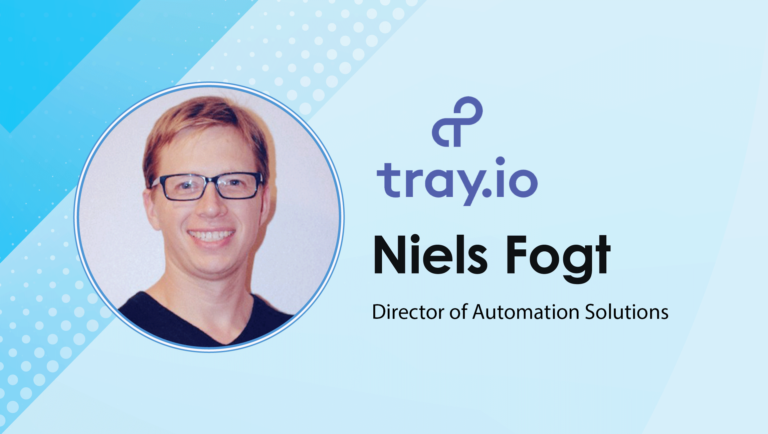
SalesTechStar Interview with Niels Fogt, Director of Automation Solutions at Tray.io

Niels Fogt, Director of Automation Solutions at Tray.io chats about the importance of tightening operational issues to drive better business and sales effectiveness:

_________

Welcome to this SalesTechStar chat Niels, tell us about yourself and more about Tray.io – how has it evolved over the years?

I spent my early career in this formative role as a digital strategist at a boutique design firm servicing the startup world. We worked at a breakneck pace, so I was exposed to all these amazing startups in a really short period of time. Eventually that burns you out, but it really helped me see how the sausage was made inside these companies and I was hooked, I wanted in.

I joined New Relic just before their IPO as their head of web strategy and my role grew into one which was focused on servicing their self-service user base. We built a data team over there to make that work and that’s where I found Tray.io.

We were doing reverse ETL before it was cool—all on the back of Tray.io—and I was just blown away by what this platform could do. As a technologist, I found Tray.io gave me these super powers where I could create these solutions on our existing revenue stack which would have previously been relegated to custom engineering or procuring some purpose-built solution. I was hooked, I wanted in—you know the drill.

I joined Tray.io because of a deep belief in the product and have been building RevOps automations here for the last four years. Our mission at Tray.io is to create a world where anyone—regardless of their technical skills—can solve the business challenges in their day-to-day operations, eliminating the constraints of poorly adapted technology. Tray.io is a low-code, cloud-first approach to automation that is delivered on a scalable, resilient and secure platform. Both line-of-business and technical users can take advantage of the power and flexibility of the platform to connect systems and build automations that provide a faster and more efficient way to do their jobs and achieve business results. By placing the power to develop automated workflows and integrations into the hands of everyday users, businesses can unleash a torrent of productivity and creativity within their organizations.

Anyone solving business departmental process challenges like streamlining Revenue Operations, fast-tracking HR onboarding, transforming finance order to cash, or automating IT user provisioning no longer have to rely on developers to do this work or deal with the back-end complexity of integrations—such as testing, error-handling, logging, resiliency, cost and security. Instead, they can focus on taming complex business logic and delivering impactful outcomes.

When it comes to enhancing the typical B2B lead lifecycle and journey, what do you think B2B sales teams need to be doing more of?

Sales teams should be focused on personalization and responsiveness. The market is undergoing a rapid evolution in customer expectations—B2B buyers increasingly expect a personalized, B2C-style experience from every vendor interaction. However, today’s bloated tech stacks, manual lead lifecycle management processes and suboptimal workarounds have become a burden on sales teams—negatively impacting sales efficiency and the customer experience.

We recently completed a study that found over 95% of companies report revenue loss due to operational issues related to lead lifecycle management. This revenue loss is primarily due to inefficiencies in the many steps involved in delivering leads through the sales cycle from initial capture to the point of sale. In my experience, monolithic platforms and outdated approaches to lead lifecycle management exacerbate these issues and often lead to a disjointed buyer experience. By combining low-code automation with best-in-class martech, sales teams can maximize the efficiency of their tech stack and ultimately enhance the customer journey.

There are two specific areas teams can focus on to improve the lead lifecycle process and customer journey. The first is automating lead-to-account matching and focusing heavily on engaging with their highest-value leads. With an automation solution in place, leads are routed to sales more efficiently and sales can easily sort leads by revenue potential. Less valuable leads can receive slightly less, but still high-quality, engagement, carried out via automated messages and supplemented with calls as needed. By automating less valuable interactions, sales team resources are freed up to deliver personalized and timely experiences to potential high-paying customers.

Second, teams should automate lead routing to reduce breakages and delays in the lead lifecycle. Any momentum gained during the early stages of the lead lifecycle can quickly be erased by lead routing inefficiencies or errors, and breakages during this critical stage make it seven times less likely that a sales team will speak to decision-makers. Teams should lean on their automation tools to minimize the time sales reps spend waiting idly for a new lead and to reduce the likelihood of human error.

By removing these two frequent pain points from the sales process, companies can drastically reduce their risk of breakages and delays and increase their chances of successful sales.

Read More: Benefits of a Channel Partner Ecosystem in B2B Tech

Can you talk about some of the most commonly missed best practices when it comes to lead lifecycle management?

There are three best practices companies should implement to combat inefficiencies in their lead lifecycle management processes and remain competitive in today’s market:

  1. Prioritize B2C-style buyer experiences: As I stated previously, today’s B2B consumers expect the same frictionless experience when buying business tools as they do when making purchases in their personal lives. B2B organizations are under more pressure than ever to keep up—the customer experience, which has traditionally been represented by a funnel, is becoming more of a cyclical, “merry-go-round” journey that marketing and sales teams must always keep running, but companies are struggling to keep up. Pervasive issues in their lead lifecycle management process continue to impede companies from providing the speed and customization that today’s consumers demand.

To keep up with this rapidly evolving B2B buying journey, sales teams must embrace automation to gain the necessary visibility into each customer’s place within the customer journey. Automation’s role is to drive the choreography of specific sets of activities that can deliver a highly personalized, highly relevant customer experience, ultimately delivering the prized and elusive “excellent customer experience.”

  1. Think about scale, customization, and ease of use when vetting integration and automation solutions. While out-of-the-box automation solutions typically require smaller initial investments, these products often lack customization capabilities, struggle to handle complex automation tasks, and cannot scale in the long run. Alternatively, monolithic legacy iPaaS products are often expensive, code-intensive and require developer-only SDKs, which significantly hinders development velocity. Similarly, developing in-house solutions tends to be equally inefficient, requiring teams to spend excessive time building and maintaining integrations and automations, while oftentimes struggling with a lack of engineering resources.

When buying an integration and automation solution, companies should look for one that is cloud-first and offers the flexibility and scalability needed to create complex workflows and handle large volumes of leads, while also being accessible to line-of-business and technical users alike.

The right low-code tool allows teams to streamline the processes and workflows in their lead lifecycle, enhancing everything from the speed at which they can route leads to the accuracy of lead data.

  1. Delegating too many of your key lifecycle processes across point solutions and sources of truth. The lead lifecycle is deceptively complex. There’s a lot going on between the point of lead capture through the remainder of the buying journey. There are marketing ops teams managing part of the lifecycle via marketing automation platforms (MAPs) and sales ops teams managing the remainder through CRMs, with all sorts of point solutions tacked onto the side to handle things in between. You end up creating this complex network of processes that you’re trying to choreograph “from behind”—meaning you’re trying to orchestrate these processes in multiple systems in an asynchronous manner. Your automation platform should be an abstraction layer to your revenue systems, putting you “in front” of the process—dictating exactly what happens across these systems. We have a very large multi-national B2B customer that’s taken this approach with an 80k lead/month business—getting 99% of their leads from inbound to the sales floor in less than three minutes, that’s an amazing achievement in my opinion.

Tray.io recently released a new low-code solution to enable the above, can you share a few highlights?  

Absolutely—Tray.io’s new solution addresses the operational challenges and process complexities teams face during the lead lifecycle management process to fix leaky lead funnels and recapture lost revenue. With Tray.io’s new Lead Lifecycle Management features, RevOps teams can tap into the power of low-code automation and integration to break down interdepartmental silos, gain full visibility into the buyer journey, deliver personalized experiences to leads and unlock revenue.

The new features available on the Tray Platform allow teams to focus on their core competencies and building engaging and personalized experiences for buyers while ensuring timely follow-up with leads. These features include:

  • Seamless connectivity across best-of-breed tech stacks that allows users to easily integrate each tool used in their sales and marketing processes to create cohesive and efficient RevOps workflows.
  • Eighty plug-and-play, standardized templates that offer the flexibility to accurately capture leads from virtually any source—including Excel, LinkedIn and Google Sheets—and record them in CRMs and Marketing Automation Platforms, despite each lead’s unique, source-created properties. The low-code nature of these templates allows for rapid workflow creation across many lead sources into a single destination, all while ensuring data integrity.
  • Purpose-built connectors for key marketing, sales and revenue tools to connect, integrate and automate more of RevOps processes across the tech stack through deeper and broader support for AdRoll, Gong, Showpad, Iterable, Amplitude, Salesforce, HubSpot, Shopify, NetSuite and more.
  • Streaming log data for error handling and greater transparency into process bottlenecks. Now, teams can programmatically stream log data at the step and automation level to quickly diagnose issues—without having to triage each individual application—and gain real-time updates, enabling quick and efficient problem solving.

Read More: SalesTechStar Interview with Ketan Karkhanis, EVP & GM, Salesforce Sales Cloud

A few thoughts on the biggest tech trends within B2B sales and marketing today?

Digital transformation, accelerated by the pandemic, has resulted in unintended consequences across organizations. Specialized SaaS applications intended to bring products to market faster, increase revenue, manage costs and reduce risk have led to teams spending inordinate amounts of time trying to reconcile conflicting data from different apps and settling for business processes that work the way software vendors believe employees should work, instead of how employees want or need to work to be efficient.

At a time when cost saving and operational efficiency are top of mind, we’re seeing companies turn to the power of low-code automation and integration to align their sales funnels, increase sales productivity and sell more efficiently, and ultimately improve customer retention.

By adopting a low-code approach to streamlining lead lifecycle management, sales, marketing, customer success and RevOps teams—who already have extensive knowledge of their unique tech stack needs—can design and deploy their own powerful integrations and automated workflows that fit their unique process requirements.

There’s this movement I call “the great abstraction”—where vendors like Tray.io, those in the CDP (customer data platform) space, the cloud data warehouse world, etc., have all created these amazing tools that help companies deal with this influx of customer data. Historically, we’ve had these monolithic systems that try to do it all—then we have best-in-breed tools trying to tap into those monoliths via native integration, but the whole thing simply becomes this slow moving beast that inevitably falls short given the pace of change. What we’re all trying to figure out is how to make the best use of it all. This is where “the great abstraction” comes in—this new class of data abstraction tooling is allowing us to delegate the movement and choreography of our customer data, agnostic of the systems of record, and engage faster than ever before, in the way we need it to work. Your process automation can sit above it all—not down in the CRM or the MAP or whatever other system whose job should be more narrowly defined. RevOps teams need to prioritize having the skills to manage these tools, just like they hired CRM administrators.


The Best API Integration Platform for Leading Enterprises | Tray.io

Tray.io is low-code automation that can easily turn unique business processes into repeatable and scalable workflows that evolve whenever business needs change. Tray.io’s flexible, self-service platform makes it simple to build integrations using any API and connect enterprise applications at scale without incremental costs. The Tray Platform empowers both non-technical and technical users to create sophisticated workflow automations that streamline data movement and actions across multiple applications. Freed from tedious and repetitive tasks, product leaders and IT are able to up-level their skill sets with automation to unlock their full potential.

The last 15 years of Niels’s career has been focused on mid- to late-stage startups, where he has found a niche helping organizations marry their customer data and revenue systems in support of their go-to-market strategy. Both as a customer, and now employee, of Tray.io, Niels has leveraged its low-code automation platform in this pursuit. As the Director of Automation Solutions, Niels has built an automation center of excellence inside Tray.io and now leads the company’s Builder Experience team, whose mission is to help Tray.io customers and prospects realize the many benefits that come with running automation at scale inside their organizations.

Missed The Latest Episode of The SalesStar Podcast? Have a quick listen here!


Episode 158: Optimizing Sales and Brand Journeys with Ken Hohenstein, CRO at OneStream

Episode 157: Inventory Optimization and Its Impact on Supply Chains with Richard Lebovitz, President and CEO, LeanDNA


Episode 156: Purpose-led Advertising Fundamentals with Julia Hitchman, Chief Commercial Officer at Good-Loop


Sycurio.Voice Now Available as Genesys Premium AppFoundry Application

Sycurio.Voice Now Available as Genesys Premium AppFoundry Application |  Business Wire

Sycurio’s secure payment capabilities combine with Genesys Cloud CX enabling customers to improve their experiences and take secure, PCI DSS compliant payments anywhere

Sycurio™ the leading provider of data security and compliance solutions for call and contact centers, today announced Sycurio.Voice, a Payment Card Industry Data Security Standard (PCI DSS) compliant payment solution for voice transactions, is now a premium application on the Genesys AppFoundry™, a marketplace of solutions offering a curated selection of applications and integrations that elevate customer and employee experiences.

Sycurio.Voice makes it easy for Genesys customers to take secured PCI DSS compliant payments while improving agent productivity, CX and trust, as well as dramatically reducing the costs and complexity of regulatory compliance.

Sycurio solutions are engineered to integrate seamlessly with the Genesys Cloud CX™ voice services and call center infrastructure, and payment service providers/gateways – providing the most secure and frictionless means of completing secure transactions over the phone. With its patented technology, the company secures millions of payment transactions and keeps payment card and bank account data safe. Sycurio helps organizations descope their call centers and meet their PCI DSS compliance obligations, improve operational efficiency, and deliver seamless customer experiences. By eliminating the need for company representatives to see, hear, or handle personally identifiable information (PII), Sycurio prevents storing, transmitting, or processing sensitive data within the business infrastructure, removing it from PCI DSS scope and reducing the risk of potential breaches and fraud.

Read More: Prime Focus Technologies Launches CLEAR Localize At NAB 2023

“We’re delighted to deepen our technical partnership with Genesys through our Premium App integration; enabling Genesys customers to take secure and compliant payments directly from the Genesys platform,” said Edward Sweigart, CRO at Sycurio. “It’s now more important than ever that security and customer experience are inseparable, and organizations provide a frictionless payment experience for every customer journey – our enhanced integration makes accomplishing that much easier.”

Read More: SalesTechStar Interview with Scott Little, Chief Revenue Officer at WalkMe

Sycurio.Voice is now available with Genesys Cloud CX™, an all-in-one composable solution that helps organizations offer frictionless and connected customer and employee experiences. As a modern, API-first experience orchestration platform, Genesys Cloud CX enables organizations to coordinate every interaction and touchpoint through a full suite of omnichannel options, built-in employee experience, turnkey AI and end-to-end journey optimization.

Write in to psen@itechseries.com to learn more about our exclusive editorial packages and programs.