New research from Return Path shows sender reputation and email deliverability are tightly linked
Email data solutions provider Return Path released its 2019 Sender Score Benchmark. Using comprehensive data from Sender Score and Return Path’s Reputation Network, this annual report provides expert analysis and insights on how reputation impacts inbox placement for commercial email senders.
“Email remains the marketer’s go-to channel. But if email doesn’t reach the inbox, brands lose the opportunity to connect with customers and ultimately make a sale—so every message counts”
Based on analysis of more than 4 trillion email messages, The 2019 Sender Score Benchmark reveals that highly reputable email marketers are far more likely to reach their intended audience than peers with lower reputation scores. For example, senders scoring 91-100 (the best possible reputation score) had 91 percent of their messages delivered. This figure drops to 71 percent for senders scoring 81-90, and 44 percent for senders scoring 71-80.
“Email remains the marketer’s go-to channel. But if email doesn’t reach the inbox, brands lose the opportunity to connect with customers and ultimately make a sale—so every message counts,” said Tom Sather, senior director of research at Return Path. “Since the initial Sender Score Benchmark Report in 2012, our research has consistently shown a clear link between reputation and deliverability. That’s why monitoring your reputation and maintaining it at the highest level possible is critical to email marketing success.”
Spam complaints are one important factor used by mailbox providers in determining which messages are unwanted and should be filtered to the junk folder. Not surprisingly, there is also a strong correlation between spam complaints and sender reputation. While year-over-year spam complaints were higher across the board, senders scoring 91-100 had an average complaint rate of just 0.9 percent. For senders scoring 81-90, this metric jumped to 4.7 percent—more than five times higher than the best senders.
“Mailbox providers face competition just like any other business, so they are constantly improving their filtering algorithms to create a better inbox experience for their users,” continued Sather. “Sender reputation offers unique insight into the source of each email, making it a key factor in those filtering decisions.”
The overall quality of email has increased dramatically since Return Path’s first Sender Score Benchmark Report. In 2012, that report found that 60 percent of all email was sent by the least reputable senders—those with a Sender Score of 10 or less—while the best senders accounted for just six percent of total volume. Today, 42 percent of email comes from top senders, while email from the least reputable senders is down to just 16 percent. This shift can be attributed to the evolution of filtering technology and an increased focus on sender reputation at the mailbox provider level, all of which has made it more difficult—and far less profitable—for spammers to deliver their messages.
TV Viewership Data Incorporates Kantar, Drawbridge Data, and Premium Demographic Attributes to Deliver Robust Partner-Agnostic Solutions to Market
TiVo Corporation, a global leader in entertainment technology and audience insights, announced that its TV Viewership Data product is being expanded to include Kantar ad occurrences, Drawbridge’s Identity Graph and premium demographic attributes; giving TiVo customers an expanded data offering with more flexibility to meet the ever-changing needs of the market.
“Household-level TV data is becoming more attractive as the advertising and media industries look to connect consumer touchpoints across screens, platforms, and campaigns across the TV ecosystem”
The availability of premium demographic attributes through TiVo’s relationship with best-in-class partners enables advertisers to supplement anonymous household viewership data with additional insights around demographics, consumer preferences and behaviors, providing contextual audience insights that better connect advertisers with relevant target audiences.
The Kantar ad data enables customers to now know both the programming viewership as well as the advertising viewership across millions of US households.
The Drawbridge Identity Graph enables customers to link viewership data with associated mobile ad identifiers, extending the reach and measurement of advertisements and marketing across pay-TV, OTT, and digital platforms.
“Household-level TV data is becoming more attractive as the advertising and media industries look to connect consumer touchpoints across screens, platforms, and campaigns across the TV ecosystem,” said Ben Maughan, VP business development and data product management, TiVo. “TiVo’s unique TV Viewership Data has been a leading innovator in the space and is constantly evolving into a more robust offering.”
“Marketers rely on Kantar’s industry-leading ad intelligence data to track competitive activity in their sector. By connecting with TiVo TV Viewership Data, we can give our customers a holistic view of what messages consumers are receiving,” says Vik Sharma, SVP for media and tech at Kantar. “We’re excited to continue providing clients with ad exposure data on a set-top-box level through our arrangement with TiVo.”
“TV’s power as an awareness channel is clear, but it’s long been missing the component of identity,” said Jon DeGennaro, VP of enterprise partnerships at drawbridge. “There’s no reason why TV can’t be as targetable and measurable as other platforms and give marketers the ability to reach and report on viewership, engagement, and conversion across the entire cross-channel consumer journey. Bringing identity to TV does just that. We’re excited to be partnering with TiVo to enable these crucial tools.”
With these integrations, TiVo solidifies its role as an innovator in the TV data landscape and continues to deliver improved viewership data products that are partner-agnostic and consistent with the transforming industry.
Email validation service ZeroBounce provides marketers with an efficient solution to validate catch-all email addresses. By using artificial intelligence, the company’s email scoring system assesses the activity levels and overall quality of an email address.
“ZeroBounce A.I. works whether you need to validate catch-all emails, or get in-depth analysis of your data quality. We wanted our customers to gain an edge over their competitors and create more powerful email marketing programs”
A unique challenge in B2B marketing is the presence of catch-all email addresses. Organizations configure them to ensure they capture all email sent to their domain, including to nonexistent accounts. Despite the positive intended purpose, catch-all emails can result in bounces, thus jeopardizing sender reputation and email deliverability.
“Email validation is the best first step marketers can take toward higher data quality. We are happy to provide them with a secure and accurate email validator. Some databases have astonishingly high numbers of catch-alls. Our customers asked us to create a solution to further investigate these emails. We created ZeroBounce A.I., our artificial intelligence-powered scoring system, to address this very issue,” says ZeroBounce CEO Liviu Tanase.
ZeroBounce A.I. analyzes granular aspects of an email account to return a quality score. The score ranges from 0 to 10 and is a relevant indicator of an email’s validity and activity levels. This generates confidence in segmenting, emailing and tracking.
The system is equally effective when it comes to rating the quality of other types of addresses. “ZeroBounce A.I. works whether you need to validate catch-all emails, or get in-depth analysis of your data quality. We wanted our customers to gain an edge over their competitors and create more powerful email marketing programs,” adds Tanase.
With its predictive quality score, ZeroBounce A.I. helps marketers to:
• receive further information on the catch-all email addresses in their lists
• gain perspective on how subscribers will engage with email content
• increase conversions by allowing better segmentation and personalization
ZeroBounce A.I. launched in June 2018 and has served numerous email marketing specialists worldwide.
New Platform Extends Access to Communications Capabilities through Pre-built Tools and APIs
Brightlink, a leading communications platform and technology company that delivers voice, messaging, analytics and cloud-based solutions, has made it easier for businesses to integrate communications capabilities into their customer engagement strategies through the 2.0 release of its Communications Platform as a Service (CPaaS) Platform. Prior functionality in Brightlink’s CPaaS Platform available via the Brightlink Phonebook is still available, such as the ability to acquire and activate phone numbers and enable business messaging, and is now enhanced with added features and improved user experience.
“We remain committed to enhancing our CPaaS technology and platform, and our latest release takes self-service to the next level to give businesses a competitive advantage,” said Rob Chen, CEO of Brightlink. “Our new platform enables companies to easily access and integrate communications capabilities into their business processes – in a matter of minutes – and provides a differentiated CPaaS user experience for enterprises.”
Brightlink’s CPaaS Platform includes a robust set of APIs coupled with an easy-to-use web user interface from which companies can easily choose and activate hundreds of phone numbers for immediate use and then enable critical features such as business texting to support marketing and customer engagement.
According to a Harris Interactive poll, 64% of consumers are likely to perceive a company contacting them via text in a positive light. Meanwhile, 75% of Millennials would rather communicate via text about things such as appointments, deliveries and coupons, according to Mobile Marketing Watch.
“Companies today that haven’t enabled their business numbers for texting are missing a critical component of their omnichannel customer engagement strategy, especially if they want to reach digital native consumers and end users,” said Chen.
Brightlink’s CPaaS Platform 2.0 release includes four major areas of capabilities:
Voice API Manager, which allows for easy provisioning and porting of numbers and supports call forwarding, E911 Registration, Caller ID Registration and the ability to search for vanity numbers and number ranges leveraging Brightlink APIs
Messaging API Manager with pre-built access to Brightlink APIs to activate and enable SMS/MMS messaging on any number, including landlines
SIP API Manager, which enables activation and management of SIP trunks utilizing Brightlink APIs
API Command Center, which provides direct API access and supporting resources such as API reference documents
Platform Helps Retailers Predict Store Performance
Marketsmith Inc., one of the nation’s leading woman-owned, data-science-driven marketing agencies, announced the introduction of its most recent marketing technology product, Retail Intelligence.
The company’s third new product introduction this year, after Dynamic Scorecards and Data Science and Modeling, Retail Intelligence is designed for manufacturers and specialty retailers to optimize their in-store performance by providing insight into trending and performance in each store, and across stores, on a daily basis.
“Our retail clients now have the ability to understand true performance, maximize their profit and mitigate their risk through data,” explains Marketsmith CEO and Founder Monica C. Smith. “Our Retail Intelligence platform layers decades of experience in driving retail success to supercharge outcomes for clients using our MarketsmithIQ suite.”
Retail Intelligence is a proven, AI-powered platform that delivers the data and analyses that manufacturers and specialty retailers need to get a complete, detailed view of their business performance across all key functions, allowing them to maximize profit and stay ahead of the competition. This data also allows Marketsmith to accurately predict store performance and highlight potential risks and rewards.
Says CIO Carina Pologruto, “We’ve worked intimately with retail data for 20 years and used our deep understanding of data sets to create a transformational product that delivers fast, actionable insights quickly and easily.”
Retail Intelligence is the company’s latest technology product innovation this year, and more are in the pipeline.
Marketsmith Inc.’s media platform, MarketsmithIQ, is patented technology that delivers clients unprecedented media measurement, benchmarking, visualization and optimization. Holding five U.S. patents, it gives clients a clear line of sight on their media investment and its performance with complete transparency, in near real time. In fact, the MarketsmithIQ Media Mix Model can predict sales based on media spend and marketing activity with 93 percent accuracy.
On the heels of announcing an industry-first developer platform and partner program, Percolate reveals Percolate Insights – Powered by Domo, an analytics solution that harnesses the power of data for marketing execution
Percolate, the leading enterprise Content Marketing Platform, announced a partnership with Domo – provider of the leading cloud-based operating system for business – and the relaunch of their analytics product as Percolate Insights – Powered by Domo.
The new solution (available Q4 2019) will introduce a new caliber of reporting to the daily workflows of marketers at enterprise companies and enable marketers at all levels of the organization to make data-driven decisions. In addition, Percolate Insights delivers new operational and strategic metrics that open up new visibility into campaign strategy, marketing mix, and productivity.
“All marketers today aspire to be more data-driven in their decision making, but in an enterprise there are many barriers to accessing and actioning insights,” says Randy Wootton, CEO of Percolate. “Percolate Insights puts the most powerful reporting tool in the hands of marketers–ensuring the data is contextual and relevant–so that marketers can apply unique insights to the critical business decisions they make each and every day.”
“Marketers are always seeking innovative ways to bring together the massive amounts of data from their marketing operations and to make real-time, strategic decisions with that information,” said Jon Shoff, vice president of Agency Sales and Partnerships at Domo. “Percolate Insights – Powered by Domo is an opportunity to provide a more powerful solution to marketers by giving them the power of collaboration and visibility paired with rich insights from their data.”
According to a recent article, Sales Representatives rank #3 in the list of Best Sales and Marketing jobs in the US. In 2017, Sales Representatives made a median salary of $56,970. This means if you are a sales rep, you are among the best-paid 25 percent salary bracket. However, it takes some special skills to top the list. Becoming the best salesperson in the world depends on a fine mix of personality traits, knowledge, skills, leadership, and command over technology.
Best Salespersons are best at what they do– on and off their desk. They showcase immaculate personality traits that they possessed and/or acquired through their journeys in sales. There are countless books and articles on how to be a great salesperson. We have expanded these ideas and got them all under one rood to help you become self-aware of what a great salesperson actually looks like.
Yes, it can be you.
Learning and Self-Development
Best salespersons are obsessed with learning and experimenting with what they learned. Self-development based on constantly reading and following great writers helps. Great sales book for business leaders let out money-making secrets; best salespeople read dozens of books in a year to learn this distilled wisdom of making money.
Intuitive
How good are you with sniffing out hot accounts and filtering out cold ones? More than what CRMs can tell you, your intuitive prowess would help you to save time chasing the best accounts.
Great sales reps are driven by strong intuitions in their workplace. They single-handedly chase an account and close deals that are similar in their profiles. To be the best salesperson, you have to clearly understand the “Psychology of Selling“.
Brutally Honest
Do you feel guilty about cannibalizing your sales colleague’s commissions? And, then you reject the commission? Do you say sorry for not putting the right numbers and projections during the quarterly meetings?
If yes, you may not have earned a lot of praise from the team, but you will win the Honesty plank in the long run. And that’s what makes great salespeople survive and thrive.
Best sales people don’t beat around the bush. Driven by honorable principles of honesty and truthfulness, great salespeople empathize with their team members and customers. The traditional stereotype of ruthless salespeople telling lies to sell is long blown away. Best sales people customers what it really feels like to own a product, even if it means counting them a few shortcomings.
Work Culture
Punctuality is one great personality trait that can turn an average sales professional into a great leader. It does not take much to stick to meeting time goals. Simply sticking to punctuality goals can out you on RADAR of your boss, team members and eventually your partners and customers. How?
Count the number of times you have been late to your scheduled calls?
How many times have you missed your team deadlines?
Do you often find yourself constantly apologizing to your team members and customers about late delivery or missed delivery?
If you have more than five such incidents, you have to work hard on your punctuality.
Within a month, you should see a drastic change in the way your sales deal shape up.
Personal Obligation to Respond
In a constantly connected business ecosystem, salespeople are expected to be on top of their emails, chats, and phone call schedules. Every call is a potential sales deal. It could be a new customer or your existing one. If your team member is slow to move the needle on the deal, help him/her out. make it your personal obligation to respond to the smallest of customer requests. Soon your customer-centric approach would positively brush over peers as well.
Accountability
Victory has many fathers; failure, an orphan.
For the best sales professionals, they walk a different line. Best salespeople have their eyes on fixing failure first. And, they would more often than not taken upon themselves to identify the pain points and find answers to mitigate these. Accountability is critical to any role — and, it’s an under-praised virtue.
Team Player
How often do you find yourself working an extra hour to close a deal? Do you willingly participate in all the team building tasks? Do you complain often about your colleagues and boss?
If you do it more than 5 times in a month, you are losing a significant amount of energy in unproductive, mindless activities. Simply, saying Yes or No to team members can help you to decide your course to become the best salesperson in the world. When you work as a team player, your energy is synced with others. Why do you think best hunters in the past always walked and speared in tribes– because that’s what best hunters do. They hunt in packs. Even, lions.
So, to be a lion in your sales job, stick to your team aspirations and influence with energy, dedication, and discipline.
Remember: Best salespeople learn from the best to hunt with the best.
Optimistic
Do you expect perfectionism in your team and demand targets are met in time? Do you glorify your achievements by saying you are always right with setting and meeting targets?
Best salespeople are humanly flawed– they take everything with a pinch of salt, especially failure to meet targets. It may sound unbelievable for new sales groups, but optimism is a key personality trait that instills positivity and motivation. In his book How to Win Friends and Influence People, Dale Carnegie expresses the true meaning of optimism and how it automatically assumes leadership.
Consistent
Consistency is a habit. If you are consistent with your good work, you will see great results. Steven Covery’s The 7 Habits of Highly Effective People: Powerful Lessons in Personal Change, you can learn why consistency is such a sought-after personality trait. Best salespeople grow beyond the proverbial managerial balloon juice to deploy consistent hard work, sales practice and build information around these to close deals and win loyal customers.
When you are consistent, you can measure what is working and what didn’t. Isn’t it true?
Persistent
Do you wonder what if I persisted a little longer, and it would have been mine to cherish?
Best salespeople don’t ponder thinking “What If?”
They are go-getters and chasers of the best quality. They are committed, driven and persistent. Just like consistency is a key personality trait seen in the best salespeople, persistence also refines your selling skills. Persistently following-up with customers, making them aware of your latest work and so on, can actually drive results.
They have a life!
Yes… best salespeople find their motivation to excel from their hobbies and activities outside of work. Playing competitive sports, vacationing once or twice a year, writing sales blogs or doing great interviews on Sales journeys open new avenues for you to build great sales ideas. Likewise, you read books on sales and watch interviews of great salespeople. Best personality traits in a sales pro are known from what they do in other spheres of life.
A friendly, conflict-free personal life is an inspiration to juniors, peers, and colleagues in the sales community.
Influencer and Power Connectors
Best salespeople and leaders in SalesTech are great influencers. They just hob around their business or how great their company is, but also say great things about others, especially competitors and partners. It’s a great personality trait in sales to truly connect like-minded people discussing business and management. People believe what they say or write. They are almost talking from a high-tree, helping businesses to find a synergy in their ongoing operations. Why just Sales? They are great power connectors in Marketing, Events, Technology and Hiring too.
When you get acquainted with Sales leaders who exude these personality traits, you will be charmed to learn more from these. Embrace the human way of selling and learning the art of leveraging technology — and voila, your personality traits would bloom, benefitting everyone you interact with.
SimplyCook, Made.com, Abel & Cole and Birchbox lead the UK ‘direct to consumer’ movement
Research into consumer awareness of ‘direct to consumer’ (DTC) brands by Rakuten Marketing reveals four of the top five names are local, UK businesses, putting them ahead of global brands Glossier, Harry’s and Casper.
Conducted among 2,000 UK consumers and a further 2,000 in France and Germany, the study proves that despite recent headlines, the top global DTC brands are lesser known than SimplyCook, Made.com, Abel & Cole and Birchbox. Global business, Dollar Shave Club – the DTC archetype – also makes the top five.
When it comes to sales, the research also confirms the efficacy of the DTC business model – for example 28% of UK respondents who recognise Birchbox have also bought from the company, 27% have bought from SimplyCook and 24% from Made.com.
% of all UK consumers who have heard of the brand
Of those consumers who have heard of the brand, % who have made a purchase
SimplyCook
50
27
Made.com
44
24
Dollar Shave Club
43
22
Birchbox
35
28
Abel & Cole
35
21
Harry’s
32
26
Tails.com
26
33
Casper
20
23
Glossier
16
26
Brushbox
15
21
High conversion channels
Looking at where consumers actually convert, the numbers are an almost even split. While 17% of consumers profess Facebook is their most likely point of sale, 12% still rely on the brand’s own website and 14% prefer cashback sites and voucher / discount code sites, highlighting the role of affiliate marketing in driving conversions.
Anthony Capano, managing director, EMEA at Rakuten Marketing explains, “DTC brands have historically relied on performance-based digital advertising strategies. Huel was started when founder, Julian Hearn, sold his affiliate marketing business to fund his successful business venture. Now, many leverage high return publishers to target audiences with direct response ads to drive conversions.”
Importantly, performance marketing should not be seen through the linear lens of social and discount sites. MoneySavingExpert is a great example of a consumer advice publisher where as many as one in ten consumers are most likely to click and buy from a DTC brand.
Fashion label Meli Melo is undertaking the move towards a DTC business model. CEO of Meli Melo, Doug Ker, comments, “Brands who can orientate campaigns through affiliate marketing with key business objectives stand to benefit the most. Focusing on what really matters, Meli Melo has been developing close relationships with regional publishers offering the most relevant and engaged audiences in different regions, for example in APAC, which puts our brand in front of our premium international buyer.”
Looking at the channels that have catalysed awareness for these brands it’s clear social media still plays a heavy role. 44% of UK consumers place Facebook as a platform that has raised their awareness of DTC brands. YouTube (31%) and Instagram (28%) are close behind.
Celebrity social media endorsements are one of the most familiar social media expenditures among brands. In fact, more respondents (11%) backed micro-influencers – those with up to 30,000 followers – as an effective means of raising their interest in DTC brands, supporting findings from a recent Rakuten Marketing study into influencer marketing.
Doug Ker explains, “The targeting available through social platforms is like nothing many retailers had encountered before. However, as these tools mature, they are also becoming more expensive, urging independent brands such as Lush, to consider whether there are more efficient solutions to reaching core segments of their audience.
“It’s ultimately an extremely high reward approach to sales, but the close relationship between awareness and purchasing doesn’t solely exist in the realm of social media.”
In B2B, the lead generation form is an important gateway between your site and the visitor. Learn how Google Tag Manager can help in B2B Sales.
Stop killing your customers!
Think of a scenario where you’ve built a bridge to have a cohort of voyagers cross-over a deep chasm over to the Promised Land.
The voyagers are already in the know about the benefits of living in the Promised Land, and how their desires can be fulfilled to the tee, once they reach there.
There are several other bridges that offer to cross the chasm and offer benefits, but you are sure that your bridge is the best approach to the land.
Now you’ve spent a lot of money & resources to build a bridge just like there are several other bridges. You continue to spend more money & resources to entice people to your bridge, cross over it, and join you to the Promised Land.
Each of these bridges has competitive charges to enter the bridge, but how does one manage to prove to the audience that your bridge is the right one!
For your website, the bridges that we are talking about are the forms, and the Promised Land is a great user experience which will ultimately translate into a better Conversion Rate & by extension, business success.
Businesses would not dare to invest on bridge access that does not guarantee a fantastic return on investment, is not robust enough as a strategy or not engaging enough for the users that have come so far in their journey to reach the Promised Land.
This is what you need to ask yourself if your bridge makes the cut or not:
Is your bridge attractive enough? (Are your form fields enticing enough or encouraging enough for the visitors to punch in their data?)
Is your bridge able to handle the entire cohort of voyagers efficiently? (Does your form suffer from lower conversion rates or higher bounce rates?)
Are some of the voyagers abandoning the bridge midway owing to some issue? (Do you know where your users drop off while filling the form?)
Are some of the planks on the bridge, weak, prompting the voyagers to abandon it? (Which fields are causing the maximum drop-offs?)
As a digital business, you need to know the answers to these questions and have the means to derive actionable data.
This blog will help you understand the necessity of form tracking, the importance of form field analysis and the business advantages associated with its step-by-step implementation.
Most users, who stumble on to the form fields of any site, usually are in two minds – whether or not they should fill it with their details. If they enjoyed the website and the info shared on other pages, they might want to ask a query related to something they need to be done.
Once interested, they fill out a few fields but then stop midway and refuse to submit the form.
Why is that, we seldom wonder!
According to some research, most site users abandon forms altogether because of:
lack of user-friendliness
lengthy nature of forms and excessive details asked
less captivating UI/ UX design
complex captcha codes proving to be a huge hassle to understand and enter
Users often drop out if they feel they are being “forced” to do it against their wishes, especially when they are bombarded with questions they feel uncomfortable or too personal to answer.
As a consequence, users abandon form fields without even submitting the information.
Form Field Tracking – Making Sense of User Actions
Form Field tracking is a useful technique for website owners to perceive user actions through form fields organized on the website. These fields bridge the gap between business and customer acquisition.
How can it help?
Carry Out Lead Generation Tasks: In B2B, the lead generation form is an important gateway between your site and the visitor. The funnel can help you with a tangible number of queries and information processed through the lead generation form.
Figure out Abandoned Fields: From the funnel, find out the fields that users usually didn’t fill. These fields if part of the pattern needs to be altered or improved or even done away with if not necessary. Keep less clutter; make the forms simple enough and user-friendly too.
Speed up Conversion Rates: Now form submission rates are not directly increased by form field analysis but they do offer important insight to get you to improve them. Funnel Visualization helps you identify loopholes in the form and you can get your form fields to be leaner and more direct too.
Convert Visitors to Customers: Form fields are great indicators of relevant traffic/ visits. If the form fields are inviting enough and direct in their layout, they do bring in more customers. Funnel visualization can help a great deal about the visitors and how many actually filled these forms, giving you an opportunity to convert them to regular customers with a smart marketing approach.
Catalyzes Decision-making Strategies: Create a visual funnel of the Form Field analysis and then create the form accordingly. See if there is any difference in the number of leads, and then use the best approach to reframe business strategies.
Boost Business ROI: Effective forms are good enough to get people to share information without troubling them for their time. Form field analysis can actually become a wise investment for some quick business and sales too, with greater chances of better ROI.
Compelling Users to Stay Filling Form Fields is an Art in Itself!
How can you make users stay on the form and compel them to submit the form with their true details?
It looks to be some sort of magic that can compel users to share their details without actually putting them off.
I suppose nearly every business would love to know this for real, even master the dark arts or compel Voldemort to get these visitors to do our bidding. Probably not.
Form field analysis is not some sort of magical spell from the school of Hogwarts. But surely, it can get the job done efficiently.
In today’s times, the implementation of Form Field analysis can be done in a plethora of ways. But there is a road, less traveled that I believe is better than all other methods combined.
For more general information on virtual pageviews, please refer to this Google standard document.
Enter Virtual Pageview – the single most efficient Form field tracking method that relies on Google Tag Manager.
But how on earth can virtual Page Views be clubbed with form fields, you would wonder. Here is the roadmap that can help you.
What Do You Really Need?
A Google Tag Manager Account to act as a middleman between Google Analytics and website
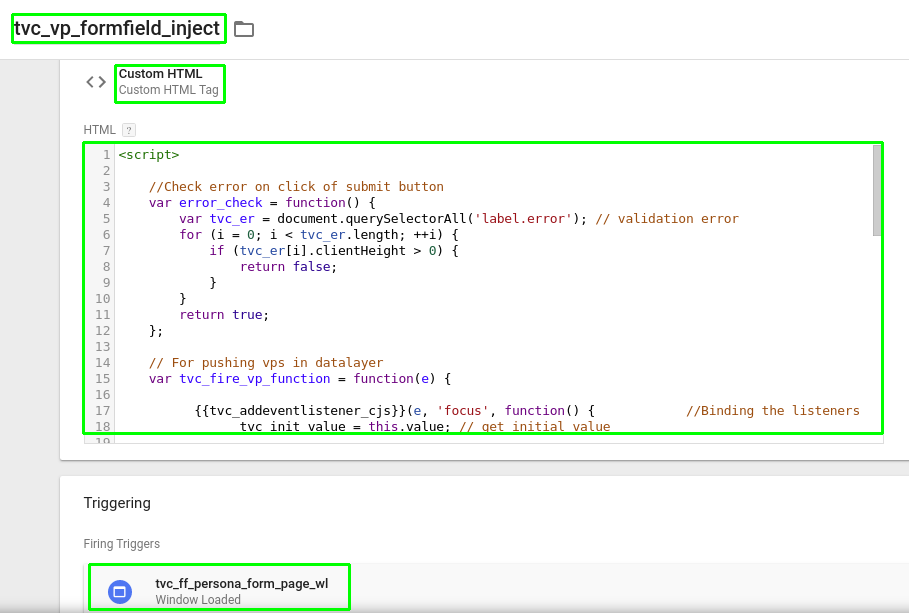
Step 1: Create Custom HTML tag – “tvc_vp_formfield_inject” to place form tracking script
Create a Custom HTML tag type – “tvc_vp_formfield_inject” and place it in the form field snippet within the script tags.
The right time to fire this tag is when you load the window as there will be several CSS selectors being used.
Ultimately it will avoid the invitation to any null selectors-related (javascript) errors. Configure a trigger of type window load event and simply provide the page URL that contains the form to be tracked.
Some script (code)nitty-gritty
The form field snippet will get all form fields, to attach listeners, validate the field on user interaction & fire Virtual Pageviews using DataLayer:
When not to fire Virtual Pageviews (VP):
When the field is empty
When the field includes some unaltered value
When to fire Virtual Pageviews (VP)
Refilled form fields- If the field includes a unique value different from the previous one or filled for the first time, then it is time fire a VP. Fire it for a particular field in a way that it has some simple nomenclature like tvcvp + fieldName. Following that, just push the dataLayer.
Successful Form Submit- Fire a VP only on successful form submission without form validation errors. This helps in knowing the final user count for a successful form submission.
Image 1: Custom HTML Tag with form field script
Note: Google automatically scans all tracking scripts of Custom HTML tags in Google Tag Manager too and discontinues them if they match known malware domains, IP addresses or URLs. Hence, you know that Custom HTML tags keep you safe and secured
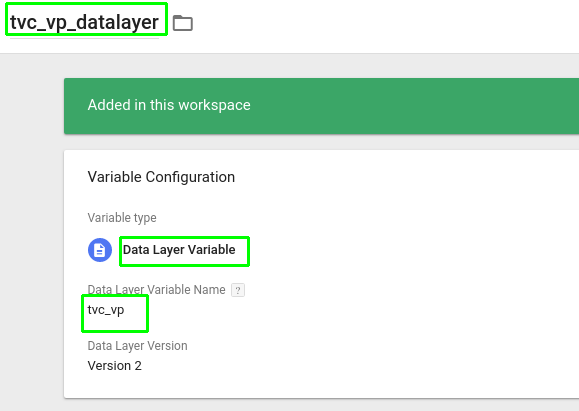
Step 2: Create DataLayer Variable – “tvc_vp_datalayer” to hold the VP name.
In DataLayer, we had a key named event with a fixed value set with every VP that fired. Why was it required? Can we capture it in Google Analytics?
Here is how it unfolded:
Create one dataLayer variable with name tvc_vp_datalayer
Image 2: DataLayer variable
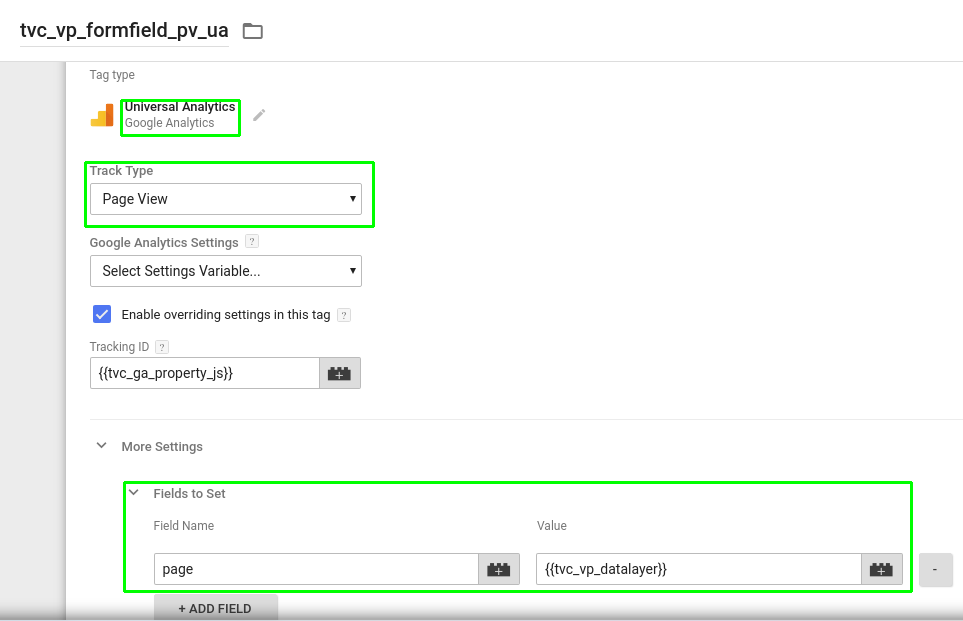
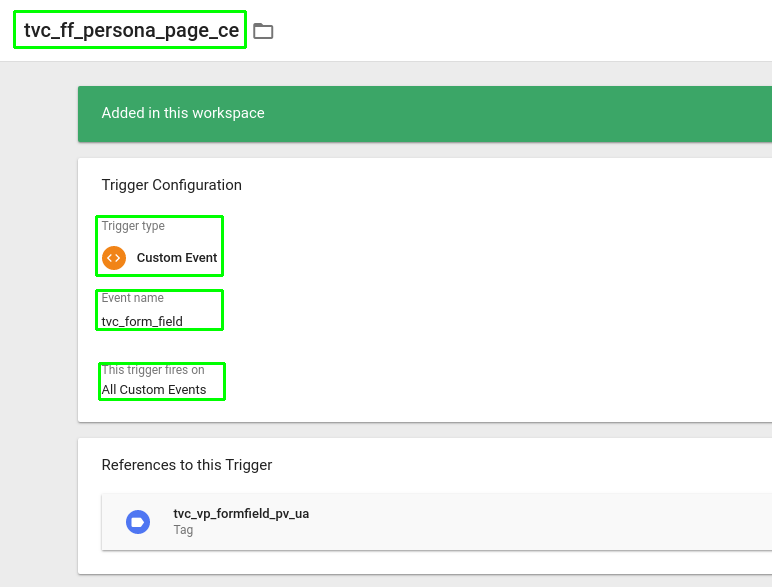
Step 3: To fire “VP”, create Universal Analytics Tag (Pageview Tag) – “tvc_vp_formfield_pv_ua” & a Custom Event Trigger – “tvc_ff_persona_page_vp” to fire the tag
It requires only one more Universal Analytics tag ‘tvc_vp_formfield_pv_ua’ with track type pageview. In the ‘Fields to set’ option, set field name as a page and pass the created dataLayer variable as its value for the virtual pageview.
Then trigger it when the event key is being pushed with the trigger type ‘custom event’, an event name & fire it on all custom events.
Image 3: Page View Tag firing the virtual pageview
Let’s see how it works
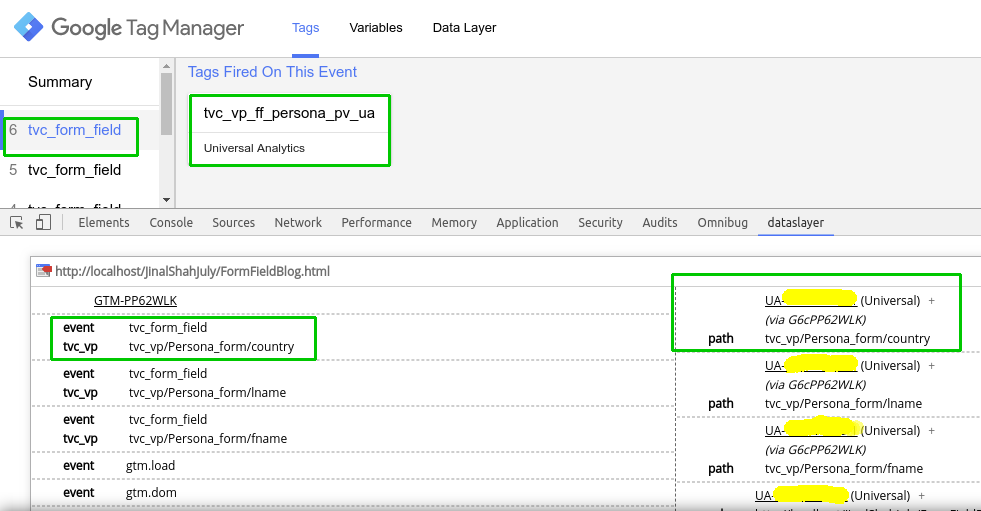
Image 5: The Outcome in the developer’s console
Form Field Setup Steps in Google Analytics
Follow the mentioned steps to configure a funnel in Google Analytics
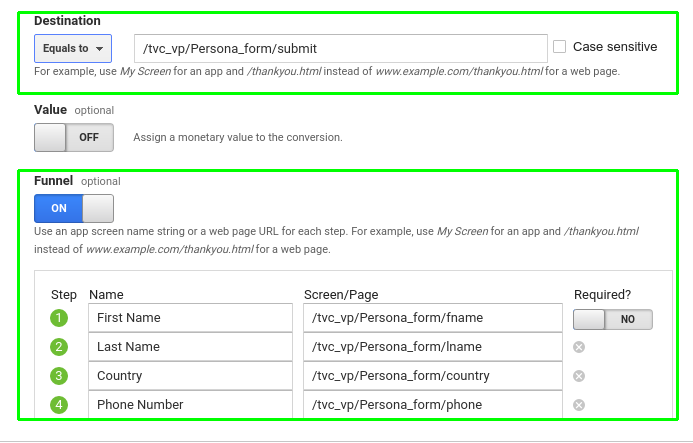
Create a Goal from View -> Goal, choose any template & goal type destination
In goal details, set destination URL, toggle the funnel button and provide the funnel steps. In the funnel, each step has a name and a page name that reflects the VP that we pushed in the script. Ensure each step has an appropriate name against the page.
Image 6: Funnel Configurations in Google Analytics
Don’t Forget This…
Don’t mark the first step of the goal as ‘required’. Keep the Goal Funnel open, or else your entire effort will go in vain. This happens because if the user doesn’t fill the first step field and instead starts from the other field, you won’t be able to track that user’s information and journey. Have a look at the above image carefully.
That’s all you need for form field tracking via VP
Let’s dive deep in Google Analytics to see what we yielded from the road less traveled…
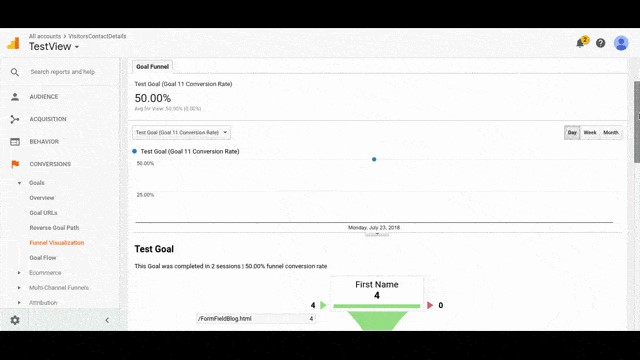
The Google Analytics Funnel Visualization Report (Conversion > Goal> Funnel Visualization) helps you identify what the majority of users cannot. Accordingly, make enhancements and apply potential fixes to keep users engaged. Keep them hooked up because small changes can make a huge impact. There are proven case studies with an exponential rise in customers too!
Image 7: Funnel in Google Analytics
Tip to reduce drop-offs (in CTAs if present in form):
You can use the form field analysis to measure the success of the Call to Action (CTA) button and then change it accordingly. But Your CTA should be classy as it is a point between conversions and bounces. So it can make or break customers. Keep it above the fold for greatest impact and be careful in using it.
Conclusion
To conclude, we have covered the essentials of form tracking, along with some tried-and-tested recipes and perks via funnel analysis. That clearly states that form tracking is a gateway to discover the success rate of a form, irrespective of the fact that it is a lead generation form, newsletter signup form, e-commerce checkout forms, etc. Ultimately, you need your bridge to perform in expected lines to get the cohort of voyagers safely to Promised Land!
Right?
Did I skip anything? Or you want to know more about form tracking using Google Tag Manager. Just sound out in the comments section below. Cheers!
Investments from Tiger Global Management & Ardian Growth to drive growth in $20B+ Spend Management software market
Ivalua, a leading provider of global Spend Management cloud solutions, announced that it has raised $60 million in growth equity funding to further accelerate its rapid growth. This capital raise values the company at a ‘unicorn’ level of more than $1 billion. Ivalua recently announced that it is on pace to exceed $100 million in annual revenue in 2019.
Investors in this round include Tiger Global Management, a new investor in Ivalua, and Ardian Growth, one of Ivalua’s early investors who increased its overall investment level. Tiger Global Management joins Ivalua’s founders, KKR and Ardian Growth as shareholders. Ivalua’s management retains a majority stake in the company to ensure stable, long term planning and a continued focus on customers.
Spend Management software has emerged as an increasingly strategic tool for businesses, boosting profitability by streamlining procurement processes, improving collaboration with suppliers and optimizing cash flow. The Spend Management market is sized at more than $20 billion and continues to develop rapidly as one of the most dynamic segments of the broader software-as-a-service (SaaS) market.
Ivalua has continued to increase its market share due to the unique advantages of its platform. The depth and breadth of its fully unified suite, combined with the unique combination of rapid delivery and unmatched flexibility, allow it to support customers at every stage of their digital transformations. The flexibility allows it to rapidly and uniquely develop and launch industry-specific solutions while maintaining a single code base. Customers realize more and faster value and never outgrow the platform, which allows Ivalua to consistently boast the industry’s highest retention rate, at over 98%, while also rapidly acquiring new customers.
Ivalua has grown while maintaining profitability. The additional funding will support future investments in organic product innovation, global expansion and possibly strategic acquisitions. David Khuat-Duy, CEO and Founder of Ivalua, said, “This investment by one of the world’s leading investment funds is a further testament to Ivalua’s long term strategy and business model. This additional capital will allow us to deliver ever more value to our customers and secure future growth.”
Laurent Foata, Head of Ardian Growth added, “We have been supporting Ivalua since 2011, at the start of their global expansion. We see Ivalua as the future leader in the large and fast growing Spend Management market. I am extremely grateful to Ivalua’s founders for their long term trust, and congratulate the team for this tremendous journey in which they remain the majority shareholder.”
We store cookies on your computer to improve your experience and provide more personalized services, both on this website and on other sites. For more information about the cookies we use, see our Privacy Policy. We won't track your information when you visit our site. We will have to use at least one cookie to ensure that you won't have to make this choice again.AcceptDeclinePrivacy Policy