
Home Blog Page 5214

SalesTech Star Primer: What Is Lead Generation?

Now that you have a business, how do you sell your products or services to customers? How do you get customers to know about your services and solutions, and educated them about using those? Do you even know who your customers are, and where you could find a good number of potential buyers in a marketplace? If not, this read this primer on Lead Generation.

This primer will give an idea on the concept of Lead Generation and the various ways of generating leads.

Who’s a Lead? 

Now, a lead is a person who has indicated interest in your company’s product or service in some way, shape, or form. A lead is a prospect that can turn into a paying customer in the future, given proper Marketing and Sales efforts are employed.

What is Lead Generation?

HubSpot defines Lead Generation as “The process of attracting and converting strangers and prospects into someone who has indicated interest in your company’s product or service. Some examples of lead generators are job applications, blog posts, coupons, live events, and online content.”

In the words of TechTarget, “Lead generation is the use of a computer program, a database, the internet, or a specialized service to obtain or receive information for the purpose of expanding the scope of a business, increasing Sales revenues, looking for a job or for new clients or conducting specialized research. Leads can consist of the names and addresses (or e-mail addresses) of individuals, corporations, institutions or agencies. Lists of leads can be gathered or filtered from targeted databases such as telephone and Internet directories.”

“Lead Generation describes the Marketing process of stimulating and capturing interest in a product or service for the purpose of developing Sales pipeline.” – Marketo

BusinessDictionary defines it as the “Process of collecting names and contact information about qualified prospects which will be contacted by the Salespeople for generating orders. It usually involves a direct response to Advertising and Telemarketing.”

Read Also: Six Ways Brands Can Increase Lead Generation in 2019

To sum it up, we can describe Lead Generation as a process that identifies probable customers for your business, gets them to show interest in your offerings, and collects useful data. The data can be in the form of names, e-mail IDs, phone numbers, or organization’s name, etc., which can then be used to contact the prospects, educate them, and nurture them to be able to qualify them as Sales Qualified Leads (SQL). The SQLs can then be passed on to the Sales team for further follow-ups and converting them into customers.
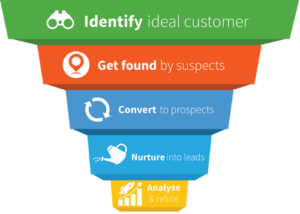
Salestech Star Primer: What Is Lead Generation?So, if 100 people visit your website and 10 of them submit their details via a pop-up or registration link, these 10 can be classified as leads as they have shown interest in one or other of your products/services. If you meet 20 people at a conference and five of them share their visiting cards or just their phone numbers, those five are leads for your business who need engaging and nurturing to be converted into customers immediately or later.

What are the channels of Lead Generation?

Primarily, there are two channels of Lead Generation – Inbound and Outbound.

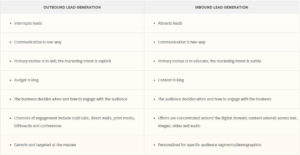
Marketo defines Inbound Lead Generation as “The process of helping potential customers find your company—often before they are even looking to make a purchase—and then turning that early awareness into brand preference, and ultimately, into leads and revenue.”

As per Forrester, buyers seek out three pieces of content about a vendor for every one piece sent by a marketer, and for every one piece sent by Sales. This makes it imperative to make the buyers find you, rather than getting to them with intrusive means of advertising.

Inbound Lead Generation involves constructive means of educating customers with a well-planned content strategy. Here, you drive them to find your business by means of quality content and SEO, websites, blogs, social media, e-mails, and webinars.

Outbound Lead Generation, on the other hand, involves reaching out to masses that may or may not be interested in your offering. The most common methods of Outbound Marketing include display ads, direct mails, PPC ads, events, and content syndication.

While Email Marketing is mostly considered as an outbound activity, it actually falls into both the channels. Email Marketing can be used to reach out to leads that have previously opted-in for your blog updates or registered for a product demo; e-mailing them is part of an inbound marketing campaign. But buying a database of leads from a third-party and mass e-mailing is an outbound method which is more spammy and generic. No wonder Outbound leads cost 39% more than inbound leads.
Salestech Star Primer: What Is Lead Generation?Image source: FreshSales

IDG carried out a survey to ascertain which methods of Lead Generation worked best for companies. It was found out that websites, conferences/tradeshows, and email marketing proved to be the best channels of communication, while print advertising and direct mail performed the worst.
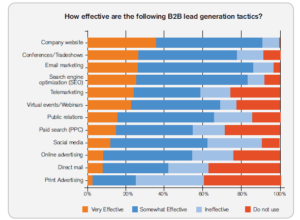
Salestech Star Primer: What Is Lead Generation?The three most commonly used B2B lead generation strategies are email marketing (78%), event marketing (73%), and content marketing (67%)

What metrics to track?

As part of your Lead Generation efforts, it is necessary to keep track of a few metrics that matter to your business. Some of the common Lead Generation metrics that companies track include:

Performance Metrics:

  • Click Through Rate (CTR) – Tells you how many visitors are clicking on a link in your ad creative, landing page, or e-mail.
  • Conversion Rate – A measure of how many visitors are performing a specific intended action like filling out a form, opting-in for blog updates, product demos, etc.
  • Return on Investment (ROI) – It is a measure of how much money you have made with an initial investment. E.g., if you make $18 off each lead, and had initially invested $10 on acquiring per lead, your ROI will be 80%
  • Time to Conversion – The time taken to convert a visitor into a verified lead.

Cost Metrics: Cost per Click (CPC), Cost per Mille (CPM), and Cost per Lead are the three most important metrics that fall under this category. They provide insights into the amount you are spending in acquiring each click via a paid advertisement campaign or if you are buying impressions via display ads.

The average cost of a B2B sales lead differs by industry. Healthcare leads cost the highest ($60/lead) followed by business/finance ($43/lead). Leads for Marketing products/services and technology are at the low-end ($32/lead and $31 per lead respectively).

Channel Metrics: Are you getting most of the traffic by website SEO, PPC ads, or by social media? Channel metrics provide insights into the performance of various channels/media employed for your Lead Generation efforts. So, checking for metrics like Lead Generation rate by channel and Month-to-date (MTD) channel goals is vital for marketers to optimize their spending on campaigns.

As a result of tracking channel metrics, you would be able to decide which channels to invest more resources in order to attain better ROI.

Read Also: How to Analyze Your Lead Generation Form Using Google Tag Manager

FocusVision Announces New Chief Product and Technology Officer Henry Harbury

Seasoned technology veteran to lead innovation on industry-leading insights technology

FocusVision, the leading provider of comprehensive survey and customer insights software solutions that enables brands to understand their customers’ truth, announced that Henry Harbury, Ph.D., has joined the company as Chief Product and Technology Officer. Harbury will drive strategic, cross-company product and technology innovation designed to advance the Company’s flagship insights solutions.

“We’re thrilled to welcome Henry to the team. Through our comprehensive survey and experience insights solutions, FocusVision is the only insights technology company that can bring brands close enough to their customers to have a full understanding of how they think, feel, and act”

As a veteran technology executive, Harbury has had a long career in Technology and MarTech, including as a Founder of TeamTek Solutions, a software engineering and consulting firm. Harbury most recently served as CTO of moovel North America (becoming REACHNOW), a highly scaled mobility-as-a-service (MaaS) solutions provider for the transportation market where he helped scale and grow the core business while bringing numerous new products to market. Before joining moovel, he served as CTO at Act-On Software, a SaaS marketing automation provider and one of the fastest growing private companies in the U.S., where he played an integral role in founding the company and securing over $70 million in venture capital investment. Harbury has also published over 27 articles in peer-reviewed journals and scientific conference publications.

Read More: Marchex Releases Conversational AI Technology Built to Predict Customer Intent, Create Personalized Sales Experiences and Improve Sales Outcomes

“We’re thrilled to welcome Henry to the team. Through our comprehensive survey and experience insights solutions, FocusVision is the only insights technology company that can bring brands close enough to their customers to have a full understanding of how they think, feel, and act,” said Zlatko Vucetic, CEO of FocusVision. “Henry’s background in technology, and especially MarTech, is important as we continue to evolve FocusVision and our products to further enable brands to integrate the data collection to MarTech platforms and similar technologies. At FocusVision, we are building products that elevate above the notion of faster and cheaper data insights and moving towards data integration through technology.”

Read More: Shyan Mukerjee Appointed as Majorel’s New Chief Digital and Transformation Officer

“FocusVisions’s product and engineering teams have built the best-of-breed technology solutions that solve a broad range of challenges across the industry,” said Henry Harbury, CTO of FocusVision. “I am honored to join a team that has delivered the flagship products in the market. I’m looking forward to helping the team continue its momentum as we bring even greater advancements and innovation to insights technology. FocusVision is perfectly positioned to be the most innovative game changer with both the market depth and reach to truly advance the industry.”

Read More: Tylie Ad Solutions Looks to the Future with Hire of Steve Brown as Chief Technology Officer

Mastercard Furthers Resources for Small Business Owners With Salesforce Essentials

Company builds upon its small business value proposition to offer the #1 CRM for small businesses from Salesforce

Small businesses are often powered by passionate teams behind the scenes, and in today’s digital world, having savvy technology resources can help them achieve their goals. Salesforce joins Intuit in the US Mastercard small business program, as additional world-class partners delivering critical solutions to the small business space. Whether it’s accelerating revenue by finding new customers or better managing customer engagement, these new Salesforce benefits—now available across Mastercard Business and Mastercard Business World Elite offerings in the US — will help small business owners boost their daily hustle.

Read More: Cendyn Announces Acquisition of the Rainmaker Group

“Every business is different. Small business owners seek freedom and flexibility. However, they need tailored platforms and services that help them enhance how they run their business and address their individual needs,” said Ginger Siegel, head of small business, Mastercard. “We are excited to further build on our small business benefit program together with partnerships like Intuit and Itemize, and now Salesforce, to deliver digital solutions that meet the needs of small business owners today and grow with them in smart, innovative and efficient ways tomorrow.”Small business owners often wear a lot of hats. Foundational resources that help fuel their business day-to-day enable them to focus their attention on their key business drivers. With a holistic suite of solutions that cater to their needs, from digital and technology enablement to acquiring new customers, they can do just that. Mastercard Small Business cardholders can now leverage specific tools and benefits to assist in these areas, including:

Mastercard and Salesforce Essentials

Mastercard Business Card customers can now tap into the power of Salesforce’s customer relationship management (CRM) solution through Salesforce Essentials, a powerful app that includes sales and customer support tools built specifically for small businesses for just $9.99/user/month with quick setup to get business owners rolling in no time. This offer is only applicable for new Salesforce Essentials customers purchasing annual subscription.

“Customers love small businesses for the personal experiences they offer but it becomes more challenging to know the details of each and every customer as that business grows. That’s where a customer relationship management solution becomes key,” said Marie Rosecrans, SVP, Salesforce Essentials and SMB. “Mastercard has a relentless focus on small businesses and we are delighted to extend Salesforce Essentials to Mastercard Business customers, empowering them to grow their businesses.”

Read More: Narrative Adds Smart TV Data Through Partnership with Inscape

Small businesses continue to contribute to their local economies, and it is Mastercard’s mission to help ensure that they succeed by first focusing on their needs and pain points. It’s for this reason that Mastercard continues to leverage advanced partnerships and industry alliances with organizations like Salesforce to expand its card value proposition and deliver on owners’ day-to-day business essentials with top digital solutions and offers.

Adding Salesforce to Mastercard’s recently enhanced small business program with Intuit, Mastercard continues to provide efficient digital resources and partner discounts including: Intuit’s QuickBooks and TurboTax, access to 24/7 Business Assistant, Mastercard ID Theft Protection, Mastercard Easy Savings, Cell Phone Insurance and Mastercard Receipt Management powered by Itemize, which is officially available to download and activate for free using a valid Mastercard Small Business card in the Apple and Android app stores. Small business needs continue to evolve every day and Mastercard is committed to ensuring that we continue to provide the solutions that help them get ahead of their needs tomorrow.

Read More: vablet Adds Social Media File Sharing Capabilities

Accenture to Support Brandix Accelerate Journey to “Future-Ready” Its Operations

Accenture has signed an agreement to help Brandix, the leading apparel manufacturer in Sri Lanka, transform its manufacturing, supply chain, finance and human resources operations to set the stage for the company’s digital future.

Under the terms of the agreement, Accenture will help Brandix develop innovative solutions that focus on process excellence, productivity improvement, data-driven analytics and the internet of things — all while driving end-to-end integrated solutions.

Read More: Tag, AI Is It: Musiio Offers DIY Window into the Power of AI Music Curation

“I’m confident that this collaboration will help us achieve new avenues of growth not only in Sri Lanka but at the global scale,” said Ashroff Omar, Brandix’s Group Chief Executive Officer. “This is in line with our overall strategic decision to develop the apparel ecosystem and create a future-ready, global organization for the digital era.”

Manish Sharma, group operating officer for Accenture Operations, said, “We look forward to continuing our ongoing collaboration with Brandix — which began in 2013 — to transform its processes leveraging our global expertise in data science, analytics, consulting, strategy and operations. Together, we will work toward significantly enhancing the company’s top-line growth and bottom-line savings in the next six years.”

Read More: Cint Acquires P2Sample to Expand Its Audience Reach and Enhance Powerful Programmatic Capabilities

Anindya Basu, geographic unit and country senior managing director for Accenture in India, said, “The retail industry is being redefined globally by consumer expectations, digital technologies and transformative business models. To create value in this highly competitive environment, apparel manufacturers need to embed technology-led innovation not only at the edges of systems but also within their core processes.”

Read More: Salesforce Completes Acquisition of Tableau

New Era of Business Intelligence Belongs to AI ML and Data Analytics

Going by the current trends in the industry, both Business Intelligence (BI) and Data Analytics have a key role to play in the economy. The combination of BI and Data Analytics is a massive force driving the transformation of all businesses today.

Fact Check: As per an industry report, the global analytics of things market was USD 8.1 billion in 2018 and is expected to reach approximately USD 56.8 billion by 2025.

AI ML and Predictive Analytics make this transformation sustainable with numerous advantages added to the whole process of data wrangling and reprocessing. Taking a massive step toward bringing AI ML and analytics within the realm of modern BI, global leader Hewlett Packard Enterprise (HPE) announced it has acquired the business assets of MapR.

Read More:  How AI is The Key to CPG Growth Amidst Channel Blurring

MapR is a leading data platform for Artificial Intelligence and analytics applications powered by scale-out, multi-cloud and multi-protocol file system technology.

Massive Impetus into Business Intelligence Economy Triggered by AI ML Technology

Recently, Salesforce had acquired Tableau while Google closed its deal with Looker. Both deals highlight the BI growth influenced by new advancing technologies in AI ML, Virtualization, Big Data Analytics, Visualization, and Cloud Computing.

With this transaction, HPE will own MapR’s technology, intellectual property, and domain expertise in Artificial Intelligence and Machine Learning (AI/ML) and analytics data management.  The latest acquisition would enable HPE to deliver AI-driven experiences to its customers by driving new business models. The company also plans to expand ideas into creating new customer and employee experiences, and increasing operational efficiency today and into the future.

At the time of this announcement, Antonio Neri, President, and CEO of Hewlett Packard Enterprise said –

“The explosion of data is creating a new era of intelligence where the winners will be the ones who harness the power of data, wherever it lives.”

Antonio added,  “MapR’s file system technology enables HPE to offer a complete portfolio of products to drive Artificial Intelligence and Analytics applications and strengthens our ability to help customers manage their data assets end to end, from edge to cloud.”

This asset acquisition accelerates HPE’s Intelligent Data Platform capabilities and helps customers optimize workload solutions for mission-critical big-data workflows – whether they are cloud-native or on-premises.

Next-Gen Data Platforms Can’t Run without AI/ML Expertise

The MapR Data Platform helps deliver the foundation for a Next-Generation edge-to-cloud AI/ML and Analytics data pipeline by:

  • Extending BlueData capabilities for stateful container-based applications. The combination of the BlueData and MapR technologies can empower data scientists and data analysts to stitch together AI/ML and analytics data pipelines in minutes across on-premises, hybrid cloud, and multi-cloud environments.
  • Enabling storage and consumption of data by a broader set of AI/ML and analytics data, engines, applications, and tools from ISV partners. MapR allows for multiple workloads in the same environment and offers expansive APIs for easy access.
  • Ensuring a consistent approach to secure, govern, protect, and orchestrate data up to exabyte scale across the AI/ML and analytics data pipeline. MapR handles a variety of data types from files and streams to documents.
  • Simplifying AI/ML and analytics data management and processing from edge to cloud. MapR multi-cloud and container support ensure seamless portability of applications across disparate environments running MapR Data Platform.

“At HPE, we are working to simplify our customers’ and partners’ adoption of Artificial Intelligence and Machine Learning,” said Phil Davis, President, Hybrid IT, Hewlett Packard Enterprise.

Phil added, “MapR’s enterprise-grade file system and cloud-native storage services complement HPE’s BlueData container platform strategy and will allow us to provide a unique value proposition for customers. We are pleased to welcome MapR’s world-class team to the HPE family.”

Read More: Sustainabile Commerce through Artificial Intelligence

Leading enterprises across industries such as financial services, manufacturing, and consumer technology, use the MapR Data Platform to power their Digital Transformation initiatives and unlock business value. These companies have been able to move more quickly, grow revenue, reduce costs, and diminish risk.

MapR has a rich ecosystem of partners that spans resellers, independent software vendors and system integrators in the AI/ML and analytics market. HPE will add these partners, as appropriate, and continue to offer choice through a broad ecosystem that includes many other data-centric ISVs.

Currently, Hewlett Packard Enterprise is a global technology leader focused on developing intelligent solutions that allow customers to capture, analyze, and act upon data seamlessly from edge to cloud.

New Research Reveals Growth of Customer Success Profession and Its Strategic and Financial Role in Enterprise Business Success

Compensation for Customer Success Professionals Increases and Compensation Structures Evolve as Revenue Responsibility Grows Across Customer Success Teams 

Totango, the leader in Customer Success for the enterprise, released preliminary findings from the 2019 State of the Customer Success Industry and Salary Report, which revealed that the Customer Success profession has grown exponentially year-over-year, expanding beyond traditional job titles and taking on a larger strategic and financial role in an enterprise’s business success. Over the past six years, thousands of Customer Success professionals have participated in Totango’s State of the Customer Success Industry and Salary Survey. The survey was conducted to provide valuable insights into trends in the Customer Success profession, including the unique challenges and goals of the industry in order to establish industry benchmarks for Customer Success compensation trends, growth and maturity of the role. The report found that compensation for Customer Success professionals has increased since 2018, reinforcing the importance of Customer Success and an organizational focus on customer-centricity to business growth. However, although great strides have been made in the recognition and importance of Customer Success, more clarity, education and awareness about the function is needed within enterprises. Totango will host a webinar on Tuesday, August 27 to deliver complete survey report details and analysis.

“The Customer Success industry is growing at an incredibly rapid pace. As organizations, particularly enterprises, realize the importance of Customer Success in business success, they are expanding their engagement beyond their top customers to include their entire customer base,” said Guy Nirpaz, Totango CEO and founder. “As a result, teams are growing in size alongside coverage models that scale to cover a broad base of customers. However, to successfully operationalize customer success, digital transformation is critical—organizations must invest in modern Customer Success platforms to equip their teams with practical means to gather customer data and effectively connect the dots across the enterprise.”

Read More: B-Scada Inc. Launches New Text Messaging Marketing Platform

The Deloitte 2019 Enterprise Customer Success Study and Outlook underscores Totango’s findings that indicate the importance of strong Customer Success programs. According to Deloitte, Customer Success results in happier customers overall with noticeable improvements experienced in the level of customer satisfaction and brand advocacy. According to Deloitte’s study, half of companies with Customer Success teams saw a rise in Customer Satisfaction Scores (CSAT) by more than 20 percent.

Customer Success as a function matures and is no longer an organizational silo 

Since Totango started surveying the Customer Success industry six years ago, the responsibility for the function has expanded beyond the core Customer Success organization. Customer Success within an enterprise is no longer built as an operational silo as customer-centricity becomes a top priority across the business. 99% of Customer Success teams surveyed collaborate with teams across the company. Teams are also more established within organizations and growing in size alongside coverage models that scale to cover a broad base of customers. 65 percent of this year’s respondents report that their Customer Success team has been in operation for over 3 years, and nearly a third have been in operation for over 5 years.

Read More: Payscout and UnionPay Announce Partnership on Global E-Commerce with Instant Onboarding

Compensation structures evolve as revenue responsibility grows across Customer Success teams 

While opinions on revenue responsibility are divided, Customer Success departments continue to be tasked with generating revenue and impacting the bottom line. Half of respondents say their Customer Success team is responsible for revenue targets (50%), which has remained flat compared to 2018 (52%). As a result, compensation structures have evolved towards a commission or bonus structure directly tied to revenue generation. According to 64% of Customer Success professionals surveyed, their compensation structure included a type of bonus structure on top of their base salary. Over the years, a larger percentage of respondents reported receiving a commission on renewals and upsells. 33% of respondents reported commission on renewals and upsells in 2013, growing to 39% in 2019. Customer Success salaries have also trended up as organizations continue to place a high value on the Customer Success professional’s responsibilities and career, reinforcing the importance of Customer Success across companies. Nearly 62% of respondents report that their compensation has increased since the previous year.

Digital transformation of Customer Success is imminent

Almost all respondents (93%) think Customer Success should be the next function that goes through a digital transformation due in part to the lack of technologies available to automate and simplify Customer Success tasks. While there has been steady growth since 2018 in the use of Customer Success platforms, a majority of Customer Success teams are still using legacy tools such as CRM, Microsoft Excel/Google Sheets and Help Desk/Support tools. Customer Success teams also continue to prioritize reduction of churn, customer renewals and product adoption. Professionals surveyed consider operational issues including a reactive approach to customers, visibility into customer adoption and health, time management and focus as top challenges. This sentiment has remained consistent since 2015.

This year close to 500 professionals and more than 10,000 data points were analyzed in order to provide valuable insights into trends in the Customer Success profession, including the unique challenges and goals of the industry.

Read More: Automation Anywhere Acquires Klevops to Maximize Collaboration Between Humans and Bots

Magnolia Recognized by Gartner in the Magic Quadrant for Web Content Management

Magnolia, one of the world’s leading providers of open-source content management, recently announced it has been positioned by Gartner, Inc. in the 2019 Magic Quadrant for Web Content Management for the very first time. Magnolia was the only vendor added to the Magic Quadrant this year.

The report evaluated Web Content Management vendors based on ability to execute and completeness of vision. Magnolia was positioned the furthest for completeness of vision in the Niche Players quadrant.

Read More: Bizzabo Study: Event Marketers See a 45% Increase In Attendee Engagement With Branded Event Apps

“Digitally savvy enterprises are looking for content management solutions that reduce complexity and increase speed. Magnolia 6 blends enterprise power with agility while offering freedom over the digital experience stack,” said Tim Brown, Chief Executive Officer at Magnolia. “This is one way we’ve brought a fresh and modern perspective to the content management experience. While we believe this recognition is largely due to the extensive innovation bred into our latest offerings, Magnolia’s long-standing experience and reputation has brought us to this point.”

Read More: Nuance Unveils Name and Brand Identity for Its Automotive Spin-Off: Cerence Inc.

Magnolia’s vision of digital experience infrastructure as an open architecture, as opposed to a monolithic suite, is increasingly resonating with the market and driving the company’s accelerating growth. Rasmus Skjoldan, Chief Marketing Officer at Magnolia, added: “We’re thrilled to see that we are recognized and believe it validates our priorities.”

Read More: Episerver Named a Leader for the Fifth Consecutive Year in Gartner’s 2019 Magic Quadrant for Web Content Management

REaD Group and Marie Curie Celebrate Award Success with Multi Award-Winning Insight Project

But the Real Winner Is Data

Marketing data and insight agency REaD Group has further cemented its success in data-driven and insight marketing after winning a number of awards at two separate industry events, and being shortlisted for a further three categories in a third.

Alongside Marie Curie, REaD Group was named as winner of the Best Use of Insight Award at the IoF National Fundraising Awards on 2nd July for the Big SHIFT project. The National Fundraising Awards celebrate the very best in fundraising and are a unique opportunity to showcase excellence in the charity fundraising sector.

The award follows swiftly on the heels of REaD’s win at the Insight in Fundraising Awards in June. Together with Marie Curie, REaD took home the Most Powerful Insight using Data Analysis award. The awards recognise the best work, innovation and inspirational stories of individuals working in data, analysis and insight contributing to fundraising practices.

Read More: Tag, AI Is It: Musiio Offers DIY Window into the Power of AI Music Curation

REaD was also shortlisted for three categories in the DataIQ Awards for Transformation with Data, alongside Marie Curie; Best Use of Data in a Marketing Programme, with customer Titan Travel; and the Best Place to Work.

“It is a genuine honour that REaD Group and Marie Curie have been recognised in these prestigious awards a reflection of the power and impact that data and insight can have on a charity’s fundraising initiatives,” commented REaD CEO, Jon Cano-Lopez. “The real winner, though, is data. In these highly regulated times, all businesses need to be confident that their data is clean, accurate, complete and compliant. And with the technology available to manage data quality more efficiently and securely advancing almost daily, there really is no excuse for it not to be.”

Deeper insight projects can completely transform business structures and promote new and more productive ways of working as the award-winning project delivered with Marie Curie UK so aptly demonstrates.

Read More: Cint Acquires P2Sample to Expand Its Audience Reach and Enhance Powerful Programmatic Capabilities

Marie Curie provides care and support for people living with a terminal illness, and their families across the UK, with people interacting with the charity through many touchpoints, including its hospices, nursing services and shops. The Big SHIFT project aims to model the effect of these services on fundraising income. A team of senior analysts was established, both internal and external, comprising Steve White from Marie Curie, Scott Logie and Diane Dao from REaD Group, Colin Stewart from Caversham Analytics and Andrew Lockett of Natural Data Insight.

A carefully-constructed methodology enabled the creation of a baseline fundraising landscape onto which Marie Curie-specific variables were overlaid. Analysis of these ‘layers’ generated predictive models that were then mapped, highlighting areas where fundraising performance is above or below expected levels, in the context of service provision in the locality. A strategically-powerful tool, it has already delivered surprising and extremely effective insights.

“This project has been a great example of successful collaboration and team work,” commented Steve White, Fundraising Strategy and Insights Manager at Marie Curie. “Understanding these impacts has not only provided invaluable insight that helps to inform our business and marketing decisions, it has also supported the business case for different areas of the organisation working more closely together.”

Read More: B-Scada Inc. Launches New Text Messaging Marketing Platform

Adobe Named a Leader in 2019 Gartner Magic Quadrant for Personalization Engines & Magic Quadrant for Web Content Management

Adobe Recognized Based on Completeness of Vision and Ability to Execute in Both Reports

Adobe announced that it was the only company recognized as a Leader by Gartner in both the July 2019 “Gartner Magic Quadrant for Web Content Management” research report and the July 2019 “Gartner Magic Quadrant for Personalization Engines” research report. As one of 18 vendors evaluated, Adobe placed in the Leaders quadrant furthest to the right for completeness of vision and highest for ability to execute in the Magic Quadrant for Web Content Management. The company was named a Leader for the ninth consecutive year. In only its second year of publishing, Adobe was named a Leader in the Gartner Magic Quadrant for Personalization Engines, which evaluated 14 vendors.

“Companies continue to deliver standout customer experiences leveraging Adobe Experience Manager and Adobe Target to lead in Customer Experience Management (CXM),” said Aseem Chandra, senior vice president, Strategic Marketing, Adobe Experience Cloud. “With both solutions working in concert, brands can keep up with customers’ constantly growing demands by delivering personalization at scale, while significantly increasing conversions, customer satisfaction and long-term loyalty.”

Read More: Payscout and UnionPay Announce Partnership on Global E-Commerce with Instant Onboarding

Gartner defines web content management (WCM) as “the process of creating, managing and delivering content over one or more digital channels through the use of specific management solutions based on a core repository.” Personalization engines are defined by Gartner as “software that applies context about individual users to select, tailor and deliver messaging such as content, offers and other interactions through digital channels in support of three use cases: marketing, digital commerce and customer experience (CX).”

Adobe’s WCM offering, Adobe Experience Manager Sites, and Adobe’s personalization engine, Adobe Target, both part of Adobe Marketing Cloud in Adobe Experience Cloud, empower marketers and IT professionals to anticipate and rapidly deliver personalized experiences at massive scale. Unlike other marketing solutions lacking deep contextual data and requiring manual management, Adobe helps companies of all sizes deliver fully connected experiences across any screen, wherever people are—from web, mobile and IoT devices, to point of sale and physical signage.

Read More: vCita Secures $15 Million Growth Funding Round Led by Forestay Capital

With Adobe Sensei, the company’s AI and machine learning technology, brands can automatically deliver targeted content on an individual level. Experience Manager is integrated with Adobe Creative Cloud to make it easy to quickly activate creative assets across all customer touch points. Enterprise and mid-sized brands using Experience Manager and Adobe Target include AAA Northeast, American Red Cross, Anheuser-Busch, Citrix, Dun & Bradstreet, East Tennessee State University, Foot Locker, Holland America, Home Depot, National Bank of Canada, Orvis and more.

Read More: Informatica Launches Data Innovators Virtual Summit Series