Home Blog Page 5210

3 Things to Know About Creating a High-Yielding Marketing Department

0

leadmd logoWe all want to achieve our Marketing goals and drive our organizations forward, and we need the right people at the helm to make this happen. But even if you believe in your team members and feel good about their performance, it’s common to have lingering questions. We’ve found that most of the CEOs and CMOs we talk to wonder if they have the right people in the right roles at the right salaries. But the breakneck pace of Marketing today leaves little time to really dig into these questions, and identify solid answers.

The good news is, there’s almost always an opportunity to optimize. We’ve seen the gamut when it comes to Marketing departments, and even the savviest teams can see dramatic results by making the right personnel changes. So if you want to get on the right track and find success in this area, we’re here to help.

To start, we updated a really popular infographic we created five years ago about the job titles you (may) need in your Marketing organization, to reflect current changes in the industry and trends in salaries. We recommend checking it out and getting familiar with it. It can act as your guide as you begin to identify the gaps in your organization, how to fill them and with whom.

In addition to this, here are three things to keep in mind to help you create and maintain the type of high-flying Marketing department you need to succeed.

1. Your ideal Marketing department won’t look like everyone else’s

This might seem weird, given that our infographic shows the types of roles that often support the best Marketing departments, so you may think yours must mimic this exactly. But it shouldn’t, and won’t. Your business is unique, your goals are specific and the role of your Marketing team in your company is going to have its own flavor accordingly.

So, consider the positions we’ve outlined in our infographic as a starting point or a template of sorts. Review it with the mindset that you may need all these jobs at some point, or may never need a few of them. But every Marketing organization will need some of them (maybe even most). And it’s best to understand how they all work together, holistically, to help you achieve your goals. Only then can you start to make decisions about what pieces and parts you need most.

2. Expertise is essential, not expendable

At this stage, you’re going to need wise words from a seasoned Marketing professional. If you don’t have a time-tested VP of Marketing or CMO, ask yourself honestly whether your CEO has the right chops (e.g. enough marketing know-how) to make strategic, informed decisions about assembling the right Marketing team. If not, we encourage you to find a third-party agency you can trust to help you make these decisions.

The expertise of a person or agency who knows the ropes of marketing, understands technology and strategy, and has seen the industry evolve through the years, is invaluable. This individual or team will help you connect the dots between what your Marketing department looks like now, and what it needs to look like if you want to accomplish your BHAGs. They can tell you which of the roles of our infographics are important to your trajectory, and which aren’t necessary right now. This will help you make strategic decisions and get crystal clear about hiring intentionally.

3. Marketing hires are investments, not expenses

And finally, if you get nothing else from all this, please remember this point. All too often, well-meaning leaders get consumed by their bottom line and become skittish about hiring experienced people who know how to get their jobs done well. The thinking goes that these people cost more money, so they, therefore, represent an unnecessary operational expense.

But, no! Hiring is an investment, not an expense. After all, if you’re selecting seasoned practitioners for the roles you really need, they should be wild revenue generators. The hires you want to make might account for $1 million dollars in salaries between them, but don’t panic – they should more than make up for this in the ROI they bring. What if they bring in $10 million for you or more? Worth it!

When all is said and done, the best thing you can do for your Marketing department is to realize your people are not overhead; they are instruments of revenue growth. And this will remain true, no matter what technology and other trends ebb and flow over the years. Hire the right people, and hire for the organization you want to be – not where you are now. Only then will your Marketing department do its job and yield you the wickedly awesome results you’ve been hoping it would. Here’s to you getting there, one “right” person at a time. 

Read more: 4 Ways Marketers Can Ensure They Learn The Right Lessons From Data

Lotame Unveils Industry’s Most Connected TV Offering: Lotame TV

Company continues its unstacked push, launching TV + digital product suite designed to help marketers connect TV viewership audiences for cross-screen digital campaigns

Lotame, the world’s leading unstacked data solutions company that helps publishers, marketers, and agencies find new customers, increase engagement, and grow revenue through audience data, announced the launch of the industry’s most connected TV product suite: Lotame TV. Lotame TV enables advertisers to seamlessly connect, build, target, activate, and analyze TV viewership audiences for cross-screen digital campaigns through DSP partners such as AppNexus, Verizon Media, Google DBM, The Trade Desk, Adobe, and Amobee. As part of it’s unstacked rollout, Lotame connects and matches TV + digital data — including ACR, OTT, website, app, and CRM data — to over 4 billion web, mobile, and OTT IDs, builds bespoke TV + digital audiences that can be activated across any channel, and helps analyze how these audiences are performing in digital campaigns.

Read More: Nuance Unveils Name And Brand Identity For Its Automotive Spin-Off: Cerence Inc.

“With Lotame TV, we have enabled impressive data connectivity between TV, a traditionally siloed channel, and digital,” said Tricia Masturzo, Director, Data & Advanced TV Solutions at Lotame. “By providing access to rich TV audience data and connecting it with DSPs to target TV viewers across digital platforms and channels, from mobile to desktop, Lotame allows advertisers to more effectively engage consumers wherever they are, maximizing their investments.”

The Lotame TV solutions suite is comprised of four products — Lotame TV Connect, Lotame TV LAB, Lotame TV Analytics, and Lotame TV Data Exchange — that enable unique connectivity while also offering the flexibility of an a la carte, unstacked approach.

  • Lotame TV Connect– Lotame TV Connect is the hub where TV + digital data — including ACR, OTT, website, app, and CRM data — is synced, matched to 4 billion web, mobile and OTT device IDs, and clustered by individual and household. When you’re ready to activate your audience segments, TV Connect is synced to most major adservers, DSPs and attribution platforms.
  • Lotame TV LAB– Lotame TV LAB is where content meets commerce to create audience segments that fit your marketing needs. ACR and OTT audience data can be mixed, matched and combined with 1st, 2nd or 3rd party data to create your ideal segments. Don’t have enough scale? Use our proprietary machine-learning modeling tool, Audience Optimizer, to intelligently scale your segments..
  • Lotame TV Analytics– Lotame TV Analytics gives you a 360-degree view of consumers watching your TV shows or commercials, and enables you to take action with a click. Leverage your 1st party online and offline data, or access the world’s largest marketplace of 2nd and 3rd party data, to generate TV + digital audience overlap and index reports that are on-demand, high-definition and binge-worthy.
  • Lotame TV Data Exchange– Lotame TV Data Exchange offers custom and ready-to-target pre-packaged TV audiences categorized by Program, Network, Show, Genre, Viewer Type, Dayparts, and Tentpoles that can be activated through any DSP. Target TV viewers across digital platforms and channels with the ability to scale through advanced machine learning and modeling. Ahead of the Fall TV season, Lotame is segmenting audiences by viewers of Primetime Fall TV Shows, Reality TV, Cord-Cutters, Home Improvement, MLB, NFL, Grammy Awards, and Golden Globes. These audiences and more can be purchased through most major DSPs to target TV viewers across digital platforms and channels.  Additionally, with Lotame TV Data Exchange, marketers can now re-engage viewers seeing their TV commercials via digital channels or can get a leg up on their competition by targeting those who viewed competitor TV ads on digital.

Read More: Bizzabo Study: Event Marketers See A 45% Increase In Attendee Engagement With Branded Event Apps

In support of its TV offering, earlier this year, Lotame extended its strategic relationship with Inscape, which delivers viewing information from nearly 11 million connected VIZIO TVs.

“As one of Lotame’s longest running partners, we are excited to continue creating value for marketers looking to reach television audiences,” said Greg Hampton, VP of Business Development at Inscape. “Together, we can provide granularity, quality, timeliness, scale and safety and above all else actionability when it comes to viewership data.

Read More: Tag, AI Is It: Musiio Offers DIY Window Into The Power Of AI Music Curation

Broadsign Partners with Place Exchange to Seamlessly Extend Digital Campaigns to DOOH

Broadsign Reach and Place Exchange Integration Addresses DOOH Publisher and Digital Media Buyer Demand to Add Out-Of-Home Inventory to Existing Digital AD Buys

Broadsign, the leading digital out-of-home (DOOH) marketing platform for media owners and Place Exchange, the only true programmatic exchange for out-of-home and place-based media, announced an integration to enable digital buyers to transact DOOH programmatically as a simple add-on to existing digital media buys. The combined platforms enable DOOH media owners and advertisers, to utilize a single set of digital creative assets that can be easily adapted to suit a variety of digital, mobile and DOOH destinations.

Read More: SalesTech Star Interview With Patrick O’Brien, CRO At Zylotech

“Broadsign has led the charge in digital out of home for many years, and has access to an incredibly robust global inventory of signage in some of the most highly trafficked locations in the world. We’re excited about the possibilities this integration brings to our vast network of digital media buyers,” said Dave Etherington, Chief Commercial Officer, Place Exchange.

Lightbox OOH Video Network (formerly Adspace), which owns and operates 4500 video screens with sound throughout premium retail centers, is one of the first media owners to leverage the integration between Place Exchange and Broadsign. The company has already benefited by tapping into previously unavailable digital campaigns for a number of consumer brands. “For Lightbox, the Place Exchange and Broadsign Reach integration further enables access to digital campaigns and incremental revenue streams. It makes it very easy for digital marketing teams to discover, and buy DOOH media alongside other channels,” said Peter Krieger, President and Chief Operating Officer, Lightbox.

Read More: SalesTech Star Interview With Sheila Aharoni VP Of Global Sales At CloudShare

“Place Exchange has taken a novel approach to adapting the programmatic digital workflow to DOOH and we are excited to partner with them to grow the programmatic DOOH market. This integration will allow digital buyers to easily extend their campaigns onto thousands of DOOH screens across the Reach network and media owners to access thousands of digital buyers around the world.” said Adam Green, SVP and General Manager, Broadsign Reach.

Read More: SalesTech Star Interview With Sridhar Iyengar, Managing Director At Zoho Europe

Voximplant Announces Major Update to Smartcalls Service: Google Dialogflow and SIP Integration, New Set of Subscription Plans

Voximplant, the leading cloud platform for communication solutions, announces major updates to the Smartcalls service. Now, users can choose from a set of affordable plans, integrate with an existing SIP, and enroll into the beta program of Dialogflow and Smartcalls engagement a next-level solution, that will easily enrich call scenarios with an IVR of any complexity.

Dialogflow Integration

Dialogflow is an advanced tool for automating communication between businesses and their customers. A voicebot created with this platform is able to communicate with the user in natural language, analyzing the context of the conversation with the ability to respond intelligently. Thanks to the capabilities of the agent, Smartcalls users can now create complex IVR solutions for advanced customer service. The agent is configured in the Google environment, and can be added to the call processing script with the Smartcalls visual editor.

“The main priority of our platform is to provide the most advanced voice technologies to our users. The convenience factor is equally important to us. Integration of the Dialogflow agent into Smartcalls makes setting up complex IVR as simple as possible. Of course, this is in part due to our technology partner, Google, and their software solutions,” says Alexey Ailarov, CEO and Co-Founder of Voximplant.

Read More: Tag, AI Is It: Musiio Offers DIY Window Into The Power Of AI Music Curation

Dialogflow can handle problems of varying complexity. It can be trained in several simple actions to help the call center staff, and if necessary, create extensive scenarios for an advanced voicebot. Moreover, the user does not require programming skills to use Dialogflow or the Smartcalls script editor all actions and scripting are performed in an intuitive visual editor.

All users can now enroll in the beta program of the integration. The global commercial release of the updated functionality is set for Fall 2019.

Integration with SIP platforms

The updated version of Smartcalls supports third-party SIP platforms. Users can make or receive incoming calls using their existing accounts on any SIP platform. Implementing this option is no different from adding any other step to a Smartcalls scenario you just need to add a new block to an existing or new script.

Read More: Cint Acquires P2Sample To Expand Its Audience Reach And Enhance Powerful Programmatic Capabilities

New plans for Smartcalls

New plans have been created for businesses of different sizes with varying levels of additional support and mentoring. Packages differ based on minutes used, the volume of monthly consumption, and the onboarding fee amount, which represents the balance available for the initial three months and is debited from the user account as service is used during this period.

To make it easy to pick a plan, each description indicates an approximate customer base (10,000, 30,000, and 100,000), call frequency, and objectives of customer communications. Additionally, the average amount of time the system spends on calling a certain number of subscribers is highlighted, taking into account the number of phone lines included in each package.

“We strive to make Smartcalls convenient for as many users as possible. Therefore, we have developed a set of plans, so those who use the service more often can save on costs. At the same time, we didn’t forget businesses that do not have high volumes of calls, retaining the “Pay As You Go” plan,” says Alexey Aylarov, CEO and Co-Founder of Voximplant.

An important addition is extended support and the option to get professional advice on working with the service. Previously, this assistance was available only via email. New plans offer subscribers the option of asking a question via chat or by phone.

Coaching will allow company experts to create one active scenario with a user, and explain the nuances of Smartcalls, which will help users get the most out of this service.

Read More: B-Scada Inc. Launches New Text Messaging Marketing Platform

Nextep Launches New Chatbot to Offer Clients 24/7 Support

Nextep’s newest support feature provides around-the-clock support

Nextep‘s new automated support feature can help clients with a variety of tasks, like setting up direct deposit, printing a paystub and changing their tax settings. Continuing Nextep’s commitment to technology, the chatbot has advanced artificial intelligence, learning that allows it to expand its knowledge base and improve its capabilities.

Read More: Adobe Named a Leader in 2019 Gartner Magic Quadrant for Personalization Engines & Magic Quadrant for Web Content Management

“We’re implementing automated support because we know our clients will benefit from immediate answers and after-hours help,” said Kim Nichols, Nextep’s operations support supervisor. “Our bot provides service that aligns with Nextep’s culture, while answering our clients’ questions right when they need it.”

Read More: W+R Studios Announces Homebeat, a New Tool to Keep Agents Top of Mind with Their Clients by Sending Scheduled Automated Online CMAs

A chatbot won’t replace any other form of Nextep support. It is simply an additional way clients can reach out for help. As an extension of the service team, Felix brings Nextep closer to clients, making support and answers more available than ever before.

Read More: REaD Group and Marie Curie Celebrate Award Success with Multi Award-Winning Insight Project

SalesTech Star Primer: What Is Lead Generation?

Now that you have a business, how do you sell your products or services to customers? How do you get customers to know about your services and solutions, and educated them about using those? Do you even know who your customers are, and where you could find a good number of potential buyers in a marketplace? If not, this read this primer on Lead Generation.

This primer will give an idea on the concept of Lead Generation and the various ways of generating leads.

Who’s a Lead? 

Now, a lead is a person who has indicated interest in your company’s product or service in some way, shape, or form. A lead is a prospect that can turn into a paying customer in the future, given proper Marketing and Sales efforts are employed.

What is Lead Generation?

HubSpot defines Lead Generation as “The process of attracting and converting strangers and prospects into someone who has indicated interest in your company’s product or service. Some examples of lead generators are job applications, blog posts, coupons, live events, and online content.”

In the words of TechTarget, “Lead generation is the use of a computer program, a database, the internet, or a specialized service to obtain or receive information for the purpose of expanding the scope of a business, increasing Sales revenues, looking for a job or for new clients or conducting specialized research. Leads can consist of the names and addresses (or e-mail addresses) of individuals, corporations, institutions or agencies. Lists of leads can be gathered or filtered from targeted databases such as telephone and Internet directories.”

“Lead Generation describes the Marketing process of stimulating and capturing interest in a product or service for the purpose of developing Sales pipeline.” – Marketo

BusinessDictionary defines it as the “Process of collecting names and contact information about qualified prospects which will be contacted by the Salespeople for generating orders. It usually involves a direct response to Advertising and Telemarketing.”

Read Also: Six Ways Brands Can Increase Lead Generation in 2019

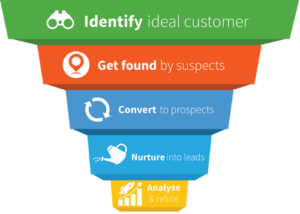
To sum it up, we can describe Lead Generation as a process that identifies probable customers for your business, gets them to show interest in your offerings, and collects useful data. The data can be in the form of names, e-mail IDs, phone numbers, or organization’s name, etc., which can then be used to contact the prospects, educate them, and nurture them to be able to qualify them as Sales Qualified Leads (SQL). The SQLs can then be passed on to the Sales team for further follow-ups and converting them into customers.

Salestech Star Primer: What Is Lead Generation?So, if 100 people visit your website and 10 of them submit their details via a pop-up or registration link, these 10 can be classified as leads as they have shown interest in one or other of your products/services. If you meet 20 people at a conference and five of them share their visiting cards or just their phone numbers, those five are leads for your business who need engaging and nurturing to be converted into customers immediately or later.
What are the channels of Lead Generation?

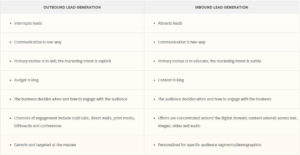
Primarily, there are two channels of Lead Generation – Inbound and Outbound.

Marketo defines Inbound Lead Generation as “The process of helping potential customers find your company—often before they are even looking to make a purchase—and then turning that early awareness into brand preference, and ultimately, into leads and revenue.”

As per Forrester, buyers seek out three pieces of content about a vendor for every one piece sent by a marketer, and for every one piece sent by Sales. This makes it imperative to make the buyers find you, rather than getting to them with intrusive means of advertising.

Inbound Lead Generation involves constructive means of educating customers with a well-planned content strategy. Here, you drive them to find your business by means of quality content and SEO, websites, blogs, social media, e-mails, and webinars.

Outbound Lead Generation, on the other hand, involves reaching out to masses that may or may not be interested in your offering. The most common methods of Outbound Marketing include display ads, direct mails, PPC ads, events, and content syndication.

While Email Marketing is mostly considered as an outbound activity, it actually falls into both the channels. Email Marketing can be used to reach out to leads that have previously opted-in for your blog updates or registered for a product demo; e-mailing them is part of an inbound marketing campaign. But buying a database of leads from a third-party and mass e-mailing is an outbound method which is more spammy and generic. No wonder Outbound leads cost 39% more than inbound leads.

Salestech Star Primer: What Is Lead Generation?Image source: FreshSales

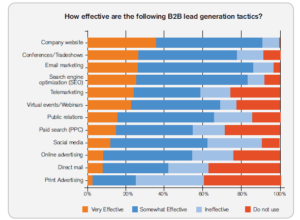
IDG carried out a survey to ascertain which methods of Lead Generation worked best for companies. It was found out that websites, conferences/tradeshows, and email marketing proved to be the best channels of communication, while print advertising and direct mail performed the worst.

Salestech Star Primer: What Is Lead Generation?The three most commonly used B2B lead generation strategies are email marketing (78%), event marketing (73%), and content marketing (67%)

What metrics to track?

As part of your Lead Generation efforts, it is necessary to keep track of a few metrics that matter to your business. Some of the common Lead Generation metrics that companies track include:

Performance Metrics:

  • Click Through Rate (CTR) – Tells you how many visitors are clicking on a link in your ad creative, landing page, or e-mail.
  • Conversion Rate – A measure of how many visitors are performing a specific intended action like filling out a form, opting-in for blog updates, product demos, etc.
  • Return on Investment (ROI) – It is a measure of how much money you have made with an initial investment. E.g., if you make $18 off each lead, and had initially invested $10 on acquiring per lead, your ROI will be 80%
  • Time to Conversion – The time taken to convert a visitor into a verified lead.

Cost Metrics: Cost per Click (CPC), Cost per Mille (CPM), and Cost per Lead are the three most important metrics that fall under this category. They provide insights into the amount you are spending in acquiring each click via a paid advertisement campaign or if you are buying impressions via display ads.

The average cost of a B2B sales lead differs by industry. Healthcare leads cost the highest ($60/lead) followed by business/finance ($43/lead). Leads for Marketing products/services and technology are at the low-end ($32/lead and $31 per lead respectively).

Channel Metrics: Are you getting most of the traffic by website SEO, PPC ads, or by social media? Channel metrics provide insights into the performance of various channels/media employed for your Lead Generation efforts. So, checking for metrics like Lead Generation rate by channel and Month-to-date (MTD) channel goals is vital for marketers to optimize their spending on campaigns.

As a result of tracking channel metrics, you would be able to decide which channels to invest more resources in order to attain better ROI.

Read Also: How to Analyze Your Lead Generation Form Using Google Tag Manager

FocusVision Announces New Chief Product and Technology Officer Henry Harbury

Seasoned technology veteran to lead innovation on industry-leading insights technology

FocusVision, the leading provider of comprehensive survey and customer insights software solutions that enables brands to understand their customers’ truth, announced that Henry Harbury, Ph.D., has joined the company as Chief Product and Technology Officer. Harbury will drive strategic, cross-company product and technology innovation designed to advance the Company’s flagship insights solutions.

“We’re thrilled to welcome Henry to the team. Through our comprehensive survey and experience insights solutions, FocusVision is the only insights technology company that can bring brands close enough to their customers to have a full understanding of how they think, feel, and act”

As a veteran technology executive, Harbury has had a long career in Technology and MarTech, including as a Founder of TeamTek Solutions, a software engineering and consulting firm. Harbury most recently served as CTO of moovel North America (becoming REACHNOW), a highly scaled mobility-as-a-service (MaaS) solutions provider for the transportation market where he helped scale and grow the core business while bringing numerous new products to market. Before joining moovel, he served as CTO at Act-On Software, a SaaS marketing automation provider and one of the fastest growing private companies in the U.S., where he played an integral role in founding the company and securing over $70 million in venture capital investment. Harbury has also published over 27 articles in peer-reviewed journals and scientific conference publications.

Read More: Marchex Releases Conversational AI Technology Built to Predict Customer Intent, Create Personalized Sales Experiences and Improve Sales Outcomes

“We’re thrilled to welcome Henry to the team. Through our comprehensive survey and experience insights solutions, FocusVision is the only insights technology company that can bring brands close enough to their customers to have a full understanding of how they think, feel, and act,” said Zlatko Vucetic, CEO of FocusVision. “Henry’s background in technology, and especially MarTech, is important as we continue to evolve FocusVision and our products to further enable brands to integrate the data collection to MarTech platforms and similar technologies. At FocusVision, we are building products that elevate above the notion of faster and cheaper data insights and moving towards data integration through technology.”

Read More: Shyan Mukerjee Appointed as Majorel’s New Chief Digital and Transformation Officer

“FocusVisions’s product and engineering teams have built the best-of-breed technology solutions that solve a broad range of challenges across the industry,” said Henry Harbury, CTO of FocusVision. “I am honored to join a team that has delivered the flagship products in the market. I’m looking forward to helping the team continue its momentum as we bring even greater advancements and innovation to insights technology. FocusVision is perfectly positioned to be the most innovative game changer with both the market depth and reach to truly advance the industry.”

Read More: Tylie Ad Solutions Looks to the Future with Hire of Steve Brown as Chief Technology Officer