Home Blog Page 5203

Clicktivated Brings Travel Brands and Tourists Closer Together Through Immersive Video Technology

New Partnerships with Tourism and Travel Brands Expand Clicktivated’s Reach and Increase User Engagement

Clicktivated, an interactive video platform that seamlessly connects viewers to locations and information in video as they watch, announced new partnerships with tourism brands including Pure Michigan, Louisiana Travel, Explore Edmonton, Daytona Beach, and Visit Saint Paul to help viewers explore destinations through video and easily find information about individual locations and activities unique to each destination.

Utilizing Clicktivated’s technology, viewers are able to directly click within a video to find more information about local attractions, locations, and excursions, without having to waste time searching for each individual activity/location. Clicktivated’s travel partners feature clickable information such as culinary trails, brewery tours, art museums, local culture, hotels and nature conservatories. Using Clicktivated’s technology, the partner sites have seen a remarkable 68% average interaction rate within their videos.

Read More: Current Attribution Solutions ‘Verging on Useless’, Say Digital Marketers – Survey

Chris Roebuck, CEO and Co-Founder of Clicktivated stated, “The need for simple travel planning solutions is more important than ever. As tourism destinations look for new ways to attract and engage potential visitors, the first step is to provide a frictionless user experience as they research their next trip. With Clicktivated’s technology, tourism brands can feature more personalized experiences and impactful video content for each potential visitor.”

“When our visitors come to Michigan.org, we want them to feel immersed in everything that makes Michigan a truly unique place. We invite them to easily explore all the destinations and activities Michigan has to offer,” stated Brian Krantz, Director of Michigan Economic Development Corporation. “Partnering with Clicktivated has helped us create a truly frictionless interactive video experience for our visitors, giving them the unique ability to click and explore all the amazing locations Michigan has to offer.”

Read More: Utopia Global, Inc. Brings on Chief Customer Officer to Accelerate Its Growth

“We are excited to leverage Clicktivated and bring a new experience to tourists visiting Saint Paul,” said Adam Johnson, Vice President of Marketing & Media Relations for Visit Saint Paul. “We now have the impactful and nonintrusive opportunity to engage with consumers while also bringing them closer to the point of purchase.”

Read More: inMarket to Acquire Thinknear, Expand Location-Based Marketing Solutions

Grovara Joins Stripe Partner Program to Bring More Global B2B Commerce Online and Increase the GDP of the Internet

Grovara’s first-of-its-kind, end-to-end B2B technology platform that automates and manages workflow associated with exporting American wellness brands, combined with Stripe’s seamless payments platform, helps merchants process complex international payments

Grovara, a Philadelphia-based technology company using data and its proprietary platform to eliminate the challenges of international trade for American wellness brands, announced that it has joined the Stripe Partner Program as a Verified Partner. With only 3% of GDP online, the goal of the program is to increase internet commerce by helping companies start, run, and scale their businesses.

Stripe is a technology company that builds economic infrastructure for the internet. Millions of businesses of every size use Stripe today to accept online payments and run complex global operations. More than half of Stripe users double their monthly payments volume after two years.

Read More: inMarket to Acquire Thinknear, Expand Location-Based Marketing Solutions

“We’re thrilled to be one of the first to join Stripe’s Partner Program,” said Grovara co-founder/CEO Peter Groverman. “Our mutual customers benefit from the combination of Grovara’s end-to-end exporting solution with Stripe’s seamless payments platform. We’re excited to support the program’s long-term mission of bringing more commerce online and growing the GDP of the internet.”

Stripe Verified Partners undertake a rigorous security and verification process, so that users can be confident in the quality of the partner’s integration with Stripe, as well as more easily find new partners. Verified Partners receive enhanced benefits, including access to millions of Stripe users through a listing on the “Works with Stripe” gallery, exclusive invites to product betas, dedicated partner support, and more.

Read More: SRAX Announces Growth of SRAX IR Platform and Enhanced Features

“Partners have integrated with Stripe for years—more than half of our fastest-growing users take advantage of one or more Stripe extensions,” said Claire Hughes Johnson, Stripe COO. “But as Stripe is increasingly getting pulled up-market, our users have asked for an easier way to discover new partners and new applications. That’s why we’re excited Grovara is joining forces with us today to provide a better overall experience for the millions of businesses scaling on Stripe.”

Read More: iKala Provides Google Cloud Marketing Analytics Solutions for EC Industry

Pathmatics Launches Facebook Advertising Intelligence in Canada

Brands, publishers, and agencies now receive access to Facebook advertising data powered by an opt-in mobile panel previously limited to the United States

Pathmatics, the digital marketing intelligence platform, announced an expansion of its coverage of Facebook advertising data to include the Canadian market. Global brands and marketers using Pathmatics will now have greater visibility into Facebook ad creatives, impressions, spend, and targeting, across mobile and desktop devices in this region, dating back to January 1, 2017.

Channel PerformanceThis Pathmatics expansion includes geographic breakdowns of ad spend for the five largest major metropolitan areas in Canada, as well as data insights for all Canadian provinces and territories.

Read More: iKala Provides Google Cloud Marketing Analytics Solutions for EC Industry

“Brands have successfully used Pathmatics Explorer in the United States to pinpoint how their competitors are spending across digital, video, display, social and mobile,” said Pathmatics CEO, Gabe Gottlieb. “Until now there has been a lack of visibility into social ad spend within the Canadian market. Through Pathmatics’ expansion, marketers and brands with a presence in Canada will have greater transparency into the digital ad landscape, and the ability to make more informed decisions about how they invest their advertising dollars.”

Content Track Performance

Read More: SRAX Announces Growth of SRAX IR Platform and Enhanced Features

Facebook continues to be a primary channel for advertisers globally, and with this data set from Pathmatics, marketers now have access to valuable insights into social advertising within Canada. Pathmatics data reveals that brands are investing heavily in social, with Canada’s top advertisers across all categories (including TD Bank Group, Procter & Gamble, Loblaw Companies, and TELUS) consistently allocating about half of their digital ad dollars to Facebook over the last two years.

Content Track Performance

Read More: inMarket to Acquire Thinknear, Expand Location-Based Marketing Solutions


Scotland Becomes a Nation of Streamers

Over half of homes in Scotland now subscribe to TV streaming services, according to a major Ofcom report revealing rapid shifts in our viewing habits

The number of households in Scotland signed up to at least one of the main UK subscription streaming platforms – Netflix, Amazon Prime Video, Now TV and Disney Life – increased from 1.13m (46%) in 2018 to 1.30m (52%) in 2019. As with the rest of the UK, Netflix is the most popular with over 46% of homes in Scotland now signed up.

While traditional TV still accounts for most TV screen time in Scotland (82%) and remains the most popular place for people to keep up with the latest news, viewing continued to decline last year.

In 2018, viewers spent an average of three hours 33 minutes per day watching broadcast television – down by 13 minutes since 2017 (-5.6%) and nearly an hour less (-21%) than in 2010.

However, viewing to other services on the TV set – such as streaming or gaming – increased by eight minutes to an average of 48 minutes per person per day in 2018.

The findings are from Ofcom’s Media Nations: Scotland 2019 report (PDF, 4.1 MB), a comprehensive study of major trends in television, radio and audio, published today.

Read More: Current Attribution Solutions ‘Verging on Useless’, Say Digital Marketers – Survey

TV is still the “go to” place for news and sport

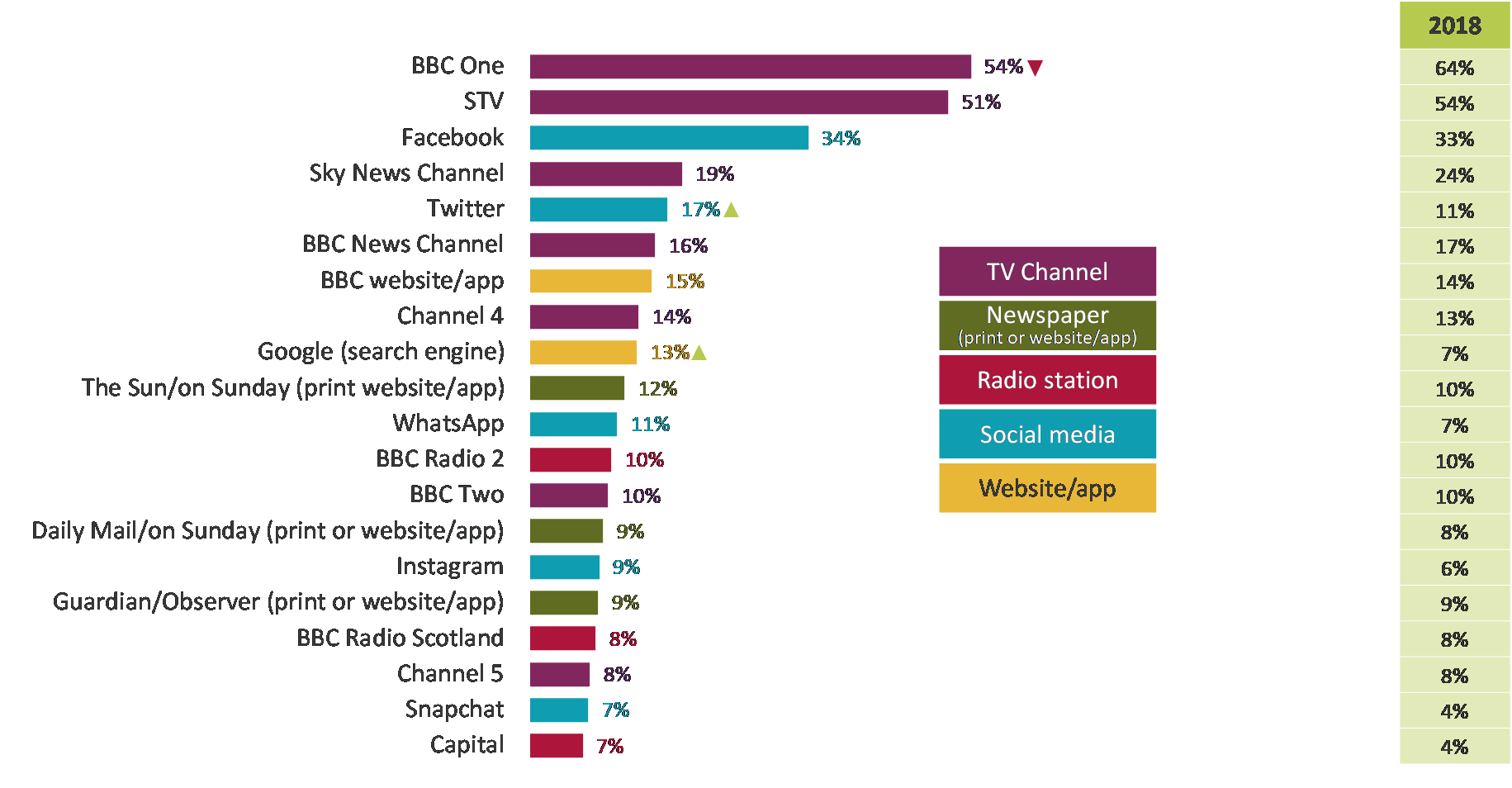
Despite the increasing popularity of online services, television remains the most-used platform for news by people in Scotland. Television channels make up five of the top ten most-used news sources in 2019, with BBC One and STV the most popular overall.

Social media sites are also highly used for news in Scotland; a third (34%) of people now say they use Facebook for news, while 8 of the top 20 most-watched programmes in Scotland in 2018 were live sport events.

Top 20 sources of news in general in Scotland: 2019

BBC One was the top source of news in Scotland in 2018 (54%), but Facebook isn't too far behind (34%).

Small Screen: Big Debate

Today’s findings underpin Ofcom’s recently-launched national debate on the future of public service broadcasting – Small Screen: Small screen: Big debate logoBig Debate.

This will involve broadcasters, production companies, governments, Parliaments, industry bodies, viewers’ groups and national and regional representatives on the wider questions around the future of public service media.

Ofcom is playing a central role in driving the debate, drawing on a range of views, evidence and research.  By the end of the year, we will publish our assessment of the state of public service broadcasting, identifying areas of risk and potential opportunities.

Glenn Preston, Ofcom’s Scotland Director, said: “The way we watch TV is changing faster than ever before.  In the space of seven years, streaming services have grown from nothing to reach over half of Scottish homes.  But traditional broadcasters, who produce brilliant Scottish and UK programmes, still have a vital role to play.  We want to sustain that content for future generations, so we’re leading a nationwide debate on the future of public service broadcasting”.

Read More: Utopia Global, Inc. Brings on Chief Customer Officer to Accelerate Its Growth

Other findings from the report include:

  • The second episode of the eighth and penultimate series of Still Game on BBC One Scotland was the most-watched broadcast programme on TV sets in Scotland in 2018. This episode achieved an average audience of 1,373,000 and a share of 56% of those watching TV at that time (see notes to editors).
  • More than half (54%) of all broadcast TV viewing was to the main five PSB channels in 2018 – BBC One, BBC Two, STV/ITV, Channel 4 and Channel 5. Their collective share of viewing in Scotland was greater than any other UK nation.
  • It was a landmark year for radio, with digital listening accounting for over half of all radio listening for the first time (55% in Q1 2019).
  • The use of smart speakers is increasing in the home. A fifth (21%) of households in Scotland own a smart speaker – up from 12% in 2018.
  • While BBC Radio 2 remains the most popular radio station in Scotland, attracting the most listeners of any individual station, commercial services such as Heart and Forth 1 account for more than half of all radio listening hours across the country.

Read More: inMarket to Acquire Thinknear, Expand Location-Based Marketing Solutions

Varazo Announces Release of Varazo Engage, Digital Marketing Management Platform

Marketers Playground is renamed & upgraded to Varazo Engage, Digital Marketing Management Platform

Varazo announced the worldwide release of Varazo Engage, software that streamlines task flow for digital marketing by providing all the tools you need to manage digital marketing teams & projects of multi-site business such as franchise and marketing agency.

Read More: Utopia Global, Inc. Brings on Chief Customer Officer to Accelerate Its Growth

Whether it’s monitoring data trends, communicating with team members, or managing projects—marketers have to juggle through a variety of tasks in order to manage and optimize their campaigns smoothly. Varazo Engage was designed to eliminate the hassle of juggling through multiple platforms to utilize the tools you need for digital marketing by integrating all the tools you need into a single platform.  Marketers can access task management, marketing dashboards, file & document hosting, website management, and conversion management tools all in one place, at an affordable price.

Read More: inMarket to Acquire Thinknear, Expand Location-Based Marketing Solutions

Regarding the product, James Lee, CEO of Varazo, stated, “As a long-time digital marketer, I’ve observed that outsourced marketers and clients had difficulty communicating and collaborating on marketing tasks. I believe that this product will eliminate those challenges and improve the workflow for digital marketers.”

Varazo Engage provides solutions for franchise business, marketing agencies, and corporations.

Read More: SRAX Announces Growth of SRAX IR Platform and Enhanced Features

Survey Finds Brand Safety Crisis Can Prompt Consumer Backlash Against Brand

More than 80% of Consumers Say They Would Reduce/Stop Purchases of Products That Advertised Near Extreme or Dangerous Content

A new survey of US consumers highlights the significant financial risk to brands from a potential brand safety crisis involving their advertising. Conducted among 1,017 respondents via SurveyMonkey by the Trustworthy Accountability Group (TAG) and Brand Safety Institute (BSI), the survey found more than 80 percent of consumers said they would reduce or stop buying a product they regularly purchase if it advertised in a range of hypothetical situations involving extreme or dangerous content.

“This survey drives home the real and measurable risk to a company’s bottom line from a preventable brand safety crisis,” said Mike Zaneis, CEO of TAG and co-founder of BSI. “While reputational harm can be hard to measure, consumers said that they plan to vote with their wallets if brands fail to take the necessary steps to protect their supply chain from risks such as hate speech, malware, and piracy.”

Read More: SRAX Announces Growth of SRAX IR Platform and Enhanced Features

The survey also discovered that consumers define brand safety broadly, including issues such as ad-related piracy and malware, as well as those involving ad placement around inappropriate content. Among potential topics of brand-unsafe content, consumers expressed the strongest concern about ads running near hate speech, pornographic content, violent content, and illegal drug-related content.

“We were surprised at the nuanced understanding of brand safety risks shown by respondents in this survey,” said Neal Thurman, co-founder of BSI. “While accidental ad placement around criminal activity has been widely covered in the media, consumers recognized that brand safety concerns extends to a full spectrum of more subjective topics. They also assigned responsibility for brand safety across the supply chain, including not only the advertisers, but also agencies, publishers, and ad tech providers.”

Read More: iKala Provides Google Cloud Marketing Analytics Solutions for EC Industry

Notable results from the survey included:

  • Large majorities of respondents said advertisers should prevent their ads from running near hate speech (73 percent), pornographic content (73 percent), violent content (70 percent), and illegal drug-related content (69 percent).
  • More than half of respondents said that advertisers should prevent their ads from running near stolen/pirated movies or TV shows (53 percent) and unsafe or hacked websites (73 percent).
  • Less than half of respondents said advertisers should prevent their ads from running near gambling-related content (43 percent) or controversial political views (41 percent).
  • The overwhelming majority of respondents (90 percent) said it was very or somewhat important for advertisers to make sure their ads don’t appear near dangerous, offensive, or inappropriate content.
  • If respondents discovered ads for a product they regularly buy had appeared next to racist Neo-Nazi propaganda, 87 percent said they would reduce their spending on that product, and 58 percent said they would stop buying it altogether.
  • If respondents discovered such ads next to terrorist recruiting videos, 90 percent would reduce their spending on the product advertised, and 67 percent would stop buying it altogether.
  • If respondents discovered such ads on a website promoting illegal activities such as stolen videos and other content, 82 percent would reduce their spending on the product advertised, and 45 percent would stop buying it altogether.
  • If respondents discovered such an ad had infected their computer or mobile device with malware, 93 percent would reduce their spending on the product advertised, and 73 percent would stop buying it altogether.
  • When asked who should be responsible for ensuring ads do not run with dangerous, offensive, or inappropriate content, respondents assigned responsibility broadly, with 70 percent naming the advertiser, 68 percent the ad agency, 61 percent the website owner, and 46 percent the technology provider.

TAG and BSI have partnered on several other research projects around brand safety topics, including white papers on defining brand safety and related execution challenges, based on extensive interviews with brand safety executives in the digital advertising industry.

Read More: Current Attribution Solutions ‘Verging on Useless’, Say Digital Marketers – Survey

GumGum Names New CFO and Announces Organizational and Leadership Restructuring to Advance Growth Strategy

Patrick Gildea joins as Chief Financial Officer; Ben Plomion appointed Chief Growth Officer; Adam Schenkel & Travis O’Neill promoted to Senior Vice President roles

GumGum, Inc., an artificial intelligence company specializing in solutions for advertising and media, announced  both that it has named tech veteran Patrick Gildea to lead as Chief Financial Officer and that it has revamped its organizational and leadership structures to serve the company’s renewed strategic focus. Gildea’s hiring, new leadership roles and expanded responsibilities for key executives are among the changes aimed to drive growth and enhance GumGum’s core advertising business, domestically and overseas.

“A few months ago, we resolved to refocus our corporate strategy on the lines of business on which we were built––serving the advertising ecosystem,” said GumGum CEO Phil Schraeder. “Today’s announcements––Patrick Gildea’s addition to our executive team in particular–– mark our commitment to that strategy. Patrick is a widely respected, high caliber executive, who knows what it takes to get the build on the success of global, tech-enabled businesses like GumGum. We’re all extremely pleased to have him on board.”

Read More: SRAX Announces Growth of SRAX IR Platform and Enhanced Features

Gildea, who fills the CFO position previously held by Schraeder, joins GumGum with extensive experience leading finance and strategy departments at a number of retail, e-commerce and media businesses, including Incentium, M-GO/Technicolor, Gracenote and, most recently, Joybird, which he led to a successful exit as acting CFO.

Along with Gildea’s hiring, GumGum also announced several promotions and role expansions.

“The leadership moves we’re making are aimed at aligning our sales and marketing efforts, leveraging our leaders’ talents by expanding their responsibilities, and bringing perspectives to the executive table that reflect expertise in segments like programmatic and supply side technologies whose importance is surging,” Schraeder explained. “They will allow us to accelerate our pace of innovation, increase our client focus, and multiply our profitable growth now and into the future.”

The announced changes to GumGum’s leadership and organizational structure are as follows:

Ben Plomion has been named Chief Growth Officer, a newly created executive role responsible for creating value for clients, ensuring product-market fit, developing go-to-market strategy, and elevating customer experience. Plomion will now lead GumGum’s Planning and Sales teams in addition to the award-winning Marketing team that he has led for the past several years as Chief Marketing Officer.

Commenting on his new role, Plomion said, “GumGum has grown exceptionally quickly and to maintain our growth we need to create a unified client experience and blend our sales, marketing and client solutions teams. I’m honored to make that my responsibility and I’m eager to take on the challenge.”

Read More: iKala Provides Google Cloud Marketing Analytics Solutions for EC Industry

“Ben’s rigorous understanding of our customer journey and his focus on client experience insights and measurement will now be unleashed across our business from product development through client delivery,” added Schraeder. “He understands how planning, sales, marketing, product and finance intersect to deliver growth. That makes him the ideal person to formalize our cross-functional capabilities as our business becomes more complex.”

Adam Schenkel has been promoted to Senior Vice President of Commercial Development, a new leadership role responsible for maintaining and growing global advertising partnerships and integrations. In his previous role as Vice President of Programmatic, Schenkel successfully established and grew GumGum’s overseas programmatic business. The advent of this new role answers the need for additional executive level support for GumGum’s growing international business.

“Adam has always been able to establish business partnerships with key industry players and then bring technical integrations to operational fruition,” said Schraeder. “Those qualities, along with his programmatic experience, made him instrumental in our pivot toward programmatic focus in Australia, and they will serve him well as he leads our international programmatic and managed services.”

Travis O’Neil has been promoted to Senior Vice President of Operations, where he will continue to lead GumGum’s Account Management, AdOps, Design, and Business Intelligence team as he did during tenure as Vice President of Operations.

Read More: Current Attribution Solutions ‘Verging on Useless’, Say Digital Marketers – Survey

“Travis has a real gift when it comes to assimilating cross-channel insights and delivering efficient single-point interactions,” Schraeder explained. “With his addition to the leadership team, we’ll be able to accelerate our success in elevating client experience and campaign outcomes across the full scope of clients’ GumGum business.”

Ken Weiner, GumGum’s Chief Technology Officer, will now oversee Publisher Development in addition to his Engineering and Product team leadership functions. Weiner has worked to develop products with publishers in mind since he joined GumGum as its first employee in 2008 and GumGum is now placing increased emphasis on productizing solutions for publishers. This role expansion formalizes GumGum’s commitment to bringing the best of GumGum’s engineering and product capabilities to its publisher partners.

Read More: Utopia Global, Inc. Brings on Chief Customer Officer to Accelerate Its Growth

UK Becomes a Nation of Streamers… but Traditional Broadcast TV Leads the Way on UK Content

Around half of all UK homes now subscribe to TV streaming services, according to a major Ofcom report revealing rapid shifts in the nation’s viewing habits

The number of UK households signed up to the most popular streaming platforms – Netflix, Amazon Prime Video, Now TV and Disney Life – increased from 11.2m (39%) in 2018 to 13.3m (47%) in 2019.

With many homes using more than one service, the total number of UK streaming subscriptions rose by a quarter in 2018 – from 15.6m to 19.1m.

And while traditional TV viewing continued to decline in 2018, the UK’s public service broadcasters – BBC, ITV, Channel 4, Channel 5 and S4C – showed more than 100 times more original, homegrown shows than the overseas streaming platforms.

The findings are from Ofcom’s Media Nations report, a comprehensive study of major trends in UK television, radio and audio, published today.

Traditional channels still form 70% of TV time

Read More: SRAX Announces Growth of SRAX IR Platform and Enhanced Features

Traditional TV viewing is falling at a slightly accelerating rate, driven by the changing habits and preferences of UK viewers.

While traditional viewing still accounts for most TV time (69% – or 3 hours 12 minutes, on average, per day), this fell by nine minutes in 2017, and by 11 minutes last year.

Viewers now watch 50 minutes less traditional TV each day than in 2010. The shift is most pronounced among younger people (16-24s), whose viewing of traditional TV has halved in that time.

The equivalent of 34 extra series of the BBC’s Bodyguard would need to have been broadcast and watched in 2018 to cancel out the decline in traditional TV viewing.

Young now spend hour on YouTube each day

In contrast, average daily viewing to streaming services rose by seven minutes last year, to 26 minutes; while viewing to YouTube rose by six minutes, to 34 minutes. For the first time, young people now spend more than an hour on YouTube every day (64 minutes, up from 59 minutes).

Two in five UK adults (2019 42%, 2018 37%) now consider online video services to be their main way of watching TV and film. Such is the attraction to online viewing, a similar proportion of people who use subscription streaming services (2019 38%, 2018 35%) could envisage not watching traditional broadcast television at all in five years’ time.

Read More: iKala Provides Google Cloud Marketing Analytics Solutions for EC Industry

Best of British

Despite the overall decline in traditional broadcast TV viewing, the five main public service broadcasters’ (PSB) channels[4] held their share of viewing – at 52% in 2018 compared to 51% in 2017. And three-quarters of viewers to the PSBs’ main and portfolio Graphic showing SVod as 221 hours viewed in 2018 and PSB channels as 32,188 hourschannels (74%) claim to be either very or fairly satisfied.

The PSBs are also critical in meeting viewers’ appetite for original programmes, made and produced in the UK, that reflect their lives.[5] They delivered more than 32,000 hours of original, homegrown productions across their channels in 2018.

That is around 125 times more than was shown on paid streaming services (221 hours). The vast majority of programmes available on streaming platforms are US-made productions, created to play out in multiple countries.

While PSBs’ spending on first-run, UK made programmes was 5% lower in 2018 than in 2016 [6], they have found new ways of financing content which has offset this decrease. Third-party funding for programmes, including co-productions, has more than doubled over 10 years to £455m in 2018.

Small Screen: Big Debate

Today’s findings underpin Ofcom’s recently-launched national debate on the future of public service broadcasting – Small Screen: Small Screen: Big Debate logoBig Debate.

This broad debate will involve broadcasters, production companies, governments, Parliaments, industry bodies, viewers’ groups and national and regional representatives in the wider questions around the future of public service media. Ofcom is playing a central role in driving this debate, drawing on a range of views, evidence and research.

By the end of the year, we will publish our assessment of the state of public service broadcasting, identifying areas of risk and potential opportunities.

Yih-Choung Teh, Strategy and Research Group Director at Ofcom, said: “The way we watch TV is changing faster than ever before. In the space of seven years, streaming services have grown from nothing to reach nearly half of British homes.

“But traditional broadcasters still have a vital role to play, producing the kind of brilliant UK programmes that overseas tech giants struggle to match. We want to sustain that content for future generations, so we’re leading a nationwide debate on the future of public service broadcasting.”

Read More: Current Attribution Solutions ‘Verging on Useless’, Say Digital Marketers – Survey

Lucidworks Raises $100 Million From Francisco Partners, TPG Sixth Street Partners, and Top Tier Capital Partners

Silicon Valley firm quietly becoming de facto standard for enterprise and commerce search, delivering personalized experiences for Fortune 1000 customers and employees

Lucidworks, a leader in AI-powered search solutions, announced a $100 million investment from investors including Francisco Partners, a global technology-focused private equity fund, and TPG Sixth Street Partners, a global finance and investment firm. With the investment, Francisco Partners and TPG Sixth Street Partners join Top Tier Capital Partners, Shasta Ventures, Granite Ventures, and Allegis Cyber. No existing investors sold shares as part of this financing and all proceeds will be used to fund Lucidworks’ continued growth and expansion.

“Search is the best way to unlock value from the world’s data,” explains Will Hayes, Lucidworks CEO. “Francisco Partners and TPG Sixth Street Partners understand that getting from question to answer when you’re dealing with thousands of employees, millions of customers, and a mountain of data is still a headache for large corporations. Our team has worked tirelessly to develop AI-powered solutions that augment human intelligence by automating tedious, time-consuming tasks to provide richer insights and real-time recommendations. With the investment, we can continue to advance the enterprise standard for personalization and AI.”

Read More: inMarket to Acquire Thinknear, Expand Location-Based Marketing Solutions

Lucidworks’ flagship product Fusion has doubled revenue year over year for the last three years and is now servicing 400 of the Fortune 1000 with global expansions into APAC and EMEA. Lucidworks was also recognized by Forrester, leading independent analyst and research firm, as a leader in the Forrester Wave: Cognitive Search, Q2 2019.

“We are excited to be partnering with Will and the rest of the management team for the next phase of Lucidworks’ growth. The feedback from customers and analysts has been excellent and we believe Lucidworks is well-positioned to capitalize on the huge market opportunity ahead of them,” said Jonathan Murphy at Francisco Partners. “Lucidworks’ powerful Fusion product enables its customers to deliver highly relevant and personalized search results to the end-user across a broad range of verticals and we believe we are in the early phases of adoption of next-generation search; our goal is for our customers to be able to leverage Lucidworks’ technology to quickly create tailored applications to search specific data sources within the enterprise.”

Read More: SRAX Announces Growth of SRAX IR Platform and Enhanced Features

“Lucidworks’ impressive management team and market-leading position in the enterprise search space makes it a compelling growth story,” said Bo Stanley, Partner and Co-Head of the Capital Solutions business at TPG Sixth Street Partners. “Their investment in this market over many years has made Fusion the best product in the space, which is evidenced by its high quality and extremely loyal customer base. We are thrilled to partner with them on their journey.”

The world’s largest organizations, including AT&T, Honeywell, Morgan Stanley, Red Hat, Reddit, Staples, Uber, and the U.S. Census Bureau, rely on Fusion. Under the strategic guidance of CEO Will Hayes since 2015, Lucidworks has created a new standard in digital experience, delivering personalized customer journeys and valuable business insights to billions of people around the globe.

Read More: iKala Provides Google Cloud Marketing Analytics Solutions for EC Industry

Higher Levels of Automation Expand Revenue Potential for Analytical Instrumentation Manufacturers

Pharmaceuticals, biotechnology, and academics emerge major adopters of analytical equipment, finds Frost & Sullivan

The rise of the Industrial Internet of Things (IIoT) has given a significant boost to the global analytical instrumentation market, making it more automated, data centric, and production oriented. This trend, along with customer demand for efficient analyzers, are prompting analytical equipment manufacturers to offer new solutions that simplify the analytical process, improve automation, store data, and enable access to this data for common use cases. Driven by clients’ high throughput and efficiency needs, the total market is expected to grow from $19.58 billion in 2018 to $20.81 in 2019.

Read More: iKala Provides Google Cloud Marketing Analytics Solutions for EC Industry

“Analytical equipment, including liquid chromatographs and mass spectrometers, will be increasingly used as diagnostic equipment due to the sensitivity and efficiency requirements of diagnostic applications,” said Janani Balasundar Research Analyst Measurement & Instrumentation. “Pharmaceuticalsbiotechnologyacademics, and food testing will be the primary end users of analytical instrumentation. However, there will be a dip in demand for gas chromatographs and gas analyzers due to the slowdown in the chemicals & petrochemicals and oil & gas markets because of fluctuating oil prices and resource scarcity.”

Frost & Sullivan‘s recent analysis, Outlook of Global Analytical Instrumentation Market, 2019, is segmented by the product sectors of chromatographymolecular analysis spectroscopyelemental analysis spectroscopymass spectrometry (MS), analytical microscopes, gas analyzers, liquid analyzers, and analytical x-ray instrumentation. It covers the geographic regions of North AmericaEuropeAsia-Pacific, and Rest-of-World.

Read More: Current Attribution Solutions ‘Verging on Useless’, Say Digital Marketers – Survey

“The market will be bolstered by the strong demand from Asia-Pacific, particularly, India and China,” noted Balasundar. “Analytical equipment manufacturers providing training, awareness, and application knowledge will experience considerable expansion in the emerging markets.”

For additional revenue opportunities in the global market, instrumentation manufacturers will look to:

  • Develop a common data platform that can store and retrieve data in a common format for complex analytical processes.
  • Simplify the user interface and functionality of the equipment to make them easy-to-use for laboratory technicians.
  • Offer predefined templates and method documentation solutions.
  • Provide a simple push and play operation for operators with inadequate training or skills.

Outlook of Global Analytical Instrumentation Market, 2019 is part of Frost & Sullivan’s global Test & Measurement Growth Partnership Service program.

Read More: Utopia Global, Inc. Brings on Chief Customer Officer to Accelerate Its Growth