
Home Blog Page 5186

Gartner Identifies Four Emerging Trends That Will Transform How Marketers Run Their Technology Ecosystems

Hype Cycle for Digital Marketing and Advertising 2019 Provides Insights on Prioritizing Marketing Technology Investments

Artificial intelligence (AI) for marketing, customer data platforms (CDPs) and real-time marketing are some of the technologies at the Peak of Inflated Expectations in digital marketing and advertising, according to Gartner, Inc.

Among the 28 technologies represented in the Gartner Hype Cycle for Digital Marketing and Advertising 2019 report (see Figure 1), four technologies have the capability to transform how marketers run their technology ecosystems and, ultimately, deliver meaningful customer experiences.

“Marketers today must strike the right balance between delivering meaningful customer experiences that differentiate their brands and focusing on providing real value to the business,” said Mike McGuire, a vice president analyst in Gartner’s Marketing practice. “Event-triggered and real-time marketing will have the biggest impact on marketing activities in the next five years. However, before marketers can realize the benefits of these technologies, they must first become proficient in predictive analytics and delivering personalized communications.”

Read  More: Leading Live Festival Event Experience Platform Acquires Event Genius

Gartner has identified four technologies that have the capability to transform how marketers run their technology ecosystems. They include:

Customer Data Platforms

Marketers’ expectations for CDPs remain at an all-time high, but the reported use of the technology differs from the advertised capabilities. Half of enterprise marketers surveyed by Gartner who have deployed a CDP say it’s their CRM system, which indicates a misperception of its purpose and unique differentiators. However, CDPs movement through the Hype Cycle has slowed due to mounting confusion on the saturation and variety of vendors, and feature overlap with similar technologies.

Attempts to differentiate based on auxiliary features — such as customer journey design and optimization, rule-based attribution, final-mile campaign execution, and website personalization — highlight redundancy with other, more mature marketing technologies.
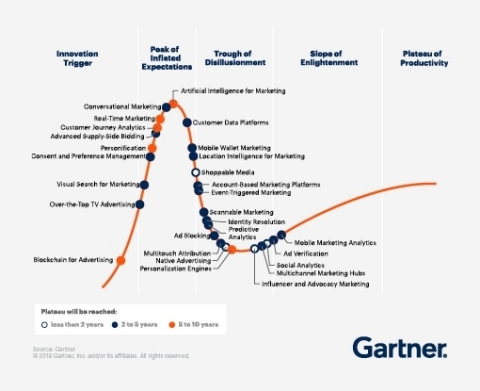
Gartner Hype Cycle for Digital Marketing and Advertising 2019

AI for Marketing

In its two years on the Hype Cycle, AI for marketing has quickly risen to the Peak of Inflated Expectations. The hype around this technology will not fade quickly, as AI continues to be the buzzword used to describe a host of features to augment the functions performed by marketers — from automated content tagging to real-time personalization.

Over the next 20 years, the power AI holds with marketers will drive pervasive shifts across the marketing technology ecosystem, effectively transforming the marketing practice. A Gartner 2018 survey revealed that 11% of marketing technology executives reported AI as their top choice as the technology that would have the most impact on their marketing efforts in the next five years.

Blockchain for Advertising

Blockchain for advertising holds tremendous promise for marketers. However, significant challenges with scalability, performance and adoption must be overcome before blockchain can alter the status quo. Dozens of companies have launched experimental blockchain platforms for advertising, but none have been able to demonstrate ongoing viability.

Despite the skepticism, the technology is gaining momentum through support from organizations such as the Interactive Advertising Bureau (IAB) and emerging innovations from technology companies such as IBM, Comcast and Amazon, which are working with industry leaders on the buy and sell side of media. Disruptive challengers from outside the industry are also adding urgency.

Read  More: Over 53% of Social Media Logins Are Fraud! Can Customer Data Be Trusted?

Real-time Marketing

Advances in technology are creating an environment characterized by on-demand marketing, not just always-on marketing. Search technologies and social media make it easy to share, compare and rate experiences while they are happening. Ignoring the real-time nature of customer behavior and expectations leads to lost opportunities or, worse, development of full-scale media crises.

Leading brands — in travel and hospitality, financial services and insurance — are combining behavioral analytics and marketing automation to serve up the right offer or message at the right time based on specific customer behaviors. To date, most real-time marketing use cases focus on demand generation, advertising, promotion, sales and service.

However, many multichannel marketers still struggle for relevance in core customer engagement moments and lack a clear business case for real-time engagement. Gartner’s 2019 Multichannel Marketing Survey showed that less than half of respondents (44%) use predictive modeling or rigorous testing to determine if a real-time response is warranted when designing event-triggered marketing. To close the gap, marketers must look to revamp processes and make greater use of marketing technologies for customer data gathering, analysis and activation.

In addition, Gartner guides marketers to continue to monitor and be aware of other technologies such as conversational marketing and multitouch attribution, which are high impact and moving forward.

Read  More: TIDAL Unveils Playable Video Sharing Capabilities For Instagram Stories

Lotame Sees 1,200% YoY Growth in Second-Party Data Adoption Globally

1

Company also taps data expert from L’Oréal, MediaMath & Yahoo as GM of Global Data Marketplace as second-party data adoption skyrockets in response to regulation and calls for transparency

Lotame, the world’s leading unstacked data solutions company that helps publishers, marketers and agencies find new customers, increase engagement, and grow revenue through audience data, announced 1,200% year-over-year growth in second-party data adoption from April 2018 to April 2019 based on usage of Lotame’s 2nd-Party Data Marketplace.

“With our 2nd-Party Data Marketplace, we have built the pipeline to a new era of data connectivity in the digital ecosystem,” said Evgeny Popov, Head of Global Data Solutions at Lotame. “We are making it possible for parties — whether you’re a marketer or a publisher — to connect to transparent datasets directly from the source at global scale. The demand for a partner that can enable that is at a fever pitch and we are excited to meet the opportunity.”

Read More: TIDAL Unveils Playable Video Sharing Capabilities For Instagram Stories

Lotame’s 2nd-Party Data Marketplace provides a safe and secure peer-to-peer exchange for data owners and buyers to connect, directly discover and size target audiences, free from the inefficient and costly process typically associated with third-party data providers and aggregators. It offers unique capabilities in the industry such as allowing DSP buyers who aren’t Lotame platform customers to connect and buy second-party data directly from Lotame partners who are. Lotame partners with over 50 activation partners including Google, Twitter, The Trade Desk, AppNexus, and more.

In addition to outstanding yearly growth, Lotame has seen a stunning 300% rise in revenue over the first four months in 2019 alone. In February, Lotame announced a 273% increase in global revenue since 2017, meaning that they have more than quadrupled their growth over the last several months.

“The explosive growth of second-party data also demonstrates the impact privacy regulation — such as GDPR and the CCPA — and transparency needs have had on data strategies,” added Popov. “With the use of second-party data, marketers and publishers gain a much needed sense of security since they know the source and trust the reliability. In a transparency-driven marketplace, data buyers require assurances as to the quality and precision of the data they purchase for campaigns and activations. The key for us is directly connecting data buyers to data sellers, so they know exactly where their data is coming from, how it is being sourced and can then ensure high-quality data at scale having direct conversations on needs and expectations.”

The upward trend towards second-party data also presents a new revenue stream for publishers and brands. Late last year, Lotame conducted research that found one-third of brands and publishers are actively creating new monetization opportunities by becoming second-party data sellers, leveraging the demand for data quality for their benefit. In the recent report, The Forrester Wave™: Data Management Platforms, Q2 2019, analysts recommended Lotame for publishers who want to “monetize their first-party data and use audience insights to customize new content or products,” as well as for marketers who want to “forge direct relationships with publishers or other advertisers.”

Read More: Brainshark Recognized in Gartner’s Market Guide for Sales Engagement Platforms

In response to its rapid growth, today, Lotame has also announced that it has tapped Aruna Paramasivam to serve as GM of Global Data Marketplace, a new role within the company. Paramasivam is recognized as a data expert in the advertising industry and joins Lotame after serving in roles such as Head of Data Acquisition & Partnerships at L’Oréal and Head of Audience Partnerships at MediaMath. She also spent several years at Yahoo working in audience platform implementation roles. Paramasivam will be overseeing global data acquisition efforts to balance market demands, and primarily focusing on niche and specialized data sets that provide high data quality at scale.

“As privacy regulation continues to spread and marketers increasingly require transparency, we’re seeing savvy publishers with trusted first-party data advantages,” said Paramasivam. “Challenged to compete against the duopoly, publishers are leveraging this demand for high-quality audience data to monetize their own first-party data. Clearly, the benefits of second-party data are resonating with marketers and publishers alike and we expect this number to only continue to increase in the coming years.”

Paramasivam continued, “Brands like Lonely Planet and eDreams are participating in Lotame’s 2nd-Party Data Marketplace and leveraging their core travel expertise to create specific and coveted travel audiences based on searches, purchases and research activity through their own sites. Being a data seller, Lotame also has the ability to educate its sellers and match them with the appropriate data buyers. For instance, if a CPG brand client is looking to launch new travel size products, Lotame could connect them with Lonely Planet or eDreams to reach frequent travelers with precision and scale, facilitating the connection, pipes and activation.”

eDreams ODIGEO, one of the world’s largest online travel companies, under its four leading online travel agency brands, eDreams, GOVoyages, Opodo and Travellink, and the metasearch engine liligo.com, provides access to the largest audience of travelers in Europe with 1.7 billion monthly searches on their websites. “Our 261 websites and Apps are a go-to destination for travel-hungry audiences,” says Zaida Salie, Director Media Services at eDreams ODIGEO. “From searches, purchases and research conducted across our sites, we have built one of the most unique travel audience data assets in the world. Lotame’s 2nd-party data marketplace supports us in helping brands reach frequent travelers with greater precision and scale.”

Read More: ViralGains Odyssey Gives Customers a Voice in Advertising

The Fort Collins Utilities (CO) Selects ACS for an Advanced Distribution Management System

Advanced Control Systems (ACS), an Indra company, announced that Fort Collins Utilities, in Colorado, has selected ACS for their Advanced Distribution Management System (ADMS) as part of a multi-year digital transformation project. This journey will bring Fort Collins to the forefront of the electric utility industry. Fort Collins Utilities’ objective is to increase system resiliency for their customers, as well as address the changing landscape of the utility industry. This initiative provides a technology roadmap for other utilities interested in grid modernization.

Read More: Smartling Promotes Ani Obermeier to Vice President of Marketing

The first phase includes the implementation of  PRISM™ OMS (outage management system) that will greatly increase the efficiency and effectiveness of  Fort Collins Utilities’ operations and crews, as they work to restore power after outages.  By leveraging the ACS suite of mobile applications, the crews will have access to real-time system information in the field and be able to provide vital information about outages so customers will be better informed regarding estimated time for restoration.

Read More: Adobe (Magento) Named A Leader In 2019 Gartner Magic Quadrant For Digital Commerce Platforms

“Both Fort Collins Utilities and ACS share the vision of where the utility industry is headed and want to be leaders when it comes to grid modernization,” explains Jon Grooters, Sales Director for ACS.

“Fort Collins Utilities understands our customers need to be informed as power outages impact both residents and businesses. Our effort with this project is to modernize our system to meet those expectations for our customers’ success,” states Kevin R. Gertig, Utilities Executive Director.

Read More: New Survey Reveals Americans Choose Dentists Based On Online Reviews, Proximity And Rank In The Search Results

red violet Raises $7.5 Million to Meet Demand and Accelerate Growth

Funding to fuel sales, product development, and marketing as additional capital unleashes growth opportunities

Red Violet, Inc., a leading analytics and information solutions provider, announced the closing of $7.5 million in growth financing from existing and new investors through the sale of 681,000 shares of common stock in a registered direct offering. The funding underscores the faith in red violet, its team and its current strong growth trajectory. The Company intends to use the proceeds to accelerate market expansion through new investment in sales, product development and marketing, as well as for working capital and other general corporate purposes. The Company has no intention of accessing any additional funds under the Company’s registration statement.

Read More: DataRobot and CallMiner Partner to Accelerate AI Capabilities

“While we had sufficient capital on our balance sheet to achieve positive free cash flow, we are pleased to announce that we have raised the requisite growth capital to accelerate our business. As evidenced in our recent quarterly results, we have tremendous demand for our products and are constrained in resources to not only meet demand but to avail ourselves of the various other strategic opportunities before us,” commented Derek Dubner, red violet’s CEO. “Investment in specific areas of the Company will accommodate increasing demand in the near term and will lay the foundation for the acceleration of our business, including investment in sales, our technology team, and marketing personnel. While we have grown revenues approximately 80% in the first half of 2019 and expect that growth to continue throughout the remainder of the year, we believe that deploying this capital will position us to accelerate our growth rate in 2020 to greater than 100%. Notwithstanding the deployment of this growth capital, we expect to achieve positive free cash flow in the first quarter of 2020.”

TwoConnect Makes BizTalk Migrate/Upgrade to Azure Cloud Available in the Microsoft Azure Marketplace

Microsoft Azure customers worldwide work with TwoConnect to take advantage of the scalability, reliability, and agility of Microsoft Azure to drive application development and shape business strategies.

TwoConnect, modern integrated applications and data solutions experts, announced the availability of its BizTalk Migrate/Upgrade to Azure Cloud 3-Day PoC migration consulting service in the Microsoft Azure Marketplace, an online store providing applications and services for use on Microsoft Azure. TwoConnect customers can now take advantage of the scalability, high availability, and security of Azure, with streamlined deployment and management.

Read More: Podium Announces Partnership With Kia Motors America, Inc. In Their Social Media & Reputation Management Program

The TwoConnect BizTalk Migrate/Upgrade to Azure Cloud Solution

TwoConnect’s BizTalk Migrate/Upgrade to Azure Cloud three-day briefing utilizes a proof-of-concept format that discusses whether or not it is worth upgrading to BizTalk or migrating your integrations to Microsoft Azure Logic Apps. Through the BizTalk 2020 Upgrade or Migrate to Azure proof of concept, you’ll explore the requirements for upgrading or migrating, review requirements for configuring on-premises gateway and code-level refactor recommendations, and learn about Azure to on-premises connectivity and more.

You’ll leave this session with a clear understanding of your options and your own roadmap for success – whether to BizTalk 2020 or Microsoft Azure Integration Services – as well as an understanding of your support and maintenance options and your managed services options.

BizTalk touches everything in your organization. Our award-winning BizTalk Managed Services team focuses on supporting, maintaining, and adapting your integration solutions to ensure the seamless continuity of your business operations.

Benefits of Migration to Azure

TwoConnect can help you move your data to the cloud, giving your company the ability to scale up or down at will, increase reliability, improve compliance, and greatly impact high availability of your workloads. Take advantage of serverless integration to easily connect data, apps, and devices anywhere, keeping all your disparate systems up-to-date, in real-time, and then easily collect, transform, and visually analyze your most strategic data. With Azure, integration has never been easier.

Read More: ThoughtSpot Raises $248 Million At $1.95 Billion Valuation To Transform Enterprises With Search & AI-Driven Analytics

From Javier Mariscal, President, TwoConnect

“TwoConnect builds modern, integrated software apps and data solutions. We successfully merge the worlds of Microsoft and open source to bring powerful business solutions to organizations everywhere. We simplify modern software development for everyone through our team of amazing Microsoft MVPs, certified development managers, trainers, and our extended worldwide community of integration experts with whom we’ve partnered for over two decades.”

From Microsoft

“Through Microsoft Azure Marketplace, customers around the world can easily find, buy, and deploy partner solutions they can trust, all certified and optimized to run on Azure,” said Sajan Parihar, Senior Director, Microsoft Azure Platform at Microsoft Corp. “We’re happy to welcome TwoConnect’s solution to the growing Azure Marketplace ecosystem.”

Read More: Undertone Names Daniel Aks As President


Finastra Strengthens APAC Team with Wissam Khoury as New Head

Expanded role sees Khoury become SVP and General Manager for MEA and APAC

Finastra has appointed Wissam Khoury to lead its Asia Pacific (APAC) business. In this new expanded role as Senior Vice President and General Manager for Middle East and Africa (MEA) and APAC, Wissam is responsible for driving Finastra’s growth strategy, strengthening its regional footprint, accelerating sales and continuing to deepen customer partnerships across both regions.

Read More: NoxInfluencer Helps People Use YouTube Channel Stats for Channel Optimization

Wissam has a very successful track record in managing high performing teams, having spent more than two years leading Finastra’s MEA operations as Managing Director. The new combined position, overseeing Finastra’s APAC and MEA regions, will foster synergies and sharing of best practice in similar high growth-potential markets. Wissam will leverage his customer-centric approach to strengthen existing client relationships and expand Finastra’s footprint in the region by bringing in the latest development and innovation to the financial market, such as Open Banking, cloud solutions and Finastra’s FusionFabric.cloud platform.

Eric Duffaut, President & Global Head of Field Operations at Finastra, said, “With over 20 years of experience helping financial institutions build competitive advantage and proven success in driving agile growth and results-driven teams at Finastra, Wissam is the right person to help us continue our journey and gain even greater market share in APAC. We look forward to seeing the regions benefit from shared best practice and supporting our customers as they transform their businesses.”

Read More: LeanData Appoints Chief Revenue Officer to Drive Next-Level Growth

Prior to joining Finastra, Wissam held senior roles at banking and payments software organizations across MEA. He has also made an instrumental contribution to the growth of the region’s fintech industry.

Wissam said, “I am very excited to lead the new expanded territory as Asia is one of our fastest growing regions, with lots of opportunities to help banks drive digital transformation, cloud adoption and the move towards new platform-based business models. Finastra is best positioned to accelerate innovation and drive collaboration between financial institutions and fintechs to create the ultimate customer experience for banks’ clients.”

Wissam took up his new role on 1 August and will split his time across both regions with bases in Singapore and Dubai.

While Finastra welcomes Wissam to Singapore, the company also sees the departure of Imad Abou Haidar, Managing Director, APAC, who will leave his role on 31 September to pursue a new opportunity.

Read More: RollWorks Launches Account Scoring Powered By Machine Learning To Help Account-Based Teams Prioritize The Accounts That Matter Most


Tomorrow’s CFOs Need New Skills and Tech to Survive

1

With CFOs roles expanding beyond treasury duties and bookkeeping tasks, it has become imperative for them to work on their skills and invest in smart tools. Studies by KPMG hints that one out of three CEOs think that their CFOs are not up to the mark.

New Expectations from CFOs

  1. Maintain strategic relationships with major stakeholders within and outside the organization.
  2. Develop a vision and strategy on how finance can back the business.
  3. Strategic decision making.
  4. Monitor and forecast trends.
  5. Plug skill gaps in the finance department.
  6. Manage regulatory authorities.
Read More: Hyperlocal Marketing, For E-Commerce?

Automate Right, Embrace Fintech

85% of CEOs of top organizations believe that applying financial data to achieve profitable growth is the greatest value addition CFO can bring in. Big Data tools can help CFOs and the managers under them to mine data and forecast market conditions. Finance departments of companies across the globe have embraced invested in such AI-enabled tools. A report by Ernst & Young suggests that around 80% of finance-related applications will very soon transform into cloud applications. Presently, the finance departments waste 25 % of the time working on excel sheets. So it’s a priority for organizations to automate such tasks. The AI-enabled software can take care of the data entry works of the finance department. This essentially gives CFOs more hands on the deck for strategizing. Machine learning is being increasingly utilized to negotiate the best supplier terms. It enhances cash flow in times of need. This essentially means the finance department can function with the lesser workforce. Larger coordination can be achieved with cloud-based applications.

CFOs as Strategy Leaders

Though the primary duty of CFO surrounds finances, the planning and risk assessment has gained prominence in the list of duties. Critical data related to finances have to be monitored more closely by modern-day CFOs. According to McKinsey’s research, more than 60 % of growth comes from riding on favorable tailwinds in the market. The finance department is increasingly in pressure to identify these tailwinds. Companies that pursue growing sectors reap better profits. CFO plays a key role in strategizing transformations and acquisitions. According to Boston Consulting Group, 52% of large public companies in Europe and North America announced transformations in 2016. Most of these companies announced multiple rounds of cost restructuring, reorganizations, and downsizing during a short span of two years. The CFOs role has changed in these instances to shaping priorities, defining KPIs and communicating the value creation story to investors. Leadership qualities serve more purpose now as in several markets CFOs are considered for the upward shift CEOs.

Read More: Aprimo Unveils “Aprimo AI” For Its Digital Asset Management (DAM) And Productivity Management Solutions

Credit: McKinsey

Communication Skills Inevitable Now

CFOs are increasingly playing the role of advisors to the CEOs. Though studies say that only a few CEOs change their decision based on the CFOs suggestions, constant feedback is demanded in matters like Budget Management. CFO plays advisory roles in tasks such as real estate acquisition. Also, the communication of the finance department to all non-experts needs to be led by CFO. Similarly, some of the works of CFOs overlap with that of HR since recruitment in the financial department happens under CFOs watch. Above all CFO communicates the financial baseline against which company measures its success. This calls for better presentation skills and improved communication skills than before.

Read More: FB Starts Campaign To Teach UK Citizens On How To Use Their ‘Privacy Settings’

Adjust Taps Mobile Growth Executive Moshi Blum to Oversee Expansion in Israel

3

Blum to become the company’s General Manager Israel

Adjust, the industry leader in mobile measurement, fraud prevention and cybersecurity, announced the appointment of mobile marketing expert Moshi Blum as General Manager Israel. In his role, Blum will be responsible for accelerating growth in the market and building out the team in Tel Aviv.

Dubbed the “Startup Nation,” Israel is home to more than 6,000 startups, and hosts R&D bases to more than 300 global technology companies. Currently, 9% of Israelis work in the tech industry, but the Aaron Institute for Economic Policy predicts that this will rise to 15% by 2030.

Read More: Mergers and Acquisitions and Meltwater Refinancing Reshape PR Software Market

“As a major tech hub where we already have our Unbotify company, Israel is a great place for us to expand our presence,” said Christian Henschel, co-founder and CEO of Adjust. “With his vast experience in mobile marketing Moshi will help Adjust leverage its culture of innovation and establish a strong foothold in the Israeli market.”

“Even before joining Adjust, I’ve always been one of its biggest advocates,” Blum commented. “I’m honored to help Adjust grow its team in Tel Aviv and strengthen its footprint in the Israeli market. Our goal is to assist companies in growing their businesses through providing mobile marketing, campaign management and fraud prevention solutions.”

Read More: FB Starts Campaign to Teach UK Citizens on How to Use Their ‘Privacy Settings’

Blum joins the company from Rakuten Viber, one of the world’s largest communication platforms. As Head of User Acquisition and Growth, he utilized both organic and paid strategies to drive app growth, while also overseeing the retention of more than 900 million users worldwide. He has nearly a decade’s experience in business development, marketing and sales in Israel, with a specialization in mobile growth. Prior to Viber, Blum was Head of Social at Moburst, an Israeli-based company helping brands and startups grow their mobile business.

Blum’s appointment comes during a highly successful year for the company. Adjust acquired two companies at the beginning of the year, and in June, secured one of Europe’s largest funding rounds in 2019 to date, raising $227 million. It will use the capital to invest in the product, bolster talent acquisition, and strengthen market share in new and existing regions, including Israel.

Adjust opened its Tel Aviv office earlier this year after acquiring Israel-based company Unbotify, and launched a bespoke, individually-tailored solution harnessing AI and machine learning to end in-app bot fraud.  The acquisition forms part of Adjust’s broader commitment to fight fraud on a global level and extends Adjust’s vision to make marketing simpler, smarter and more secure, and offer actionable data insights to help customers scale their business.

Read More: Dentsu Aegis Network Acquires Top Direct-to-Consumer Marketing Agency MuteSix

VvAA Groep B.V to Transform Service Experience and Performance with Vonage’s NewVoiceMedia Solution

0

Vonage a global business cloud communications leader, announced that VvAA Groep B.V has selected its NewVoiceMedia (NVM) contact center soution to boost its members’ customer experience.

VvAA Groep B.V is a member organization and a leading insurance provider for healthcare professionals and institutions in the Netherlands. The group’s main objective was to provide a state-of-the-art experience for its members and customers, while strengthening its performance, operational efficiencies and team productivity. Following a market evaluation, the company implemented Vonage’s contact center solution for its Salesforce integration and rich functionality.

Read More: Mergers and Acquisitions and Meltwater Refinancing Reshape PR Software Market

Freek Roelofs, member of the Executive Board at VvAA Groep B.V, comments, “We wanted to raise the bar on the experience for our members and customers with the introduction of Vonage’s contact center solution integrated with Salesforce. Implementing the new contact center technology across our business will enable our advisors to improve the quality of each call they have, and also boost our service in terms of our processes. This is an investment in our relationship with our members and customers and we look forward to making this transformation.”

VvAA Groep’s advisors will now benefit from immediate access to a customer’s entire history of interactions, and inbound calls can be dynamically managed and routed, ensuring callers are connected to the most appropriate agent – improving handling time and customer satisfaction. The routing capabilities of Vonage’s solution can also help optimize performance by identifying callers who have previously received a quote and routing them directly to the account team or assigning them higher priority in the queue.

Read More: Mergers and Acquisitions and Meltwater Refinancing Reshape PR Software Market

All advisors can log into the same system wherever they are, as all they need is a phone and internet connection, meaning they can work from multiple locations. The platform offers a real-time window into the entire contact center operation, so agents can be easily managed, and call recordings together with customizable reports allow the company to understand where improvement opportunities exist.

Paul Turner, VP Benelux and Nordics at Vonage, adds, “We are pleased to have been chosen as an important partner of VvAA Groep B.V and look forward to seeing the company transform its member and customer experience, together with its business efficiencies. Salesforce integration is central to Vonage’s contact center solution, enabling businesses like VvAA Groep to create customer experiences that help them serve better and sell more. Our solution integrates effectively, for better access to rich customer data, from which agents can make personal connections through every channel.”

Read More: FB Starts Campaign to Teach UK Citizens on How to Use Their ‘Privacy Settings’

Identifying the Key Ingredients for Optimizing Customer Experience

2

Liveclicker logoEmail is often the key ingredient in cooking up a successful Marketing campaign, leading to happier customers who are willing to buy your products or services. But many email marketers wonder how they can use Email Marketing in new ways. This article offers three tips anyone can follow to become a true master chef and serve up a winning recipe for their next Marketing campaign with enhanced customer experience.

Not that long ago, email was used as a one-way channel for sending a single, impersonal message to a large audience. It was — and still is — an extremely cost-effective channel, but Marketing teams that continue to use it in this way are missing a real opportunity to connect with consumers and engage them in a meaningful way. (Worse, they could get left behind.)

Today, thanks to many innovations related to real-time Personalization and other advanced experiences, email is often the secret ingredient in the most successful Marketing campaigns. Why is this? When used to its full potential, email connects with consumers on a one-to-one basis. In doing so, it delivers a much better experience, one that is capable of converting prospects, generating higher Sales, improving Customer Retention, or achieving just about any other Marketing Technology goal.

Read More: 72 Stats To Understand SEO In 2018 (Infographic)

Focusing on Customer Experience Is the Winning Recipe

As you consider these benefits, think of your own approach. To stay with our culinary metaphor, are you a master chef, taking full advantage of all that today’s advanced email experiences have to offer? Or are you still in the “send-one-message-to-many” phase, essentially throwing spaghetti at the wall to see what sticks?

If you don’t yet consider yourself to be an email master chef, this article will provide three important tips to help you create the best customer experience possible. It will also describe how creating helpful, highly personalized, customer-focused email is now the winning recipe in successful Marketing campaigns. Yet there’s something more. We’ll show how improving the customer experience can help you increase customer satisfaction and loyalty, generate impressive new results, and achieve the fastest ROI possible.

Read More: Why is Delivering Online Customer Experience Actually Harder to Measure than Anticipated

Do Today’s Marketers Have the Key Ingredients?

Before we get started, we need to take stock of our kitchen to see if we have the right tools and ingredients to succeed. It turns out that we all do, but we tend to overlook the most important ones. For proof, a joint study recently conducted by Liveclicker and Holistic Email Marketing shows that while many brands are making progress toward the goal of delivering the best customer experience possible, many still have a long way to go.

This research report, “Customer Experience Email Marketing: Getting Ahead of the Consumer,” surveyed 82 different retail and travel brands to see how well they delivered on three pillars of great customer experience: Helpful Content, Personalization, and Customer-focused messaging. According to Holistic Email Marketing, these three attributes are essential to improve Customer Experience (CX).

Read More: How AI Can Be Used To Shape Your Customer Experience

The Three Pillars for an Improved Customer Experience

What can marketers do to improve in each of these three pillars and create a better customer experience? Let’s take a closer look at each one and highlight specific best practices you can follow to achieve better results:

1. Helpful Content

Emails are obviously short messages, so many Marketing teams feel the pressure to sell, sell, sell! Yet in doing so, they may miss the opportunity to connect with their recipients and stand apart as a partner invested in the customer’s success. Worse, these marketers may risk alienating consumers and lose them forever.

Many Marketing teams today are flipping the script by delivering content that helps recipients succeed with their own objectives. Examples of this include industry research, tips, tricks, and best practices, ROI tools, buying guides, and more. These Marketing teams have discovered that email content that helps the customer goes a long way to help them accomplish their goals, too.

2. Personalized Content

Many marketers think of Personalization as the end product, or the use of data to introduce personally relevant information in an email blast or a triggered email. But true Personalization is so much more than just merging the customer’s first name into a subject line or a greeting. Instead, it’s about using preference data in segmentation, behavioral data in email messages, or those contextual elements that can make a message more helpful or customer-centric.

Contextual Personalization is a fast-growing technology that takes marketers on the journey from mass broadcast emails to true one-to-one messaging. For example, using moment-of-open technology, real-time Personalization tools can show changing weather conditions, deliver in-message polls or videos, update product images or offers, provide in-email shipment tracking, and so many other examples. All of this creates new experiences that delight recipients and help marketers stand apart from the competition.

3. Customer-centric Marketing

On one hand, this element should be the easiest to achieve because it seems to rely on copy tone and overall approach. But it’s actually one of the most difficult because it forces marketers to change their habits. Specifically, they need to do a better job demonstrating how their products benefit customers — not just how various features work.

Many marketers default to an approach where they attempt to sell a product based on its features, such as what it does, how it works, or what makes it different. This information may be valuable in a different context, but as an email message, it will fall flat with consumers who want to know how this product can help them overcome a specific problem.

Read More: Why Better Parental Leave Matters for the MarTech Industry

Become an Email Marketing Master Chef

Focusing on the three pillars of Customer Experience Email Marketing will help you begin the process of becoming an Email Marketing Master Chef. Specifically, improving in areas such as Helpful Content, Personalization, and Customer-centric messages will keep you from throwing pasta at the wall to see what sticks and help you create new recipes for your next great main course.

Read More: Why Better Parental Leave Matters for the MarTech Industry