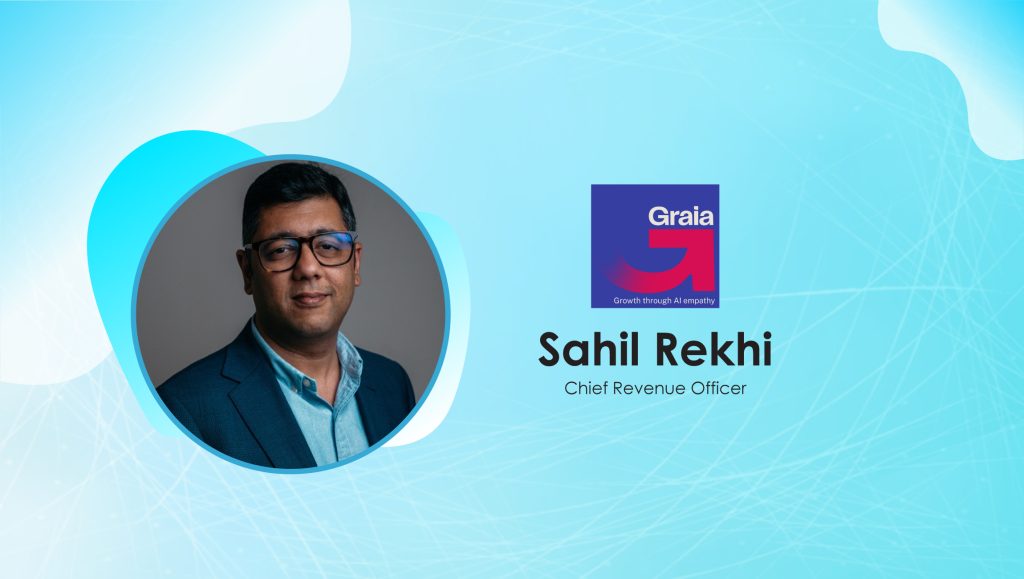
Sahil Rekhi, Chief Revenue Officer at Graia chats about the benefits of using agentic AI to craft more intuitive experiences across sales and marketing cycles in this SalesTech Star interview:
__________
Hi Sahil, tell us about yourself and your role at Graia.
I’m Sahil Rekhi, Chief Revenue Officer at Graia. I lead our global revenue strategy, overseeing sales, partnerships and market expansion. My focus is to help enterprises unlock new value through Agentic AI and intelligent contact center solutions. With decades of experience in transforming customer experience and AI domains, my role is to bridge cutting-edge innovation with measurable business outcomes—accelerating revenue and elevating both customer and employee experiences.
What makes your GenAI platform for user and customer interactions different?
Graia stands apart because we’ve reimagined the entire AI-powered engagement stack from the ground up. Unlike most players that bolt AI onto legacy systems, our platform natively fuses Agentic Contact Center-as-a-Service (CCaaS) capabilities with an Agentic AI agent orchestration layer. This means our customers don’t just automate tasks—they create intelligent agents that reason, act and adapt across complex workflows in real-time.
Additionally, we own the full stack—both the contact center infrastructure and the AI—which gives Graia unmatched agility, control and depth. Most importantly, we’ve built the system to be empathetic by design, blending human-like interactions with intelligent decision-making for a truly elevated experience.
How are you seeing AI impact the way customer interactions are led or planned today in terms of workflows?
AI has shifted customer workflows from static, reactive processes to dynamic, proactive journeys. We’re now seeing leading enterprises design experiences not just around inbound queries but around predicted needs—thanks to real-time data analysis, context-aware agents, and predictive orchestration.
Gartner predicts that by 2029, Agentic AI will autonomously handle 80% of standard customer queries, reduce operating costs by approximately 30%, and free up teams to focus more on high-value, growth-driven interactions.
With Agentic AI, workflows are no longer linear. Agents can take initiative, interpret customer intent, retrieve knowledge, and coordinate actions across systems autonomously. It’s transforming how businesses think about support—not as a cost center, but as a growth engine.
Read More: SalesTechStar Interview with Travis Rehl, CTO and Head of Product at Innovative Solutions
What will customer service look like in the future in your view as AI starts permeating varied aspects of this business function?
The future of customer service will be deeply agentic—autonomous, predictive and hyper-personalized. AI agents will act as trusted copilots, handling everything from first contact to resolution, and even post-interaction follow-ups.
We’re already seeing early signs of this shift. In a recent Gartner survey conducted among enterprise decision-makers, 64% stated that they are pursuing significant Agentic AI initiatives within the next six to 12 months in their organizations.
Traditional tiered support models will dissolve, replaced by intelligent service layers where AI handles most interactions and humans are brought in only for exceptions or strategic moments. But beyond efficiency, service will become more human—not less—because AI will empower organizations to understand context, sentiment and intent at scale.
Why is it becoming more and more crucial for AI systems to be built with empathy in mind?
According to Cisco’s global research report, 89% of customers say they value a blend of AI efficiency and human connection. In other words, people don’t just want fast responses—they want to feel understood. That’s where empathy comes in.
As AI takes on more responsibility in customer interactions, it’s not enough for it to be intelligent or responsive—it also needs to be emotionally attuned.
AI agents must be engineered to listen, understand and respond with contextual sensitivity to ensure that customers feel heard, not handled. Empathy isn’t just a feature—it’s a foundation. In high-stakes moments, such as complaints, cancellations or confusion, the difference between churn and loyalty often comes down to how a customer feels and whether they feel understood.
Can you highlight a little about some of the top global brands that have successfully deployed AI for customer support and customer service functions?
Across the global AI landscape, we’re seeing brands such as Bank of America, IKEA, Vodafone, and Emirates lead the charge in adopting AI for CX. These organizations are not just deploying AI to reduce costs—they’re strategically transforming their customer engagement models to create intelligent, emotionally resonant, and proactive service experiences that set them apart in competitive markets.
Together, these brands represent the future of customer experience—one where empathy, intelligence, and automation work in concert to deliver lasting value.
Read More: Beyond CRM: How SalesTech is Shaping the Future of Deal Management?

Graia is an Agentic Contact Center-as-a-Service (CCaaS) and GenAI platform purpose-built to deliver more empathetic, intelligent, and autonomous customer experiences at scale. By combining deep customer experience (CX) expertise with proprietary Agentic AI and fully owned CCaaS IP, Graia helps enterprises drive revenue, enhance productivity, and scale support with confidence.
Unlike traditional platforms, Graia adapts in real-time, interpreting user intent, tone and behavior to personalize interactions across service, sales and operations. Graia’s conversational and GenAI models prioritize the user’s perspective, allowing brands to deliver human-like responsiveness and bring a new level of understanding to every user interaction.
Sahil is a GTM leader with a proven track record, with 20 years of industry experience covering development & GTM of Customer Experience, AI , and Communications Solutions globally to businesses of all sizes, to drive accelerated revenue growth.
At Graia, Sahil is responsible for all aspects of sales and marketing, ensuring revenue performance globally. This includes demand generation, brand awareness, and all sales via direct sales, partner sales, and strategic alliances. Before Graia, Sahil was responsible for all indirect revenue globally via partner sales at Kore.ai.