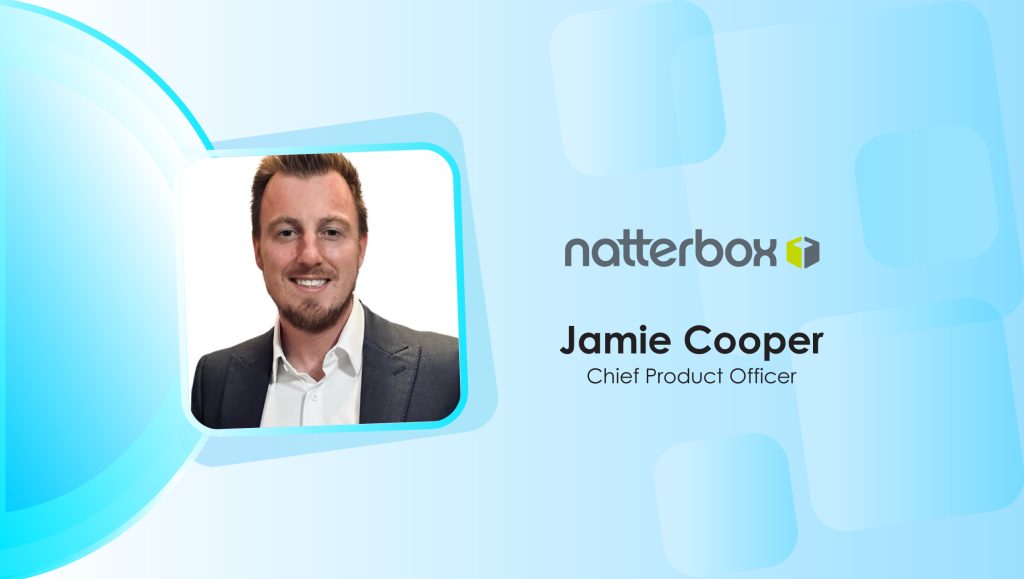
Jamie Cooper, Chief Product Officer, at Natterbox chats about the future of AI powered customer support and interactions and what the future holds for this business area in this catch-up:
______
Hi Jamie, take us through your experience as a CPO?
I’d been closely involved in product development and strategy in prior roles but stepped into my current position as Chief Product Officer in 2022. In this role, I lead Natterbox’s product strategy and vision, overseeing the full product lifecycle from concept to launch.
It’s incredibly rewarding to turn customer insights into solutions that solve real-world problems. We’ve placed a strong emphasis on AI and omnichannel capabilities to transform the contact centre experience, and I’m proud of how our teams have embraced innovation while staying grounded in customer value.
We’d love some brief highlights on Natterbox’s latest AI enhancements and how they power customer query cycles?
Natterbox recently introduced AI Assistants and AI Agents, in addition to our AI Advisor offering. AI Assistants can handle up to 70% of routine customer queries, such as answering frequently asked questions or checking order statuses, while AI Agents go further by completing end-to-end tasks like processing refunds, scheduling appointments, and cancelling orders, all without human intervention.
These enhancements mean that customers don’t have to wait in a queue until a human agent is available before their call is answered, with AI Assistants working as the first point of contact for customers and routing queries accordingly. The way AI powers customer query cycles is simple: it removes the need for queues, hold music, and “out of hours” messages. Using AI, information is available 24/7, and customers can have their questions answered by AI Assistants instantly.
As brands slowly get accustomed to deploying more AI powered tech to solve different aspects of customer interactions and support, how can they ensure human-machine balance?
AI and human agents need to work alongside each other for the best possible customer experience – while AI can answer information-based questions and perform tasks, only humans can deal with emotions, pick up on subtle cues, and provide comfort if things go wrong.
However, the key is collaboration. AI is no longer simply assisting, it is becoming a core part of the workforce. Like with any team, it’s critical that context is preserved and the right skills are matched to the task, whether that’s a human or an AI agent.
We’re seeing AI take on increasingly sophisticated roles, especially with our AI Agents. From handling end-to-end resolutions to dynamically adapting based on customer behaviour and sentiment. What matters is ensuring that handovers – in either direction – are seamless and contextual, so the customer doesn’t feel like they’re starting over. When the experience is designed well, AI and humans complement each other to deliver faster, smarter, and more empathetic support.
AI can be trained to identify cues from customers such as keywords or emotional signs to know when to pass to a human agent to avoid a negative customer experience. When a query is escalated, it is automatically routed to a specialized human agent with a summary of the query, ensuring customers do not have to repeat themselves. Alternatively, repetitive tasks that are easy to resolve without human intervention can be handled by AI, leaving human agents with more time to answer complex questions or deal with emotion-driven issues.
Read More: SalesTech Star Interview with Steven Birdsall, CRO at Alteryx
What will the future hold for customer-facing roles in customer service and support as AI agents become more streamlined to daily conversations and processes?
Natterbox’s goal is not to remove humans from contact centers – they’re essential to resolving difficult issues that AI can’t handle. Our objective is to help companies improve their customer experience by finding the right balance and pace of implementation, and ensuring humans and AI work together seamlessly to deliver exceptional customer service.
Every contact centre is different — the right model depends heavily on customer demographics, expectations, and the nature of the interactions. What works for a digitally native consumer base may not suit a more traditional audience. It’s necessary to evaluate where you will get the most value out of using AI on an ongoing basis instead of trying to use it to do absolutely everything and abandoning essential human agents.
The roles of human agents will change, increasingly focusing on oversight, exception handling, and continuous improvement of AI systems. They will also take on more strategic functions, such as customer relationship management. By empowering human agents to focus on more strategic and complex tasks, contact centres can expect to see a reduced attrition rate in customer service roles, decreasing the large costs that come with replacing and training new employees. That said, upskilling in areas like data literacy, AI collaboration, and soft skills will be crucial, positioning human agents as value amplifiers in an AI-augmented service model.
A few thoughts on the future of AI and customer service and support?
AI is only going to improve from the level it operates at today – it will be able to retain more information, answer more queries, speak more naturally, and resolve more issues. Crucially, AI systems will begin to learn automatically from every interaction, continuously improving without manual intervention. Indeed, AI can be trained to recognize who is calling and remember the specific ways the customer likes to be spoken to in terms of tone, professionalism, verbosity and so on, creating a highly personalized customer service experience.
Our research shows that 78% of consumers are frustrated with customer service, and it’s not difficult to see why: automatic out of hours messages after 5pm and robotic pre-recordings that make us choose our issue from a drop-down list aren’t nearly enough to deal with the huge range of problems that we need contact centres for. As AI improves, the demand for it will also increase, and consumers will start seeing contact centers in a new light entirely. Being left on hold or in long call queues will become things of the past, and companies will save significant sums by prioritising answering calls using AI.
Five thoughts on optimizing AI implementation you’d leave everyone with before we wrap up?
- Treat AI like a human hire by onboarding it properly and committing to continuous learning. As with new employees, AI needs clear objectives, quality training and feedback to perform at its best. Continuously train models with real interaction data to improve natural language abilities, accuracy, and overall performance. Keep its knowledge base current and, if it cannot answer a query, ensure it learns automatically from the human-provided answer so it is prepared next time.
- Personalize AI interactions to match its audience. Implementing regional accents, customising tone, verbosity and professionalism etc. will help AI appear friendlier, more human, and approachable. As already mentioned, AI can also be trained to recognize specific callers and remember their exact communication preferences. This ensures interactions feel natural and engaging, and mirror what it’s like speaking with a human agent who is capable of building rapport with customers and adjusting their approach depending on who they’re speaking with.
- Use analytics to guide strategic decisions. Monitor resolution rates, customer satisfaction and the amount of interactions requiring human handover. These insights can highlight where AI is performing well and how different regions or customer segments respond. This allows you to adapt deployment strategies and ensure the AI is delivering measurable value across the board.
- Introduce omnichannel support to streamline customer experience. For example, by having AI present across voice calls, WhatsApp, and other messaging services, customers can engage on their preferred channels and won’t need to repeat themselves when they switch channels, as the AI will remember what they said on the phone if they choose to switch to WhatsApp. In addition, AI can automatically detect and switch to the best channel for each query, so if a customer calls and requires complex instructions, AI can send the instructions over WhatsApp or SMS, rather than reading them out to the customer, which is not always helpful. .
- Start small and scale gradually. Begin by using AI in more straightforward areas such as providing out-of-hours customer support or replacing traditional switchboards. Multiple AI agents can be deployed from day one, but they should not be expected to manage every type of query straight away. As the system proves itself, expand its role to cover a wider range of complex questions across different business functions.
Read More: Developing Sales Leaders in 2025 – Top Recommendations to Meet Changing Selling Cycles

With Natterbox, customers instantly connect to personalized support—no waiting, no frustration, no hold music
Jamie Cooper, Chief Product Officer, at Natterbox