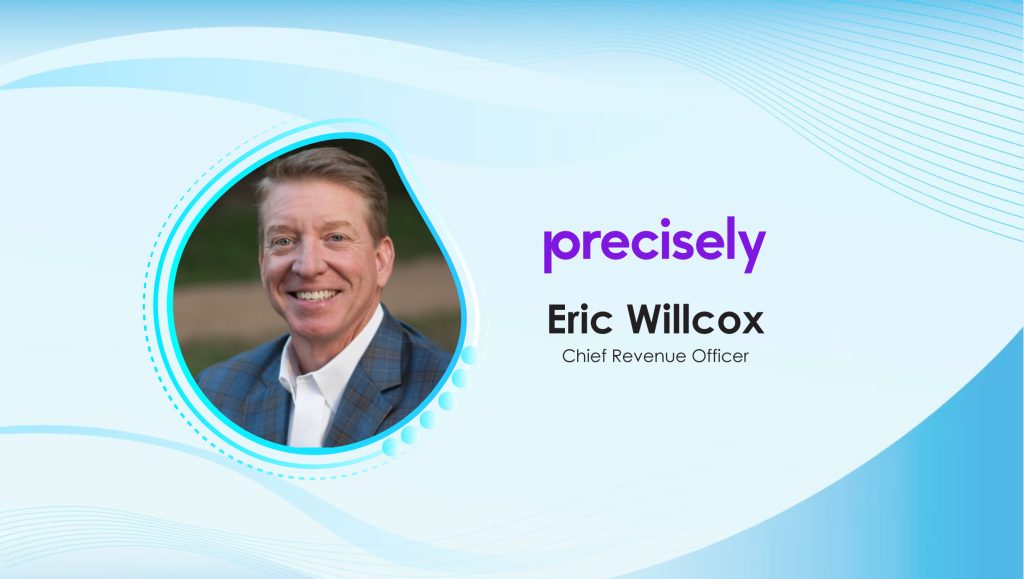
Eric Willcox, CRO at Precisely chats about the state of B2B SaaS sales while sharing key tips for aspiring CSOs and CROs in this SalesTechStar interview:
__________
As Precisely’s CRO, what guiding principles shape your approach to leadership?
My philosophy as a sales leader has always been simple: put the customer first. Start by asking, “What does the customer want?” and “How can we help?”. We earn the right to do business with our customers from consistently understanding their challenges, creating value at every step of the journey, and delivering meaningful, high-quality engagements.
As companies grow and solutions become more complex, maintaining this customer-first mindset across the revenue organization is critical. It keeps everyone aligned around the outcomes we’re here to deliver, and reminds us why we do what we do.
I’m also a big believer in mastering the fundamentals. I’ve learned a lot from great coaches in the world of sports, where success comes down to daily discipline, showing up consistently, and playing your role with excellence. Great teams win together – and that is just as true in sales as it is on the field.
What are some of the top CRO myths that B2B teams need to bust in the market?
In the sales industry, especially in leadership positions, there can often be too much of a focus on the big wins. While high-profile wins are great, the true hallmark of a strong CRO – and a successful software organization – is establishing a broad track record of wins and go-lives that deliver value for customers. For Precisely, this means helping our customers achieve accurate, consistent, and contextual data that drives their business forward.
When we consistently help customers enable new outcomes and overcome challenges, we not only build trust but also gain deeper access within their organizations. That leads to more opportunities, stronger partnerships, and long-term revenue growth.
In what ways should the role of the typical B2B CRO change to accommodate new market trends?
Today’s CRO must be more than just a sales leader – they need to be a strategic growth driver, guiding sustainable growth across the entire customer lifecycle. Cloud subscriptions and usage-based models have shortened contract commitments and raised the bar on proof of value, while today’s uncertain economy puts every purchase under a cost-consolidation lens. Modern buyers expect vendors to show clear business impact, up front and throughout the partnership.
To meet those expectations, revenue teams must lead value-based, highly personalized conversations tailored to each customer’s journey. This means moving beyond simply selling products and instead acting as trusted advisors who guide customers toward impactful outcomes.
Partner ecosystems can play a significant role here. Strategic alliances present new opportunities to deliver integrated solutions, strengthen customer relationships, and unlock value through shared innovation.
Finally, when it comes to technology such as AI, CROs have an opportunity to greatly enhance their team’s performance. AI can help to surface relevant insights faster, streamline client research, and help salespeople to understand customer’s priorities more quickly and deeply than ever before. Used effectively, AI can allow sellers to spend less time on prep and more time delivering high-quality engagements that create strong customer relationships.
Take us through some of your planned sales and revenue generation initiatives for the rest of this year.
As organizations place a greater emphasis on data integrity to drive successful AI initiatives, advanced analytics, and better customer experiences, we’re seeing a trend toward a more converged approach to data management. This presents new opportunities to deliver comprehensive solutions that address the full spectrum of data opportunities and challenges customers are facing.
Another key focus is fostering broader organizational participation in revenue growth. Sales isn’t just the responsibility of the sales team — every department plays a role in listening to customer goals, developing insights, and contributing to pipeline growth.
Finally, we’re evolving how we engage in conversations with customers. By monitoring, listening, and deepening our knowledge about the market and organizations’ strategic priorities, we will be able to meet our customers anywhere on their data integrity journey and take a more consultative, holistic approach to driving their success.
What daily best practices should aspiring sales executives pursue to reach the level of CSOs and CROs in your view, given current market dynamics?
Aspiring sales executives should ground their daily work in a broader context – starting with the customer, then the company, and finally themselves. That means going beyond their individual quota or product line to understand the customer’s world: their industry dynamics, business model, and the challenges they’re navigating. Aim to bring the full strength of your organization to the table, even if it means stepping outside your lane to connect dots or recommend a solution that isn’t in your area of focus.
Next, seek to understand and elevate your company’s priorities, including what metrics matter, where the business is investing, and how your role contributes to larger goals. This context sharpens your judgment and helps you operate with enterprise-level awareness.
Finally, focus on consistency. The best future CROs build trust by being prepared, collaborative, and dependable. Trust earns you access, keeps conversations honest, and makes you the kind of partner customers and other executives want by their side.
A few thoughts on the future of AI and sales and how this would impact the way B2B sales teams are built out in future?
AI innovation brings the promise of greater efficiency, productivity, and growth across many industries. This is equally true within the technology sector and in go-to-market functions. McKinsey reports that generative AI tools could generate up to $1.2 trillion in productivity within sales and marketing in the coming years. These tools not only improve efficiency but also drive top-line growth and enhance customer experience. With generative AI, sales teams will have quick access to contextual information, reducing time spent on research, and enabling more meaningful customer interactions.
Nonetheless, AI isn’t a replacement for human connection. The most successful sales teams will be those that blend AI-driven innovation and efficiency with human empathy to create more personalized and impactful customer experiences.
 As a global leader in data integrity, Precisely ensures that your data is accurate, consistent, and contextual. Our portfolio, including the Precisely Data Integrity Suite, helps integrate your data, improve data quality, govern data usage, geocode and analyze location data, and enrich with complementary datasets for confident business decisions. Over 12,000 organizations in more than 100 countries, including 93 of the Fortune 100, trust Precisely software, data, and strategy services to power AI, automation, and analytics initiatives. Learn more at www.precisely.com.
Eric Willcox is the Chief Revenue Officer at Precisely, leading go-to-market strategy and design, client satisfaction initiatives, and sales performance. In this role, Eric oversees the overall operations of the company’s field-facing organization globally, ensuring seamless alignment between customer success and sales execution. Prior to this role, Eric served as Precisely’s SVP of Sales, Americas, where he brought a fresh emphasis on customer-centricity, operational excellence, and high-impact sales strategies. With over two decades of leadership experience at SAP and IBM, Eric has a proven track record of building and leading top-tier sales teams and driving successful customer outcomes. Eric is a graduate of Purdue University, and earned an M.B.A. from the University of Colorado Denver.