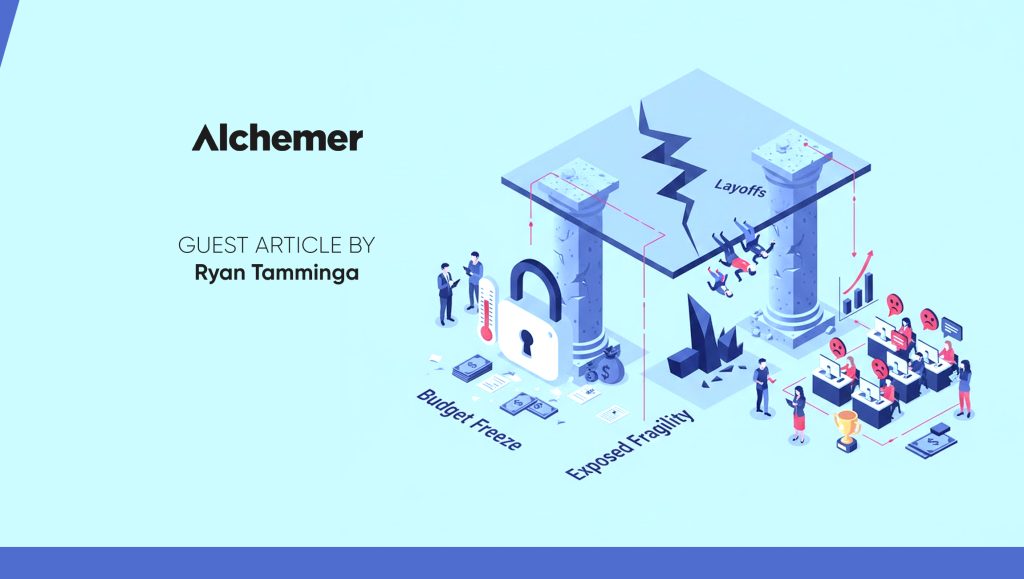
Layoffs, hiring freezes, and tightened budgets have become a common refrain across various industries, symbolizing continued uncertainty. Executives are under pressure to cut costs, preserve cash, and demonstrate immediate return on investment. As a result, some business functions inevitably end up on the chopping block. Too often customer experience (CX) is a function that gets cut.
Cutting CX investment in tough times is like removing a plane’s wings; it may improve the next quarter’s balance sheet, but weakens your competitive position for years. A strong customer experience is what keeps customers loyal when uncertainty reigns. Every leader knows that retaining a customer is far cheaper than acquiring a new one.
For CX teams, layoffs and budget cuts are often unavoidable, so it’s important to first explore why so many CX initiatives crack under pressure and then understand what you can do to build CX resilience that lasts beyond the downturn.
The Fragility of Many CX Programs
Oftentimes CX programs are built on surprisingly fragile foundations. They rely on massive spreadsheets, manual handoffs, and heroic employees to keep the wheels turning, but these systems simply don’t scale down gracefully. When teams shrink, workflows stall, and vital customer signals slip through the cracks.
Here’s what happens:
- Manual survey management becomes a game of “inbox ping-pong,” where feedback piles up waiting for someone to compile and analyze it.
- Siloed feedback channels turn into a game of telephone. For example, Marketing hears one story, Support hears another, and no one sees the full picture or connects the dots.
- Delayed analysis means slow insights and action.
- Reactive decision-making keeps teams in firefighter mode, responding to flare-ups instead of preventing them.
When budgets are healthy, these cracks are easy to overlook; people patch them up with extra hours and deep institutional and process knowledge. However, when resources tighten, the duct tape comes off, revealing the gaps in CX programs that become impossible to ignore.
The symptoms of CX fragility are easy to spot: falling Net Promoter scores, rising churn, and feedback loops left open. Each missed support moment or interaction erodes trust, revenue, and brand strength over time.
Building CX Resilience
Resilient organizations understand that challenges can turn into opportunities when met with the right response. This is where feedback automation and integrated CX ecosystems become essential.
By automating the collection, analysis, and distribution of customer insights, companies maintain a steady pulse on customer sentiment even when human capacity is limited. Automation helps ensure all feedback is acknowledged, key trends are recognized, and every customer voice is heard.
Additionally, new advancements in AI feedback analysis and data integrations make it possible to analyze large volumes of feedback in real-time, identify emerging issues, and route actionable insights directly to the team and systems best equipped to resolve them. This enables leaner operations to deliver strong, responsive CX.
Here are several steps leaders can take to build CX resilience:
- Integrate direct and indirect feedback channels into a unified system. Consolidate surveys, chat logs, and social reviews so that insights are visible across teams.
- Automate data routing to the right stakeholders to close feedback loops quickly.
- Embed CX insights into daily workflows, making feedback actionable, not just measurable.
- Use AI sentiment analysis tools to monitor real-time trends and detect friction points early to prevent escalations.
- Secure leadership alignment. CX resilience succeeds when every department sees it as a shared responsibility.
When done correctly, automation and AI-powered analysis amplify human effort by freeing people to focus on strategy, relationship-building, and taking the right action.
Real-world Examples of Thriving with Leaner Teams
A fast-growing online eyewear retailer had a manual survey process that led to constant bottlenecks. Customer feedback was delayed, insights were incomplete, and issues often went unnoticed until too late. By automating post-support interaction surveys, the company gathered over 12,000 responses in three months, improved response rates by 75%, and lifted satisfaction on resolved cases to 85%. Real-time feedback helped agents act before issues escalated, while leadership gained live visibility into service quality, transforming a strained support team into a responsive, data-driven operation.
Another example is a global automotive research firm that was challenged by an overwhelming volume of open-ended survey responses. What once took six months of manual analysis now happens in hours thanks to automated text analysis using AI and feedback workflows. This shift saved more than 1,000 hours annually and dramatically improved analysis accuracy. Clients now receive insights in near real-time, empowering them to spot market shifts sooner and respond strategically. As one executive put it, “The horizon has expanded — we can see much further and with more clarity.”
CX Resilience is Business Resilience
Economic conditions ebb and flow. What does not change is the customer’s expectation for fast, personalized, and reliable experiences. In a world where uncertainty is constant, CX resilience is business resilience.
Here’s a checklist to see if your organization has CX resilience:
- Do we have real-time visibility into customer sentiment across all touchpoints?
- Can our CX processes perform effectively with leaner teams?
- Is feedback automatically routed to the right people to take action?
- Are we using AI and automation to remove manual bottlenecks?
- Is CX integrated into our business continuity and growth strategy?
If any answer is “no,” it’s time to remove CX fragility and reinforce your CX foundation–especially critical during challenging economic times. Connected feedback systems can protect relationships and future-proof your customer experience, ensuring every interaction builds loyalty and lasting value.
Read More: The Future of Customer Experience: Balancing AI Efficiency with Human Empathy